

Quick answer: The strongest SendGrid alternatives split by job. For cheap high-volume sending, Amazon SES is about $10/mo at 100,000 emails. For developer experience, Postmark ($15/mo at 10k) and Resend ($20/mo at 50k) lead. For sending transactional and marketing email on one bill — the biggest structural gap in SendGrid, since it “bills for transactional and marketing emails as separate products” (EmailTooltester) — Bluey Email, Brevo and SendPulse bundle both. Pick by which of those three problems you actually have. Written with AI assistance and reviewed against primary sources.
Full disclosure: Bluey Email is my own product, and it is on this list. I have applied the same criteria to it as to everything else, named exactly where each competitor beats it, and cited a third party rather than myself for every competitive claim. Read it with that bias in mind.
Why do people leave SendGrid?
Worth being precise, because the answer determines which alternative fits. Inka Wibowo of EmailTooltester — who has tested the field extensively — names three specific triggers (EmailTooltester):
You are a low-volume sender. “SendGrid’s free plan is good for sending only 100 emails per day, and its cheapest paid plan is $19.95 per month for 50,000 emails. Startups and smaller businesses that don’t need to send that many emails may find such fees pricey.”
You want one simple bill. “SendGrid bills for transactional and marketing emails as separate products. As a result, you’d potentially need to pay more to send both types of emails. Your billing might get more complicated, too.”
You need real automation. “I found SendGrid’s automation workflow editor rather simplistic. For one, you can’t have conditional paths in your automations or set up multiple triggers for them.”
Note what is not on that list: reliability. The official SendGrid plans run from a 60-day trial at 100 emails/day through Essentials at $19.95/mo and Pro at $89.95/mo (Twilio SendGrid), and people generally do not leave because the mail stopped going out.
The 8 best SendGrid alternatives
1. Bluey Email — best if you send transactional and marketing
Who it is for: teams tired of running two products and paying two bills for one company’s email.
Bluey bills on sends, not contacts: Free at 500 sends/mo permanently, Spark from $7/mo (~$14 at 10,000 sends), Grow at $30/mo with unlimited contacts around 50,000 sends (~$84 at 250,000, ~$180 at 1M), and Business at $300/mo adding a built-in CRM, landing pages and pre-built ecommerce flows.
Why it is ranked first: one specific, checkable reason — it closes the exact gap EmailTooltester names in the SendGrid billing model. Transactional and marketing share one workspace and one plan. While writing this I validated a live transactional payload against the API and it returned valid, using a key that also carries campaigns and CRM write scopes. That is one credential covering both jobs.
Where SendGrid beats it: track record and scale. SendGrid has moved mail under Twilio for years; Bluey is young. SendGrid also classifies bounces into seven categories for real diagnostic depth (EmailTooltester). Where others beat it: SES is far cheaper at raw volume; Postmark has a deeper transactional-only pedigree.
Pros: one bill for both email types · $7 entry · unlimited contacts on Grow · branching automations · built-in CRM on Business. Cons: young product without a decade of scale history · smaller ecosystem than SendGrid.
2. Amazon SES — best for cheapest high volume
Who it is for: engineering teams who want raw sending at near-cost and can absorb the complexity.
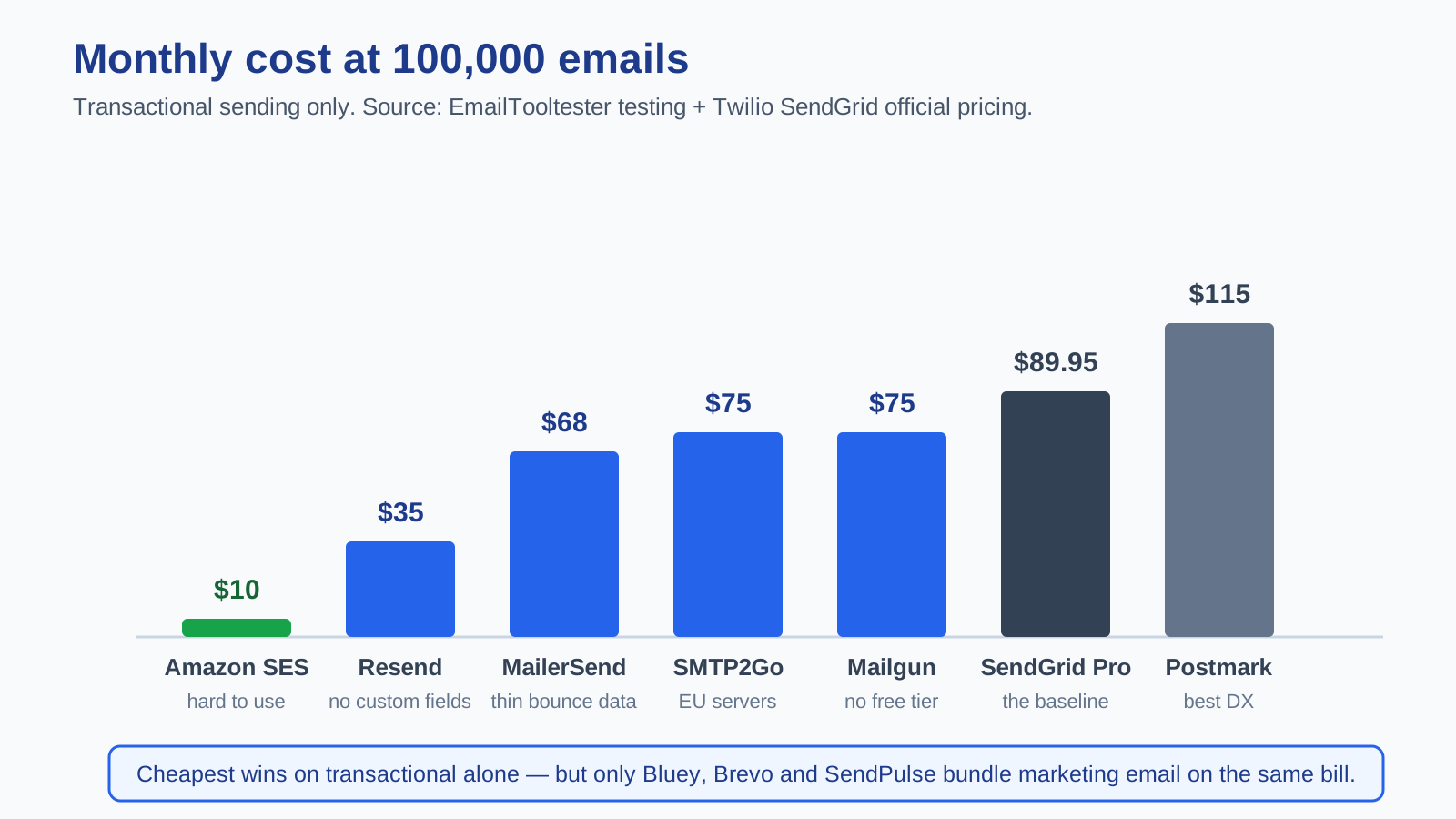
Pricing (EmailTooltester): 10k emails $1/mo · 50k $5/mo · 100k $10/mo. Extra cost for attachments. Amazon EC2 users can send up to 3,000 emails/month free in the first year.
At 100,000 emails, that is roughly $10 against the SendGrid Pro tier at $89.95 — an order of magnitude. But the tax is real: “despite its name, the Amazon SES isn’t that simple to use,” and support costs extra as a separate plan, whereas “SendGrid’s plans all include varying degrees of support” (EmailTooltester).
Where SendGrid wins: dramatically more user-friendly, and support is included. Pros: cheapest at volume · bring-your-own-IP · AWS-native. Cons: hard to use · paid support · no marketing tooling worth the name.
3. Postmark — best developer experience for transactional
Who it is for: teams who want transactional email to be excellent and will pay for it.
Pricing (EmailTooltester): 100 emails free · 10k $15/mo · 50k $55/mo · 100k $115/mo.
The distinguishing move is that you get “full access to almost all of Postmark’s features at every pricing tier” — you pay more only for volume or add-ons like dedicated IPs, whereas SendGrid gates premium features behind higher plans (EmailTooltester). It also integrates with parent company ActiveCampaign, so you can send transactional mail from marketing automations. Its Message Streams feature is the cleanest implementation of the transactional and marketing separation Gmail recommends (Postmark).
Where SendGrid wins: price. Postmark is “one of the more expensive email delivery services in the market” — $115 vs the $10 from SES at 100k. Pros: all features on every tier · superb docs · Message Streams · GDPR-compliant. Cons: expensive at volume.
4. Resend — best modern developer-first pick
Who it is for: developers who want a clean, current API and find the SendGrid interface cluttered.
Pricing (EmailTooltester): 3k emails $0 · 50k $20/mo (Pro) · 100k $35/mo (Pro).
Resend launched in 2023 calling itself “a next-generation SendGrid.” Its free tier is more generous than the SendGrid one: 100 free transactional emails per day plus unlimited marketing email to up to 6,000 contacts. Deliverability Insights checks things like DMARC validity and body size.
Where SendGrid wins: Resend is developer-first to a fault — no visual automation editor (you code flows via its scheduling feature), a command-based editor rather than drag-and-drop, and no custom contact fields, so you will need a separate CRM (EmailTooltester). Pros: clean API · generous free tier · $35 at 100k. Cons: no visual automations · no custom contact fields · non-technical users will struggle.
5. SMTP2Go — best for global or GDPR sending at low volume
Who it is for: lower-volume transactional senders who need servers outside the US.
Pricing (EmailTooltester): 1k emails free/mo · 10k $15/mo · 50k $30/mo · 100k $75/mo.
The differentiator is geography: SMTP2Go has servers in the US, EU, Australia, New Zealand and Singapore, letting you connect to the nearest one and use EU servers for GDPR compliance — while “SendGrid has servers in only the US” (EmailTooltester). EmailTooltester named it their Best Transactional Email Provider for 2023.
Where SendGrid wins: SendGrid has built-in marketing email; SMTP2Go does not. Pros: worldwide servers · EU/GDPR option · 1,000 free/mo. Cons: transactional only.
6. MailerSend — best free tier for tight budgets
Who it is for: businesses that want transactional email at near-zero cost.
Pricing (EmailTooltester): 500 emails free/mo · 50k $35/mo · 100k $68/mo (Premium). Beyond the free plan, roughly $1.20 per 1,000 emails.
It offers a drag-and-drop transactional builder with unusual blocks (signature, countdown), and can send transactional SMS — which SendGrid cannot without adding the Twilio MessagingX service. Sister product MailerLite covers marketing.
Where SendGrid wins: bounce diagnostics. MailerSend reports only hard or soft; SendGrid gives seven categories (EmailTooltester). Pros: cheap · transactional SMS · good editor. Cons: shallow bounce data.
7. Mailgun — best deliverability tooling
Who it is for: teams who want inbox-placement testing and send-time optimization built in.
Pricing (EmailTooltester): 50k $35/mo · 100k $75/mo (Foundation). Pay-as-you-go for overage without forced upgrades.
Mailgun offers inbox placement tests and ML-powered send-time optimization that “neither SendGrid nor many other SMTP email services I’ve tested offer” (EmailTooltester).
Where SendGrid wins: Mailgun has no forever-free plan — you trial for a month, then move to paid. Pros: placement testing · send-time optimization · dedicated IPs · clean UI. Cons: pricier · no free tier.
8. Brevo — best established all-in-one
Who it is for: teams wanting transactional and marketing bundled from a company with a longer history than mine.
Brevo bundles transactional and marketing into its marketing plans rather than splitting them, which is the same structural fix Bluey makes (EmailTooltester). If you want that bundling from a larger, older vendor, Brevo is the honest recommendation over Bluey — I would rather say that than pretend otherwise. Compare directly in Bluey Email vs Brevo and Brevo alternatives.
Pros: bundled transactional and marketing · established · strong free tier. Cons: contact-based pricing can bite as lists grow.
How should you choose?
Match the tool to the reason you are leaving:
- Leaving on price at volume — Amazon SES ($10 at 100k), then Resend ($35).
- Leaving because of two bills — Bluey, Brevo or SendPulse.
- Leaving for developer experience — Postmark or Resend.
- Leaving for automation depth — Bluey, Brevo, or Postmark paired with ActiveCampaign.
- Leaving for EU data residency — SMTP2Go.
- Not sure you should leave — stay. SendGrid at 50k emails for $19.95 with a decade of reliability is a reasonable deal, and migrating email infrastructure has real costs.
SendGrid alternatives compared at a glance
| Service | Free tier | ~100k emails/mo | Best for |
|---|---|---|---|
| Bluey Email | 500 sends/mo | ~$84 (Grow, incl. marketing) | Transactional + marketing, one plan |
| Amazon SES | 3k/mo, 12 months | ~$10 | Cheapest at volume |
| Postmark | 100 emails | $115 | Transactional reliability |
| Resend | 3k/mo (100/day) | $35 | Modern developer API |
| SMTP2Go | 1,000/mo | ~$75 | Reliable SMTP relay |
| MailerSend | Yes | ~$68 | Value + templates |
| Mailgun | None (trial) | ~$75 | Routing + validation |
| Brevo | ~9k/mo (300/day) | ~$69 | Low-cost both types |
| SendGrid (baseline) | 60-day trial | ~$90 (Pro) | Enterprise scale |
Frequently asked questions
What is the cheapest SendGrid alternative? Amazon SES — about $1/mo at 10k and $10/mo at 100k emails, though attachments cost extra and support is a paid add-on (EmailTooltester).
Which SendGrid alternative has the best free plan? SMTP2Go gives 1,000 emails/mo free permanently; Resend gives 3,000/mo; Bluey gives 500 sends/mo. The SendGrid free tier is a 60-day trial only (Twilio SendGrid).
Can I send marketing and transactional email from one tool? Yes — Bluey, Brevo and SendPulse bundle both. SendGrid bills them as separate products (EmailTooltester). Do still separate the sending streams — see the transactional email guide.
Is SendGrid still good in 2026? Yes, for high-volume transactional sending with enterprise requirements. Its weak spots are low-volume pricing, split billing, and simplistic automation (EmailTooltester).
Which alternative is best for a developer? Postmark for polish and per-tier feature access, Resend for a modern API — but Resend has no custom contact fields, so plan for a separate CRM.
Does switching hurt deliverability? It can temporarily. Any new sending domain or IP needs warming. Get SPF, DKIM and DMARC right before you migrate.
The bottom line
There is no single best SendGrid alternative — there is a best answer to why you are leaving. If it is cost at volume, SES wins on maths nobody else can touch. If it is developer experience, Postmark or Resend. If it is the two-bill problem, that is the gap Bluey was built for, and Brevo is the established alternative if you would rather not bet on a young product.
If none of those describe you, staying put is a legitimate answer.
Next: read the head-to-head in Bluey Email vs SendGrid, learn the category in the transactional email guide, survey the field in best email marketing software, or fix inbox placement with the email deliverability guide.
Does SendGrid still have a free plan? No. SendGrid removed its permanent free tier and now offers only a 60-day trial. Alternatives with a genuine free plan include Amazon SES (3,000/month for 12 months), Brevo (300 emails/day), Bluey Email (500 sends/month) and MailerSend.
Why are people leaving SendGrid? The most common reasons are the removal of the permanent free tier, sharp pricing jumps between tiers (roughly $20 to $90+ per month), and support many find rigid. The right alternative depends on whether you want lowest cost, best deliverability, or transactional plus marketing on one plan.
— Shivam
What it costs per thousand emails: Email API pricing compared.
What SendGrid actually costs, including overage: SendGrid pricing explained.
Ready to switch? how to migrate from SendGrid — step by step, without wrecking your deliverability.
2 thoughts on “8 Best SendGrid Alternatives in 2026 (Tested Pricing, Honest Picks)”