
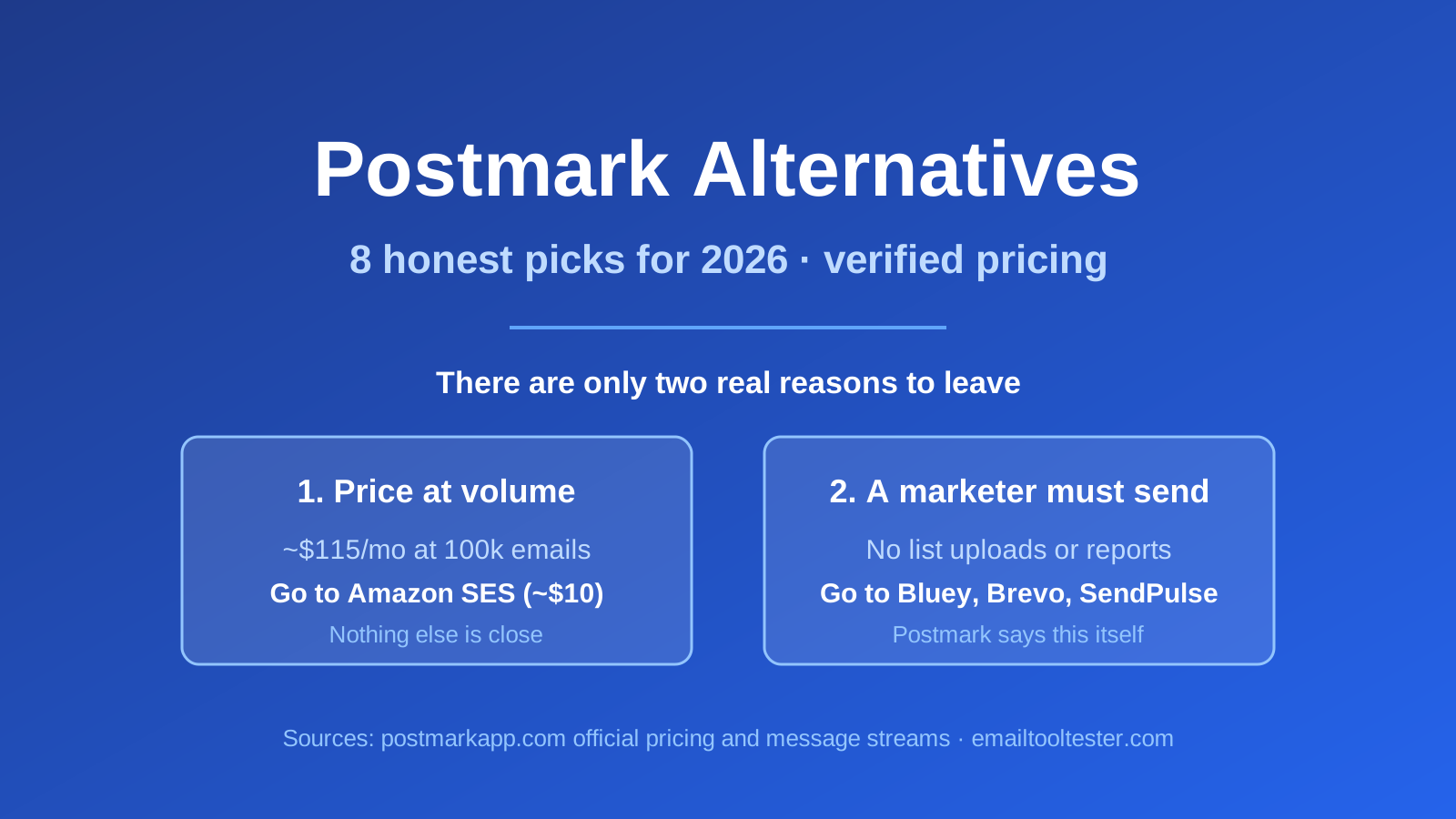
Quick answer: Almost everyone leaving Postmark leaves for one of two reasons, and they point to different tools. If it is price at volume, Amazon SES is about $10/mo at 100,000 emails against Postmark’s ~$115 (EmailTooltester) — SES wins and nothing else is close. If it is that a marketer needs to send, you need a platform with list uploads and campaign reporting, which Postmark states plainly it does not offer (Postmark) — Bluey Email, Brevo and SendPulse all do. Diagnose which of the two you have before you shortlist. Written with AI assistance and reviewed against primary sources.
Full disclosure: Bluey Email is my own product, and it is #1 on this list. Read that with appropriate suspicion. I have tried to earn it by ranking on a stated criterion rather than a vibe, citing third parties for every competitive claim, naming exactly where each tool beats mine, and telling you outright in the very next paragraph when Bluey is the wrong answer.
Why do people leave Postmark?
Worth being precise, because the answer picks the tool. Postmark is not a bad product — EmailTooltester’s Inka Wibowo calls it “a fantastic transactional email platform, offering features such as superior deliverability, template pushing across environments, and inbound email processing” (EmailTooltester). People do not leave because it broke. They leave for three specific reasons.
1. Price at volume. “From our research, Postmark is one of the more expensive email delivery services in the market,” Wibowo writes, pricing it at $15 at 10k emails, $55 at 50k, and $115 at 100k (EmailTooltester). Her fit verdict is telling: “Businesses with higher budgets for quality transactional email features may find Postmark perfect.” Higher budgets. Postmark’s official rates confirm the shape — Basic is $15/mo starting at 10,000 emails with overages at $1.80 per 1,000 (Postmark).
2. A marketer needs to send. This one comes from Postmark itself: “Postmark is built for application email. That means that we do not offer some of the features you might want if you were sending traditional marketing campaigns, including support for list uploads, a WYSIWYG editor, and campaign-based reporting” (Postmark). It goes further and tells you to leave: “If your needs are less about supporting application-based sending and more around enabling marketing promotion, there are other tools that may be a better fit for you than Postmark.”
3. Signup friction. Postmark is “still manually vetting each potential customer” and “will never be an open door to any sender” (Postmark). If you want to ship tonight, that is a real cost — though note it is also the reason Postmark’s shared IPs are clean, so be careful what you wish for.
Note what is not on that list: deliverability. Postmark runs “parallel but separate sending infrastructures” so “transactional and broadcast traffic do not mix in Postmark, including IP ranges” (Postmark). That is best-practice architecture and most of this list does not match it. If deliverability is why you are shopping, you may be shopping in the wrong direction — read the email deliverability guide before you switch anything.
Postmark alternatives at a glance
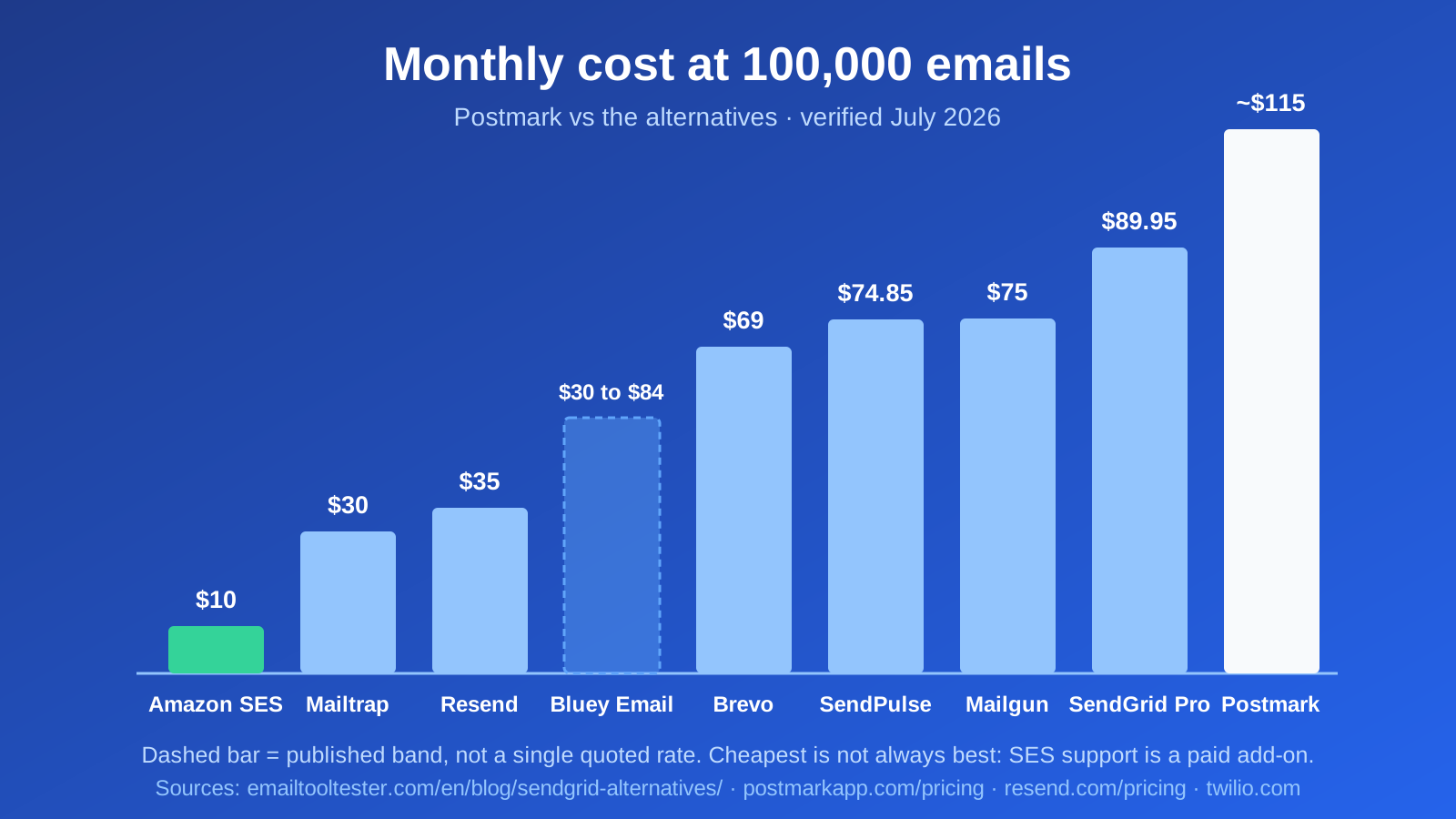
| Tool | 10k emails | 50k emails | 100k emails | Marketing features? |
|---|---|---|---|---|
| Postmark | $15 | $55 | $115 | No (by design) |
| Bluey Email | ~$14 | $30 | $30 to $84 band | Yes |
| Amazon SES | $1 | $5 | $10 | Minimal |
| Resend | Free tier | $20 | $35 | Separate contact-priced plan |
| SendGrid | $19.95 (Essentials) | $19.95 | $89.95 (Pro) | Separate product |
| Mailgun | — | $35 | $75 | No |
| Mailtrap | $15 | $20 | $30 | Limited |
| Brevo | — | $55 at 60k | $69 | Yes |
| SendPulse | — | $16.85 | $74.85 | Yes |
The 8 best Postmark alternatives
1. Bluey Email — best if a marketer also needs to send
Who it is for: teams whose password resets and whose newsletter come from the same company but currently need two vendors.
Why it is ranked first — and when to ignore that. One checkable reason: it closes the exact gap Postmark publishes about itself. Postmark says it does not do list uploads, a WYSIWYG editor, or campaign-based reporting, and that your main lists must live “outside of Postmark” (Postmark). Bluey does all three in the same workspace as the transactional API. While writing this I ran a live dry-run against Bluey’s transactional endpoint — it returned valid: true on a password-reset payload — using an API key that also carries campaigns:write, audiences:write and crm:write scopes. One credential, both jobs.
But if you are leaving Postmark on price, skip to #2 right now. Amazon SES is roughly $10 at 100k emails. Bluey is not going to beat that and I am not going to imply it might.
Pricing: Free at 500 sends/mo permanently. Spark from $7/mo (~$14 at 10,000 sends). Grow $30/mo with unlimited contacts at ~50,000 sends (~$84 at 250,000, ~$180 at 1M). Business $300/mo adds a built-in CRM, landing pages and pre-built ecommerce flows.
Where Postmark beats it: track record and architecture. Postmark has nine-plus years, ActiveCampaign behind it, and documented separate IP ranges for broadcast vs transactional traffic — a claim Bluey does not make. Postmark also gives you full feature access at every tier (EmailTooltester); Bluey gates the CRM behind Business. Where others beat it: SES on raw cost, Resend on developer experience, Brevo on maturity. Compare head-to-head in Bluey Email vs Postmark.
Pros: one bill and one workspace for both email types · $7 entry · unlimited contacts on Grow · self-serve signup · built-in CRM on Business
Cons: young product · no separate-IP-range claim · smaller ecosystem than any incumbent here
2. Amazon SES — best for cheapest high volume
Who it is for: teams with an engineer who will own email as infrastructure.
Pricing: $1/mo at 10k emails, $5/mo at 50k, $10/mo at 100k (EmailTooltester). Amazon EC2 users can send up to 3,000 emails/month free within the first year.
At 100,000 emails that is about $10 against Postmark’s $115 — an order of magnitude, and no argument about product polish survives contact with that number if volume is your problem.
The tax is real, though. “Despite its name, the Amazon SES is not that simple to use,” Wibowo writes, adding that SES users “need to pay for a separate support plan to get help from a support agent” and that attachments cost extra (EmailTooltester). Her fit note: SES “might be suitable for enterprise businesses with dedicated IT teams for managing their email operations.”
Where Postmark wins: everything except price — usability, support, retention, deliverability tooling. One Postmark customer, Dave Marshall of Childcare.co.uk, is quoted on Postmark’s own site saying he “was shocked to see Postmark open rates were an 11% improvement over SES in our test” (Postmark). That is a vendor-published testimonial, not independent research, and should be weighed as such — but a deliverability gap between a managed service and raw SES is plausible enough that you should test rather than assume.
Pros: unbeatable unit cost · bring-your-own-IP support · AWS-native
Cons: steep learning curve · paid support add-on · extra cost for attachments · you own the deliverability work
3. Resend — best modern developer-first API
Who it is for: developers who want Postmark’s ergonomics with a lower bill and do not need a CRM.
Pricing (official): Free at $0 for 3,000 emails/mo (capped at 100/day, 1 domain). Pro $20/mo at 50,000 or $35/mo at 100,000, overages $0.90 per 1,000. Scale runs $90/mo at 100k up to $1,150/mo at 2.5M (Resend).
That is $35 at 100k against Postmark’s $115 for a comparable managed developer experience, which is the most interesting number on this page for most Postmark refugees.
The catch is the one Postmark also has, in a different shape. Resend prices marketing email separately, by contacts: Pro marketing runs $40/mo at 5,000 contacts up to $650/mo at 150,000 (Resend). So switching Postmark to Resend solves price, not the two-bill problem.
Where Postmark wins: maturity and marketing-adjacent tooling. Wibowo notes Resend has no visual automation editor — “you need to code them using Resend’s scheduling feature” — a command-based rather than drag-and-drop editor, and that “custom contact fields are not available,” so “you will need to manage your contact information in a separate CRM or database” (EmailTooltester). Compare directly in Bluey Email vs Resend.
Pros: modern API and SDKs · React Email · 3,000/mo free · SOC 2 Type II · SMTP relay on every plan
Cons: no custom contact fields · no visual automation builder · marketing billed separately by contacts
4. Mailtrap — best stream separation on a budget
Who it is for: teams who chose Postmark for its stream separation and want the same discipline cheaper.
Pricing: $0 at 1k emails, $15/mo at 10k, $20/mo at 50k, $30/mo at 100k (Basic plan) (EmailTooltester).
This is the closest philosophical match on the list. Mailtrap “separates transactional and bulk emails into distinct sending streams by default,” which “helps you protect your sender reputation” (EmailTooltester) — the same principle behind Postmark’s Message Streams, at a quarter of the price at 100k. It also exposes throttling controls directly in the UI.
Where Postmark wins: support depth and pedigree. Mailtrap “provides only email support if you want to get help from a human agent,” with no stated support hours (EmailTooltester).
Pros: stream separation by default · strong pre-send testing tooling · $30 at 100k
Cons: email-only human support · less established than Postmark
5. Mailgun — best deliverability tooling
Who it is for: developers who want diagnostic instruments, not just a send endpoint.
Pricing: $35/mo at 50k, $75/mo at 100k (Foundation plan) (EmailTooltester).
Mailgun offers inbox placement tests and ML-powered send-time optimization that “neither SendGrid nor many other Simple Mail Transfer Protocol (SMTP) email services I have tested offer” (EmailTooltester). If you are leaving Postmark because you want to see deliverability rather than trust it, this is the pick.
Where Postmark wins: free tier. Mailgun has none — “you get to trial its features for free for a month before being upgraded to its paid Foundation plan” (EmailTooltester). Postmark’s 100/month free tier is permanent.
Pros: best-in-class deliverability instrumentation · clean UI · pay-as-you-go overages · dedicated IPs
Cons: no forever-free plan · pricier than Resend or Mailtrap at the same volume
6. SendGrid — best battle-tested scale
Who it is for: teams who need an API that has survived a decade of everyone’s traffic.
Pricing: Free trial at 100 emails/day for 60 days, Essentials from $19.95/mo, Pro from $89.95/mo, Premier custom (Twilio SendGrid).
Where Postmark wins: honesty about scope and simpler billing. SendGrid “bills for transactional and marketing emails as separate products,” so “you would potentially need to pay more to send both types of emails. Your billing might get more complicated, too” (EmailTooltester). Wibowo also found SendGrid’s automation editor “rather simplistic.” SendGrid does classify bounces into seven categories, which is real diagnostic depth. See Bluey Email vs SendGrid and SendGrid alternatives.
Pros: enormous track record · seven-category bounce classification · 24/7 support
Cons: two products, two bills · simplistic automations · $89.95 at Pro
7. Brevo — best established all-in-one
Who it is for: people with Bluey’s problem who would rather not bet on a young vendor.
Pricing: free plan sends up to 300 marketing or transactional emails/day (~9k/mo); Starter is $55/mo at 60,000 emails and $69/mo at 100,000 (EmailTooltester).
“Brevo’s marketing plans include transactional emails. This makes for simpler billing,” Wibowo notes (EmailTooltester) — the same structural fix Bluey makes, from a larger and older company. If bundling is what you are after and vendor risk matters to you, Brevo over Bluey is the honest recommendation, and I would rather say so than pretend the age gap does not exist. Compare in Bluey Email vs Brevo and Brevo alternatives.
Where Postmark wins: Postmark’s transactional deliverability architecture is more rigorous. Where SendGrid wins over Brevo: native email validation, which Brevo lacks (EmailTooltester).
Pros: transactional included in marketing plans · if/else automation branching · SMS and WhatsApp · established
Cons: no native email validation · marketing-first rather than API-first
8. SendPulse — best free transactional allowance
Who it is for: low-budget teams who want a lot of free sends and a marketing platform attached.
Pricing: 12,000 transactional emails/month free (400/day), then $8.85/mo at 25k, $16.85/mo at 50k, $74.85/mo at 100k (EmailTooltester).
That free tier is 120x Postmark’s 100/month. Wibowo calls the “sheer generosity of SendPulse’s free transactional email plan” the thing that first caught her eye (EmailTooltester).
Where Postmark wins: reporting depth and deliverability focus. Where SendGrid wins: “SendGrid offers more detailed reporting features… You will not get such deep customer insights in SendPulse” (EmailTooltester).
Pros: 12k free transactional emails/mo · cheap mid-tier · marketing, CRM and landing pages included
Cons: shallower reporting · jumps steeply to $74.85 at 100k
How do I choose a Postmark alternative?
Answer one question honestly: why are you actually leaving?
- Leaving on price at volume — Amazon SES ($10 at 100k), then Mailtrap ($30) or Resend ($35).
- Leaving because a marketer cannot use it — Bluey, Brevo or SendPulse.
- Leaving because signup vetting blocked you — Resend or SES, both self-serve.
- Leaving but you loved the stream separation — Mailtrap, which does it by default.
- Leaving for deliverability — reconsider. Postmark’s architecture is the thing most of this list does not match; the problem may be your list, not your vendor. Start with the email deliverability guide and SPF, DKIM and DMARC explained.
Whatever you pick, keep your transactional and marketing sending streams separate — separate subdomains, From addresses and ideally IPs. That is Gmail’s own recommendation, and it is independent of which vendor you buy. The transactional email guide covers how.
Frequently asked questions
What is the cheapest Postmark alternative? Amazon SES — about $1/mo at 10,000 emails and $10/mo at 100,000, against Postmark’s $15 and ~$115 (EmailTooltester). Attachments cost extra and support is a paid add-on.
Which Postmark alternative has the best free plan? SendPulse, at 12,000 transactional emails/month free. Resend gives 3,000/mo, Mailtrap 1,000, Bluey 500 sends. Postmark’s own free tier is 100/month (Postmark).
Can Postmark send marketing emails? Partly. Broadcast Message Streams carry no extra fee, but Postmark states it does not offer “list uploads, a WYSIWYG editor, and campaign-based reporting,” and that campaigns must still be sent via your application (Postmark).
Is Resend cheaper than Postmark? At volume, substantially: Resend is $35/mo at 100,000 transactional emails (Resend) against roughly $115 for Postmark (EmailTooltester). But Resend prices marketing email separately by contact count, so it does not consolidate your bill.
Which alternative is closest to Postmark’s deliverability approach? Mailtrap, which separates transactional and bulk into distinct sending streams by default (EmailTooltester). Postmark goes further by running separate IP ranges entirely (Postmark).
Do I have to leave Postmark to send marketing email? No — a common pattern is keeping Postmark for transactional and adding a marketing platform. That is two bills and two vendors, which is fine if the deliverability is worth it to you. Consolidating onto one platform is the alternative, not the only option.
Is Postmark worth it? If your email is application email and $115 at 100k is inside your budget, yes — it is a well-built, honest product with a clean sender pool. The alternatives on this list win on price, on marketing features, or on self-serve access, not on being better at Postmark’s actual job.
Verdict
There is no single best Postmark alternative, because there is no single reason to leave Postmark. It is an unusually well-scoped product that tells you where its scope ends — which makes the diagnosis easy.
If you are going on price, go to SES and accept the engineering tax. If you are going because a marketer needs to upload a list and read a report, that is the gap Bluey was built for — and Brevo is the safer bet if you would rather buy from someone older. If you are going because of deliverability, look harder at your list before you blame your vendor.
More context: best email marketing software · transactional email guide · the complete email marketing guide.
Does Postmark offer EU data residency? No. Postmark restricts data to US hosting. If you need EU data residency, Mailgun (EU region), Brevo and MailerSend all offer European hosting.
References
- Postmark — Pricing: postmarkapp.com/pricing
- Postmark — Message Streams: postmarkapp.com/message-streams
- Inka Wibowo and Robert Brandl, EmailTooltester — SendGrid Alternatives, updated Jun 15, 2026: emailtooltester.com
- Resend — Pricing: resend.com/pricing
- Twilio SendGrid — Email API Pricing: twilio.com
All competitor pricing verified against the linked sources on 17 July 2026. Bluey’s transactional endpoint behaviour verified first-hand via a live dry-run validation on the same date.
— Shivam
What it costs per thousand emails: Email API pricing compared.
2 thoughts on “8 Best Postmark Alternatives in 2026 (Verified Pricing, Honest Picks)”