
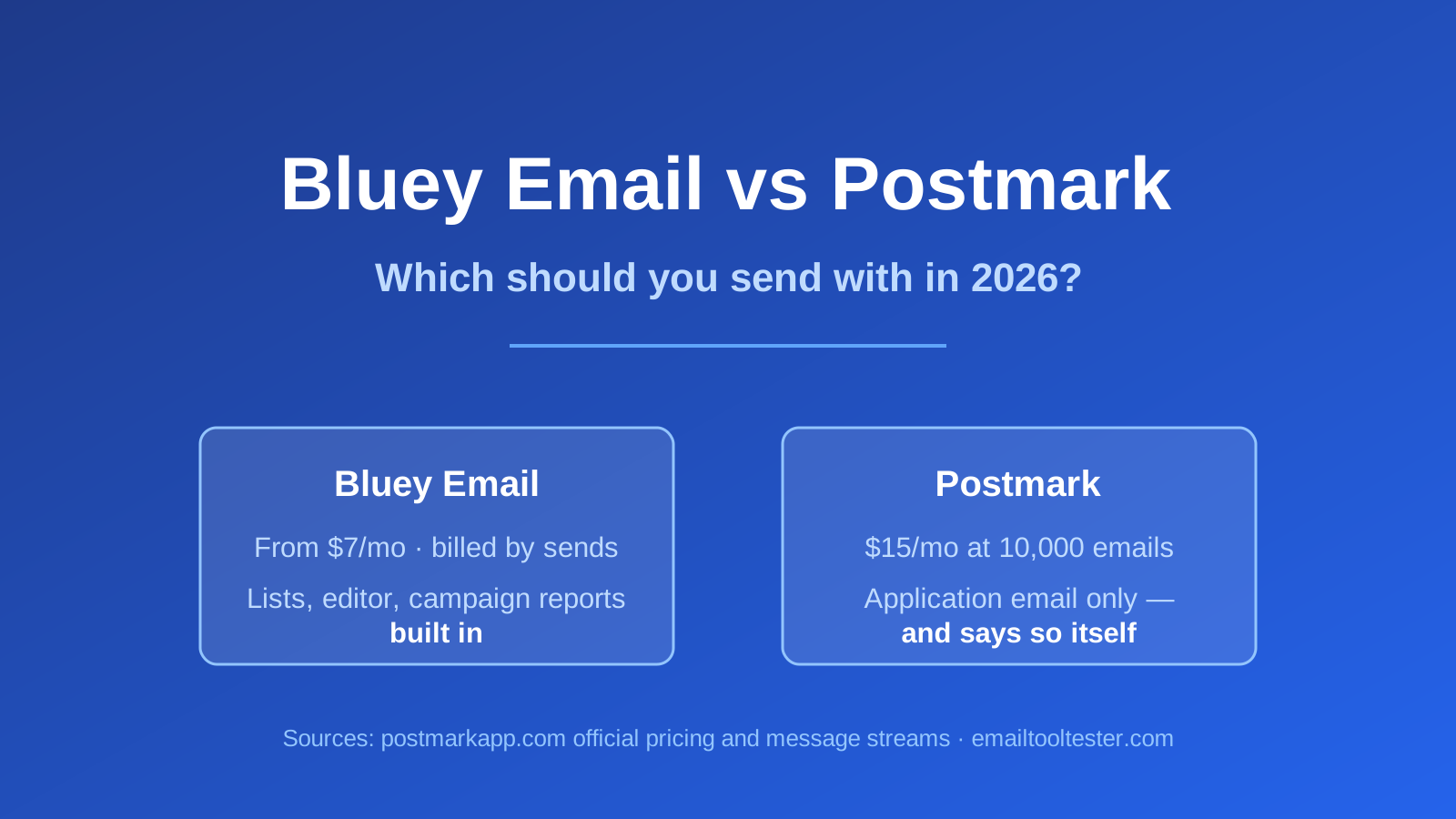
Quick answer: Postmark is a transactional email specialist: free at 100 emails/month, then Basic $15/mo, Pro $16.50/mo and Platform $18/mo, each starting at 10,000 emails (Postmark). It is exceptionally good at application email and says so honestly — and it says just as honestly that it does “not offer some of the features you might want if you were sending traditional marketing campaigns, including support for list uploads, a WYSIWYG editor, and campaign-based reporting” (Postmark). Bluey Email does those things and starts at $7/mo. Pick Postmark if your email comes from your application; pick Bluey if a marketer also needs to send. Written with AI assistance and reviewed against primary sources.
Full disclosure: Bluey Email is my own product. That is a real bias and I will not pretend otherwise. What I can do instead is cite Postmark’s own words for every claim about Postmark, name the places where it is flatly the better tool, and give one specific reason — not a vibe — for the case where Bluey wins.
This comparison is unusual for a reason worth stating up front: Postmark is one of the easiest competitors to write about honestly, because Postmark already publishes its own limitations. Most vendors make you dig. Postmark puts it on the feature page.
What is Postmark, and who is it actually for?
Postmark is an email API built for product development teams — the mail your application sends. Password resets, receipts, notifications, digests. It has been doing this for over nine years and is now owned by ActiveCampaign (Postmark).
Its identity used to be narrower still. In its own telling: “In the past, Postmark optimized deliverability and time-to-inbox by restricting the email sent through our infrastructure to transactional only” (Postmark). That restriction has since loosened — more on that below — but the DNA has not changed. Postmark is for email that a machine sends because a user did something.
How do Bluey Email and Postmark compare at a glance?
| Bluey Email | Postmark | |
|---|---|---|
| Free tier | 500 sends/mo, permanent | 100 emails/mo, permanent, no overages |
| Entry paid plan | Spark from $7/mo | Basic $15/mo at 10,000 emails |
| Overage cost | Included in send tiers | $1.80 / 1,000 (Basic), $1.20 / 1,000 (Platform) |
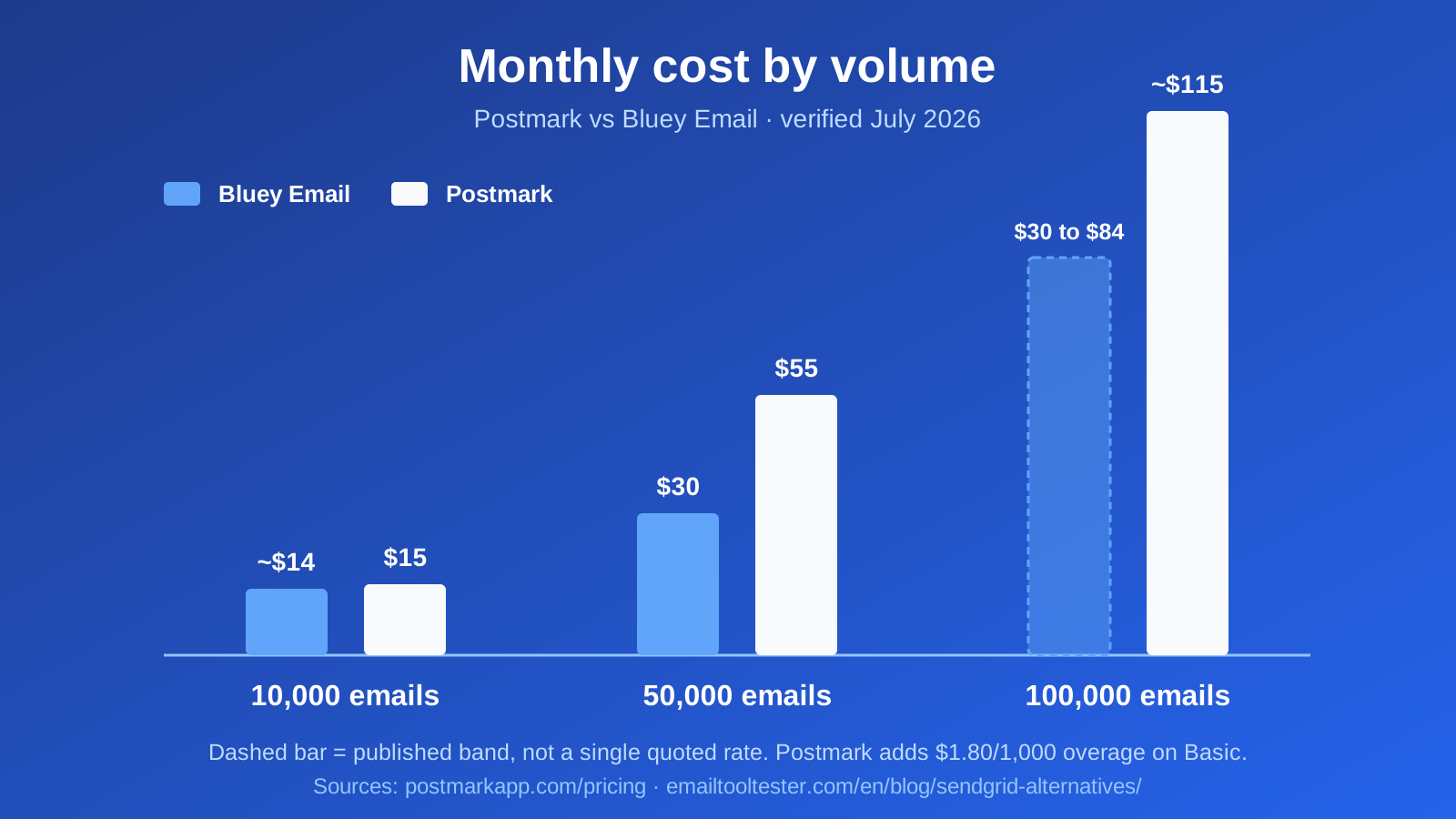
| At ~50k emails | Grow $30/mo | ~$55/mo |
| At ~100k emails | $30 to $84 band | ~$115/mo |
| List uploads | Yes | No — stated by Postmark |
| Drag-and-drop editor | Yes | No — stated by Postmark |
| Campaign reporting | Yes | No — stated by Postmark |
| Separate IP ranges, broadcast vs transactional | Not claimed | Yes |
| Built-in CRM | Yes (Business $300/mo) | No |
| Account approval | Self-serve | Manually vetted |
| Track record | Young product | 9+ years, ActiveCampaign-owned |
What does Postmark actually cost?
Postmark’s pricing is unusually legible. Three paid tiers, all starting at 10,000 emails/month, differing mainly in overage rate and retention (Postmark):
- Free — $0, 100 emails/month. Postmark notes it “never expires or runs out,” and no overages are allowed on it.
- Basic — $15.00/mo, extra emails at $1.80 per 1,000, 45-day retention, 5 custom sending domains.
- Pro — $16.50/mo, extra emails at $1.30 per 1,000, retention customizable up to 365 days, 10 domains, inbound email processing.
- Platform — $18.00/mo, extra emails at $1.20 per 1,000, unlimited domains and streams.
Note what the $1.50 gap between Basic and Pro buys: a lower overage rate. If you send meaningfully above 10,000, Pro is cheaper than Basic despite the higher sticker price. That is a genuinely fair pricing design and worth saying so.
Add-ons are priced separately: dedicated IPs start at $50/month per IP and are only available to customers sending 300,000+ emails/month on Pro or higher; custom activity retention starts at $5/month; DMARC monitoring starts at $14/month per domain (Postmark).
Where it gets expensive is volume. EmailTooltester’s Inka Wibowo, who has tested the field extensively, puts it plainly: “From our research, Postmark is one of the more expensive email delivery services in the market” — pricing it at $15 at 10k, $55 at 50k and $115 at 100k (EmailTooltester). Her verdict on fit: “Businesses with higher budgets for quality transactional email features may find Postmark perfect.”
Bluey is billed on sends, not contacts: Free covers 500 sends/mo permanently, Spark starts at $7/mo (about $14 at 10,000 sends), and Grow is $30/mo with unlimited contacts at roughly 50,000 sends, rising to about $84 at 250,000 and $180 at 1M. Business is $300/mo and adds a built-in CRM, landing pages and pre-built ecommerce flows.
The real difference: does a marketer need to send?
This is the whole comparison, and Postmark answers it for me.
Asked on its own feature page whether you can use it for marketing campaigns, Postmark says: “Postmark is built for application email. That means that we do not offer some of the features you might want if you were sending traditional marketing campaigns, including support for list uploads, a WYSIWYG editor, and campaign-based reporting” (Postmark).
On list management, it is equally direct: “We are creating tools for managing unsubscribes and suppression lists, but you will need to continue managing your main email lists outside of Postmark” (Postmark).
And then it does something most vendors never do — it refers you elsewhere: “If your needs are less about supporting application-based sending and more around enabling marketing promotion, there are other tools that may be a better fit for you than Postmark” (Postmark).
That is not a gotcha. It is a product decision, stated cleanly, and I respect it more than most of the marketing I read in this category. But it does define the fork in the road: if a human on your team needs to upload a list, lay out an email without writing code, and see how the campaign did, Postmark is not built for that job and does not claim to be.
Bluey is. To check I was not just reciting my own marketing copy, I ran a live dry-run validation against Bluey’s transactional endpoint while writing this — the API accepted a password-reset payload and returned valid: true with the message “Request is valid and would be accepted.” The same API key also carries campaigns:write, audiences:write, crm:write and emails:send scopes. One credential, one workspace, both jobs.
That is the substantiated reason Bluey ranks first for the marketer-also-sends case — not that it is faster, more deliverable, or more mature than Postmark. It is none of those things, and I have no evidence to claim otherwise. It is that Postmark’s own documentation names three things it does not do, and Bluey does them.
Where does Postmark win?
Several places, and some of them are the ones that matter most.
Stream separation at the infrastructure level. This is Postmark’s strongest and least-copied feature. Its Message Streams route transactional and broadcast mail through “parallel but separate sending infrastructures,” so that “transactional and broadcast traffic do not mix in Postmark, including IP ranges” (Postmark). Postmark claims this makes it “the only major email API provider adhering to the email traffic management standard promoted by the world’s most popular inbox providers, including Gmail.”
I want to be careful here, because this cuts against me. That claim is Postmark’s own and I have not independently verified the “only major provider” part. But the underlying practice — separating streams by IP and From domain — is exactly what Gmail recommends, and it is the single most important structural thing you can do for deliverability. Bluey does not make an equivalent separate-IP-range claim, and I am not going to invent one. If infrastructure-level stream separation is your top requirement, Postmark has a real, documented answer and I do not. See the transactional email guide for why this matters and SPF, DKIM and DMARC explained for the authentication layer underneath it.
Feature access at every tier. EmailTooltester notes that “you will get full access to almost all of Postmark’s features at every pricing tier. You will have to pay more only if you want to send more emails, or use add-ons such as dedicated IP addresses” (EmailTooltester). Most vendors, including plenty on the best email marketing software list, gate features behind tiers. Postmark gates volume. That is cleaner.
A vetted sender pool. Postmark says it is “still manually vetting each potential customer, chatting with them one-on-one about what they send and why,” and that it “will never be an open door to any sender” (Postmark). That is friction at signup — and it is also precisely why the shared IPs you would be sending from are clean. It is a cost that buys something real.
Track record. Nine-plus years, ActiveCampaign behind it, and a customer list including Asana, 1Password and Webflow. Bluey is young. If you are choosing infrastructure you do not want to think about again for five years, that asymmetry is not in my favour.
Inbound email processing on Pro and above, plus template pushing across environments — features EmailTooltester singles out when calling Postmark “a fantastic transactional email platform” (EmailTooltester).
Does Postmark send broadcast email now, though?
Yes — and this deserves precision rather than a convenient blur, because it partially undercuts the framing above.
Postmark is “no longer for transactional email only.” Broadcast Message Streams exist, they carry “no additional add-ons or fees,” and broadcast messages simply count against your plan’s monthly email limit like anything else (Postmark). Postmark defines broadcast as email “sent to multiple recipients at once” — product update announcements, terms-of-service notices.
So the honest version of the distinction is not that Postmark cannot send to a list. It can. The distinction is that Postmark expects the application to do the sending, and expects the list to live somewhere else: “if you choose to use Postmark for things like marketing campaigns or newsletters, you will still need to send those messages via your application” (Postmark).
That is a developer workflow, not a marketer workflow. If your newsletter is assembled in code and triggered by a deploy, Postmark handles it fine and handles it well. If your newsletter is assembled by a person who does not have a terminal open, it does not.
Which should you choose?
- Your email comes from your application, full stop — Postmark. It is better at this than I am, and it costs $15 to find out.
- Deliverability is the entire requirement and you want stream separation by IP range — Postmark, on its documented architecture.
- You send over 100k/month and price is the constraint — neither, probably. Amazon SES is roughly $10 at 100k (EmailTooltester). See Postmark alternatives.
- A marketer needs to upload a list, design an email, and read a campaign report — Bluey, for the specific reason Postmark itself publishes.
- You want both, from one vendor, on one bill, self-serve — Bluey, or Brevo if you would rather not bet on a young product.
- You want a modern developer-first API and do not need a CRM — look at Bluey Email vs Resend or Bluey Email vs SendGrid.
Frequently asked questions
Is Postmark good for marketing emails? Partly. Postmark supports broadcast Message Streams at no extra fee, but states it does not offer “list uploads, a WYSIWYG editor, and campaign-based reporting,” and that you will manage your main lists outside Postmark (Postmark). It is suitable for application-sent announcements, not for a marketer-run campaign.
How much does Postmark cost per month? Free for 100 emails/month; $15 (Basic), $16.50 (Pro) or $18 (Platform) per month starting at 10,000 emails, with overages at $1.80, $1.30 and $1.20 per 1,000 respectively (Postmark).
Is Postmark expensive? At volume, yes, by third-party assessment: EmailTooltester calls it “one of the more expensive email delivery services in the market,” at roughly $115/mo for 100,000 emails against Amazon SES’s ~$10 (EmailTooltester). At 10,000 emails it is competitive.
Does Postmark have a free plan? Yes — 100 emails/month, permanent, with no overages permitted (Postmark). It is an integration testbed, not a production tier.
Who owns Postmark? ActiveCampaign. Postmark describes ActiveCampaign as its parent platform and notes the two integrate, letting you send transactional email from marketing automations (EmailTooltester).
Can I get a dedicated IP with Postmark? Yes, from $50/month per IP — but only on Pro plans or higher and only for customers sending 300,000+ emails per month (Postmark).
Do I still need to separate transactional and marketing streams if I use one platform? Yes. Stream separation and vendor separation are different things — Gmail’s recommendation is about sending streams, subdomains and IPs, not about invoices. See the transactional email guide and the email deliverability guide.
Verdict
Postmark is the better product for the job Postmark is built for, and it is refreshingly honest about where that job ends. If your mail is application email, the interesting comparison is not Bluey vs Postmark — it is Postmark vs its own price at volume.
The case for Bluey is narrow and specific: Postmark publishes three things it does not do — list uploads, a visual editor, campaign reporting — and a lot of companies need exactly those three things alongside their password resets. If that is you, one platform beats two. If it is not you, buy Postmark.
References
- Postmark — Pricing: postmarkapp.com/pricing
- Postmark — Message Streams: postmarkapp.com/message-streams
- Inka Wibowo and Robert Brandl, EmailTooltester — SendGrid Alternatives, updated Jun 15, 2026: emailtooltester.com
- Postmark — Transactional vs. marketing email: postmarkapp.com/blog
Pricing verified on Postmark’s official pricing page on 17 July 2026. Bluey’s transactional endpoint behaviour verified first-hand via a live dry-run validation on the same date.
— Shivam