
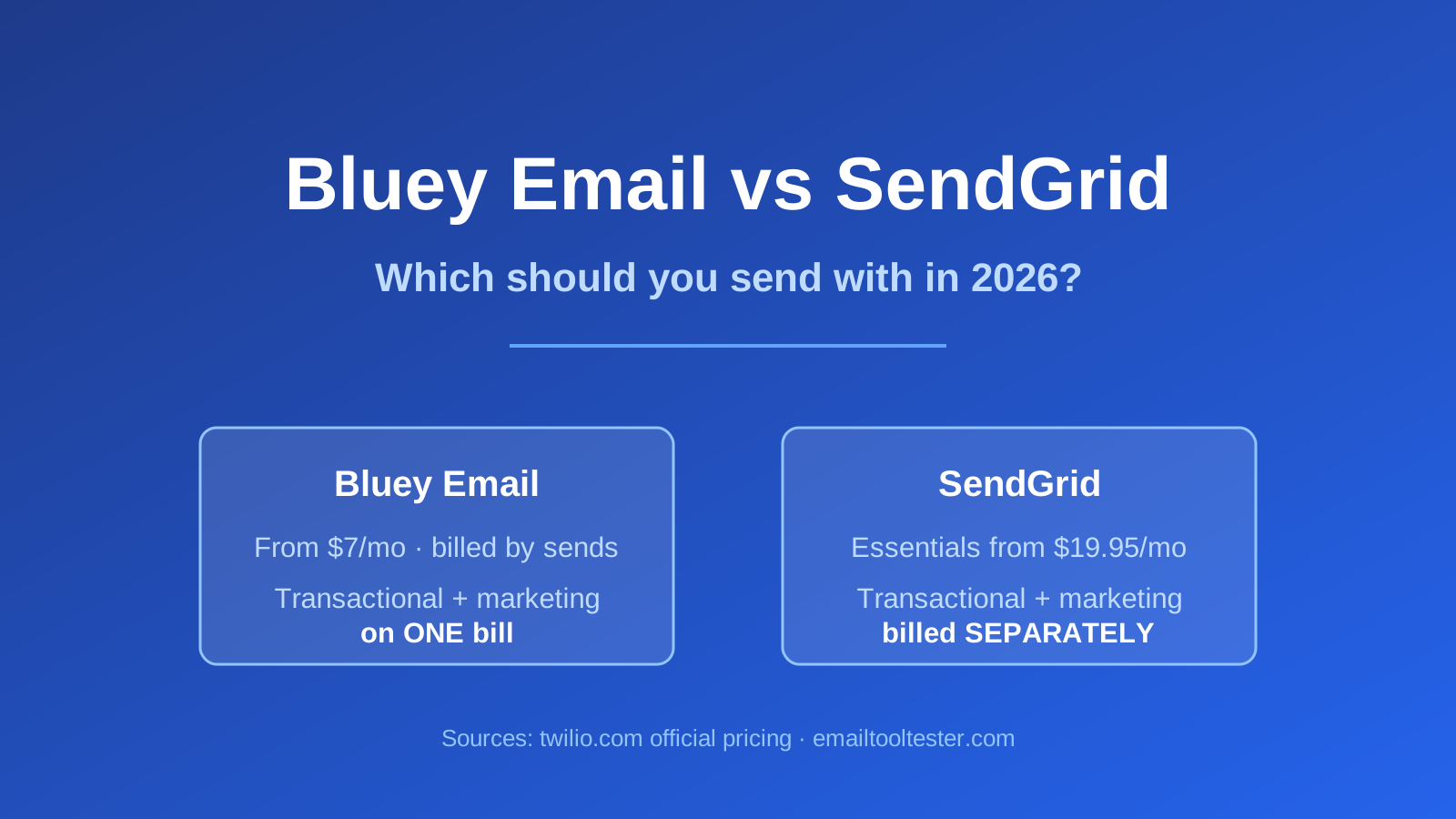
Quick answer: SendGrid is a developer-first email API with a free trial of 100 emails/day for 60 days, Essentials from $19.95/mo and Pro from $89.95/mo (Twilio SendGrid). Its real catch is structural: SendGrid bills transactional and marketing email as separate products, so sending both means two plans and two bills (EmailTooltester). Bluey Email puts both on one plan from $7/mo. Pick SendGrid if you need a battle-tested API at high volume; pick Bluey if you send both kinds of email and want one bill. Written with AI assistance and reviewed against primary sources.
Full disclosure: Bluey Email is my own product. I built it, so I have an obvious bias. What I can offer instead of false neutrality is a specific, checkable reason for every claim — and a plain statement of where SendGrid is the better tool. Judge both on the same yardstick below.
What is SendGrid, and who is it actually for?
SendGrid (now Twilio SendGrid) is one of the oldest and most widely deployed email APIs on the internet. It is built for developers who need to push mail through an API or SMTP relay at scale — password resets, receipts, alerts — with deliverability infrastructure they do not have to run themselves.
That heritage matters. If your problem is that your application needs to send a lot of mail reliably, SendGrid is a serious, proven answer, and has been for over a decade. Where it gets awkward is when your company also wants to send a newsletter.
How do Bluey Email and SendGrid compare at a glance?
| Bluey Email | SendGrid | |
|---|---|---|
| Free tier | 500 sends/mo, permanent | 100 emails/day, 60-day trial |
| Entry paid plan | Spark from $7/mo | Essentials from $19.95/mo |
| Next tier up | Grow $30/mo, unlimited contacts | Pro from $89.95/mo |
| Transactional + marketing | One plan, one bill | Billed as separate products |
| Billed by | Sends | Emails (API) / contacts (Marketing) |
| Built-in CRM | Yes (Business $300/mo) | No |
| Automation depth | Visual flows with branching | “Rather simplistic” per EmailTooltester |
| Track record at scale | Young product | 10+ years, enterprise-proven |
What does SendGrid actually cost?
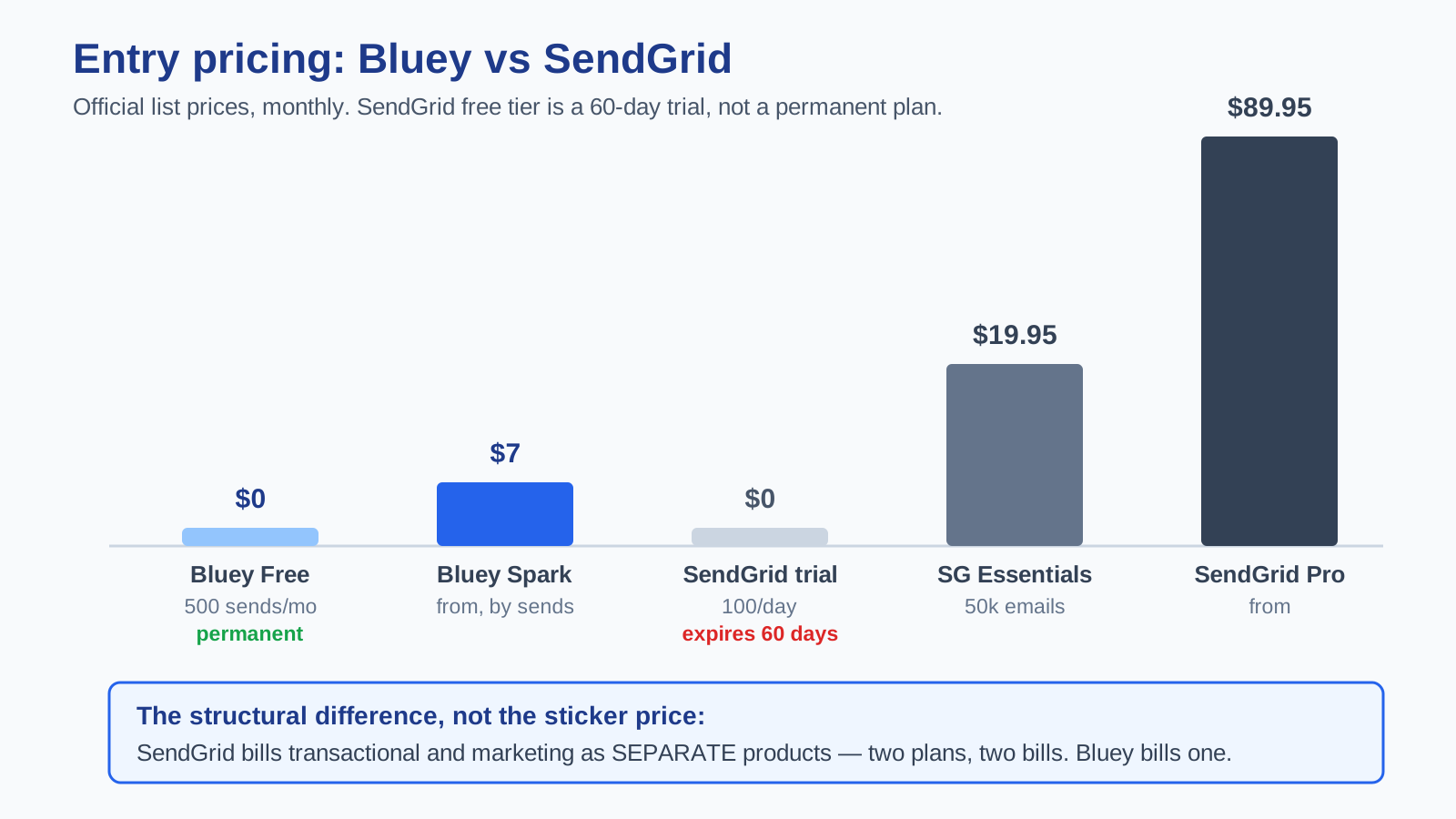
The official SendGrid pricing page lists four Email API tiers: a Free Trial at $0/mo for 60 days, Essentials starting at $19.95/mo, Pro starting at $89.95/mo, and Premier at custom pricing (Twilio SendGrid). The free trial is capped at 100 emails per day and expires — it is a trial, not a free plan in the sense most tools mean it.
Inka Wibowo of EmailTooltester puts the entry cost in context: the SendGrid “cheapest paid plan is $19.95 per month for 50,000 emails,” and she flags that low-volume senders “may find such fees pricey compared to other providers” (EmailTooltester). That is the honest shape of it: SendGrid pricing assumes volume. If you send 50,000 emails a month, $19.95 is excellent value. If you send 3,000, you are paying for headroom you do not use.
Bluey is billed on sends rather than contacts: Free covers 500 sends/mo permanently, Spark starts at $7/mo (about $14 at 10,000 sends), and Grow is $30/mo with unlimited contacts at roughly 50,000 sends, rising to about $84 at 250,000 and $180 at 1M.
The real difference: one bill or two?
This is the part that decides most comparisons, and it is not about price per email.
SendGrid treats transactional and marketing email as two products. As EmailTooltester puts it plainly: “SendGrid bills for transactional and marketing emails as separate products. As a result, you would potentially need to pay more to send both types of emails. Your billing might get more complicated, too” (EmailTooltester).
So a company running both a password-reset flow and a monthly newsletter ends up with an Email API plan and a Marketing Campaigns plan — two line items, two sets of limits, two mental models.
Bluey collapses that. Transactional and marketing run through one workspace on one plan. To check I was not simply describing my own marketing copy back to myself, I ran a live validation against the Bluey transactional endpoint while writing this — the API accepted a password-reset payload and returned valid, and the same API key also carries campaigns, audiences and CRM write scopes. One credential, one workspace, both kinds of mail.
This is the substantiated reason Bluey ranks first for the case where you send both — not that it is faster or more deliverable than SendGrid (I have no evidence for either), but that it removes a billing and architecture split that the SendGrid structure imposes.
Does Gmail not want transactional and marketing separated?
Yes — and this deserves an honest answer rather than a dodge, because it sounds like it contradicts the point above.
Gmail officially recommends that “if you send both promotional mail and transactional mail relating to your organization, we recommend separating mail by purpose as much as possible” (via Postmark). But that guidance is about sending streams — separate subdomains, IPs, and From addresses — not about separate vendors or invoices. You can and should separate streams while keeping one platform. Conflating the two is a marketing sleight-of-hand, and I would rather name it than use it. See the transactional email guide for how to set the separation up properly.
Where does SendGrid win?
Plainly, and these are not small:
Scale and track record. SendGrid has been moving enormous volumes of mail for over a decade under Twilio ownership. Bluey has not. If you are sending millions of messages a month and an outage is a company-level incident, that history is worth more than a cheaper invoice.
Developer ecosystem. Mature SDKs, exhaustive docs, and an enormous body of Stack Overflow answers. Whatever you hit, someone hit it in 2019 and wrote it up.
Bounce diagnostics. SendGrid classifies bounces into seven categories so you can see why mail failed — more granular than many competitors, which report only hard or soft (EmailTooltester).
Enterprise procurement. Twilio is a public company with the compliance paperwork, SLAs, and vendor-review answers that large buyers require.
If you are a developer at a company whose email is overwhelmingly transactional and high-volume, SendGrid is likely the right answer and I would say so.
Where does Bluey win?
One plan for both kinds of email, as covered above — the structural difference.
Low-volume economics. A $7/mo entry versus $19.95 matters most to exactly the senders the SendGrid tiers are not designed for.
Automation. EmailTooltester found the SendGrid automation editor “rather simplistic” — specifically, “you cannot have conditional paths in your automations or set up multiple triggers for them” (EmailTooltester). If your flows need branching, this is a hard limit, and the recommended workaround is bolting on a second tool.
Built-in CRM on Business ($300/mo), where SendGrid expects you to bring your own.
Which should you choose?
Choose SendGrid if: you are API-first and high-volume, transactional mail is the whole job, you need enterprise procurement and a long track record, or you want deep bounce diagnostics.
Choose Bluey if: you send both transactional and marketing mail and want one bill, you are under ~50,000 sends and $19.95 buys headroom you will never use, or you need branching automations without a second subscription.
Choose neither if: you want the cheapest possible pure-transactional sending and can handle rough edges — Amazon SES is roughly $10/mo at 100k emails, versus the much friendlier SendGrid interface (EmailTooltester). More options in SendGrid alternatives.
Frequently asked questions
Is SendGrid free? Not permanently. The free tier is a 60-day trial capped at 100 emails/day (Twilio SendGrid). The Bluey free plan of 500 sends/mo does not expire.
Does SendGrid do email marketing? Yes, via Marketing Campaigns — but it is billed as a separate product from the Email API, so sending both types means two plans (EmailTooltester).
Is SendGrid good for beginners? It is built for developers. If you want a drag-and-drop newsletter tool, a marketing-first platform will fit better — see best email marketing software.
Can Bluey handle transactional email? Yes — transactional and marketing share one workspace and one bill. I validated a live transactional payload against the API while writing this.
Which has better deliverability? I will not claim an answer. I have no controlled test comparing the two, and anyone quoting you a precise head-to-head number without publishing their methodology is guessing. Deliverability depends more on your authentication and list quality than on vendor choice.
Is SendGrid automation good enough? For simple linear sequences, yes. For conditional paths or multiple triggers, EmailTooltester found it cannot do it (EmailTooltester).
The verdict
SendGrid is a genuinely good email API that has earned its position, and at high transactional volume with enterprise requirements it beats what I have built. Its weakness is not the sending — it is that the moment you want marketing email too, you are buying a second product.
The Bluey argument is narrow and specific: one plan, both kinds of email, from $7. If that is your problem, it is a real answer. If it is not, SendGrid is a fine place to be.
Next: browse SendGrid alternatives, understand the category with the transactional email guide, compare the wider field in best email marketing software, or protect inbox placement with the email deliverability guide.
— Shivam
What it costs per thousand emails: Email API pricing compared.
What SendGrid actually costs, including overage: SendGrid pricing explained.
Ready to switch? how to migrate from SendGrid — step by step, without wrecking your deliverability.