
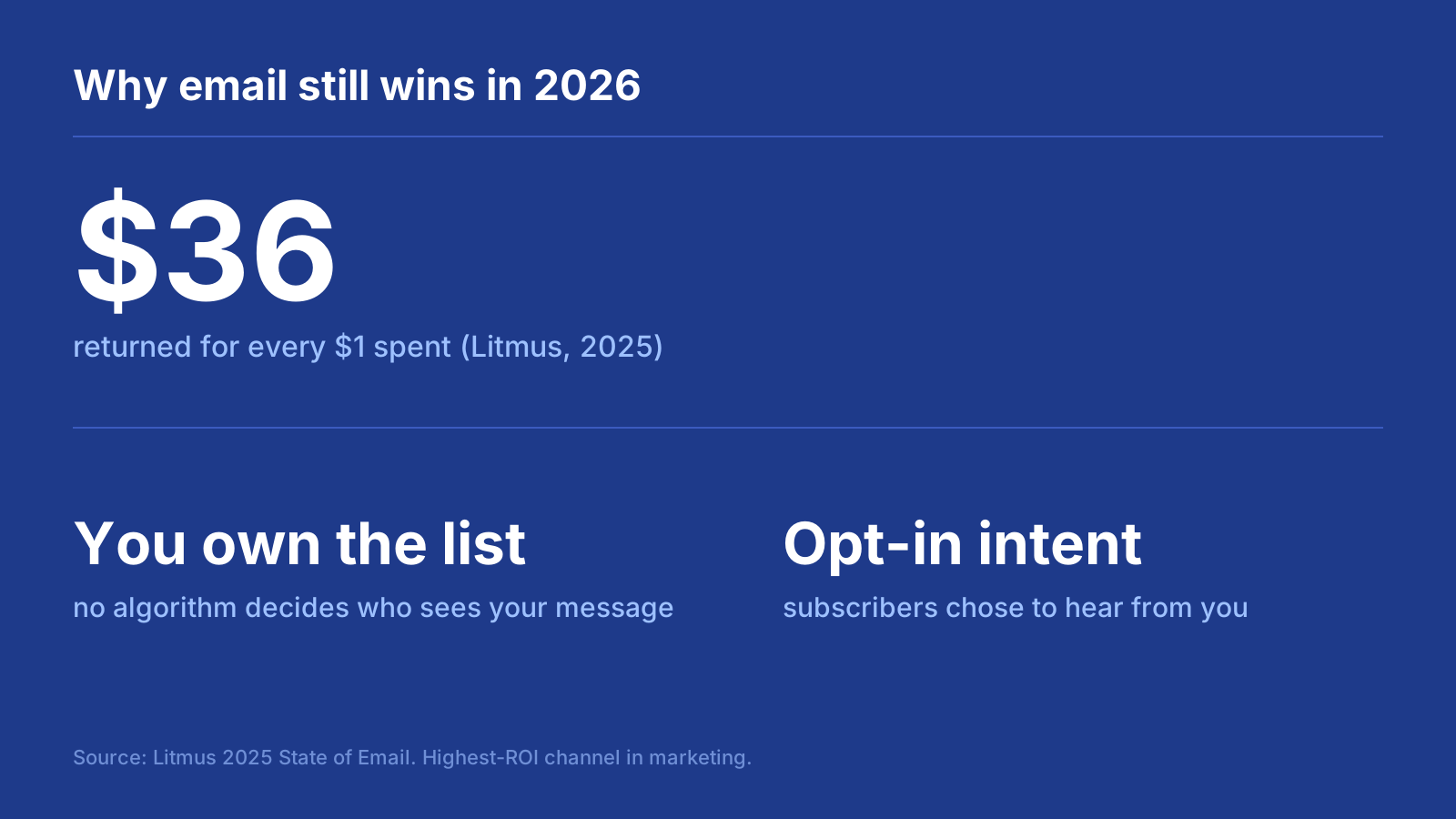
Quick answer: Email marketing is sending commercial or relationship-building messages to a list of people who opted in to hear from you — and in 2026 it is still the highest-ROI channel in marketing, returning around $36 for every $1 spent (Litmus, 2025 State of Email). This guide is the fundamentals hub: what email marketing is, why it works, the types of email, how to build a list, deliverability, segmentation, automation, the metrics that matter, compliance, and how to choose a tool. Quick disclosure: I run Bluey Email, so I will flag where I mention it and keep the advice tool-agnostic.
Every few years someone declares email dead, and every year it quietly out-earns the channel that was supposed to replace it. The reason is structural: email is the only major channel where you own the audience. You do not rent it from an algorithm that can throttle your reach overnight — you have a direct line to people who asked to hear from you, in a place they check every day.
Few people have made that case longer than Neil Patel, co-founder of Neil Patel Digital. Asked whether email is still relevant, his answer was blunt: “The problem is not that email marketing is outdated; it is that people are not adapting to the new technology.” Your email list is the foundation of your marketing, not just another tactic, because you own that relationship outright while everything else is borrowed.
Why email marketing works in 2026
ROI. At roughly $36 returned per $1 spent (Litmus, 2025), email dwarfs paid social and search — sending is cheap and you reach people who already raised their hand. Ownership. Your list is an asset you control and can export; social reach can vanish with an algorithm change. Intent. Subscribers opted in, which makes email warmer than almost any acquisition channel and is why engagement and conversion run higher.
The main types of email
- Newsletters — recurring value that builds the relationship over time; the trust-builder.
- Promotional / campaign emails — one-off sends tied to a launch or sale; the revenue spike.
- Transactional emails — receipts, shipping, resets; very high open rates and often an underused brand surface.
- Automated / lifecycle flows — welcome, abandoned cart, onboarding, win-back; relevant by design, they do the heaviest lifting.
A healthy program runs all four in balance. One tooling note: most platforms bill marketing and transactional email separately; a few (including Bluey and Brevo) put both on one bill.
Building and growing your list
Everything starts with permission. Never buy a list — it tanks deliverability and breaks the law in many regions. Instead, earn opt-ins:
- Offer real value for the signup — a lead magnet (guide, template, discount, free tool), not just subscribe to our newsletter.
- Put signup forms everywhere — header, footer, popups, blog posts, social bios, checkout.
- Use the right opt-in — double opt-in protects deliverability and quality; single opt-in grows faster.
- Set expectations at signup — say what they will get and how often; it cuts complaints later.
Growth matters, but list quality beats list size every time — worth remembering when a tool charges you per contact whether those contacts engage or not.
Deliverability fundamentals
The best email in the world earns nothing if it lands in spam. Most email-is-not-working problems are really deliverability problems. It rests on three pillars:
- Authentication — set up SPF, DKIM, and DMARC on your sending domain. Since 2024 Gmail and Yahoo effectively require these for bulk senders; skipping it is the most common reason new senders hit spam.
- List hygiene — remove hard bounces and long-dormant contacts; sending to dead addresses damages your reputation (and, on per-contact tools, costs money for nothing).
- Engagement — mailbox providers watch opens, clicks, replies, and complaints. Sending relevant email to people who want it is the deliverability strategy.
Segmentation and personalization
The fastest upgrade to almost any program is to stop blasting everyone the same thing. As Neil Patel puts it, “You cannot blast the same message to your entire list and expect great results — you have got to send the right message to the right person.” Segment by behavior, lifecycle stage, interest, and source; then personalize the offer and content beyond a basic first-name merge tag. Done well, this lifts opens, clicks, and revenue without sending a single extra email.
Automation and lifecycle flows
- Welcome series — your highest-engagement moment; set the relationship and deliver an early win.
- Abandoned cart / browse abandonment — recover revenue that is already half-won.
- Onboarding — drive new users to their first success (SaaS).
- Post-purchase — thank, educate, cross-sell, request reviews.
- Win-back / re-engagement — pull dormant subscribers back before you sunset them.
Build these once and they run forever, improving as you test. For most businesses, flows out-earn one-off campaigns per email sent.
Design and copy basics
- Subject line — the biggest lever on opens; be specific and honest, and test relentlessly.
- Preheader — the preview text; treat it as a second subject line.
- One email, one goal — a single primary call to action beats five competing links.
- Mobile-first — most opens are on phones; single-column, big tap targets, short paragraphs.
- Voice — write like a person; an email should feel like you are talking to a friend.
The metrics that matter
- Open rate — directional only (muddied by Apple Mail privacy); useful for subject-line and deliverability trends.
- CTR and click-to-open rate — whether the content landed.
- Conversion rate and revenue per email — the numbers that actually matter.
- Unsubscribe and spam-complaint rates — your early-warning system.
Benchmarks vary enormously by sector, so see our email marketing by industry and business size guide for the real ranges, and weight your own trend over any single benchmark.
Compliance, in plain terms
- CAN-SPAM (US) — accurate headers, a physical address, and a working unsubscribe honored promptly.
- GDPR (EU/UK) — a lawful basis (usually consent), clear records, and easy opt-out.
- CASL (Canada) and similar — consent-first rules with real fines.
The simple version: only email people who genuinely opted in, make unsubscribing easy, never hide who you are, and keep records of consent.
Choosing your tool
Once you have the fundamentals, the platform decision comes down to fit and pricing model. Match the tool to your job — ecommerce flows, B2B/SaaS CRM and lifecycle, or cheap-at-scale newsletters — and watch how the bill scales: per-contact pricing climbs with list size even if you do not email everyone, while send-based pricing tracks how much you actually send. That lens drives our full comparison in Best Email Marketing Software in 2026, plus Klaviyo alternatives and Mailchimp alternatives. Full disclosure: Bluey is built on send-based pricing for exactly that reason — but choose the tool that fits your business, not mine.
Your first 30 days: a starter checklist
- Pick a tool and authenticate your domain (SPF, DKIM, DMARC) before sending anything.
- Create one lead magnet and put a signup form on your highest-traffic page.
- Write a 3-email welcome series and turn it on.
- Send a first newsletter to introduce yourself; aim for value, not a pitch.
- Set up one revenue flow (abandoned cart for ecommerce, onboarding for SaaS).
- Watch CTR, conversions, and complaints, then iterate one change at a time.
Frequently asked questions
Is email marketing still effective in 2026? Yes — it remains the highest-ROI channel at roughly $36 per $1 spent, largely because you own the audience rather than renting reach from an algorithm.
How do I start email marketing? Pick a platform, authenticate your domain, offer a lead magnet to collect opt-ins, set up a welcome series, and send consistent, valuable email.
How often should I send? Often enough to stay familiar, rarely enough to stay welcome — usually weekly to monthly for newsletters, plus behavior-triggered flows.
Why are my emails going to spam? Almost always authentication (missing SPF/DKIM/DMARC), poor list hygiene, or low engagement. Fix those three first.
What is a good open rate? It depends entirely on your industry — see the benchmarks by industry. Compare to your sector and your own trend, not a global number.
The verdict
Email marketing is not complicated, but it is cumulative — the programs that win get the fundamentals right and compound them: real permission, clean deliverability, relevant segmentation, a few automated flows, and honest measurement. Do these and email will quietly out-earn everything else in your stack. Ready to go deeper? Compare platforms in Best Email Marketing Software in 2026, or tailor the playbook with email marketing by industry and business size. And whatever tool you pick — Bluey Email included — the fundamentals on this page are what make it work.
— Shivam
Free tools for this
Put this into practice with our free, no-signup tools — everything runs in your browser:
Browse all 15 free tools →Ready to write? Our email template library has copy-paste templates for welcome, cart recovery, re-engagement, newsletters and order confirmations.
7 thoughts on “The Complete Email Marketing Guide (2026)”