
Quick answer: There is no single best email strategy — what works is set by your industry and your business size. A nonprofit and a Shopify store live in different worlds: average open rates run from about 30.5% for government and 25.2% for nonprofits down to 15.7% for ecommerce and 13.9% for retail (WebFX, 2026). So benchmark against your own industry, not the average, and pick tooling that fits your size and sending pattern. This guide breaks it down by industry and by company size, with honest notes on where Bluey Email (my own product, disclosed up front and reviewed fairly) fits and where it does not.
The fastest way to feel bad about a great email program is to compare it to the wrong benchmark. A 19% open rate is mediocre for a nonprofit and excellent for a high-volume retailer. Email is not one game; it is a dozen games with different rules, and the rules are set by two things: what industry you are in and how big you are.
Get this lens right and everything downstream gets easier — you will set realistic goals, choose the right tool, and stop chasing tactics built for someone else’s business. Get it wrong and you will copy an ecommerce playbook into a B2B funnel, wonder why it flops, and blame the channel instead of the mismatch.
Why the average is a trap
Across all industries the average open rate is about 19.21% and click-through 2.44%, according to WebFX, drawing on Campaign Monitor and Mailchimp data across more than 25 industries. But the spread underneath that average is enormous:
| Industry | Avg. open rate | Avg. click rate |
|---|---|---|
| Government | 30.5% | 4.1% |
| Nonprofit | 25.2% | 2.6% |
| Education | 23.4% | 3.0% |
| Construction / manufacturing | 22.4% | 3.2% |
| Ecommerce | 15.7% | 2.0% |
| Retail | 13.9% | 2.1% |
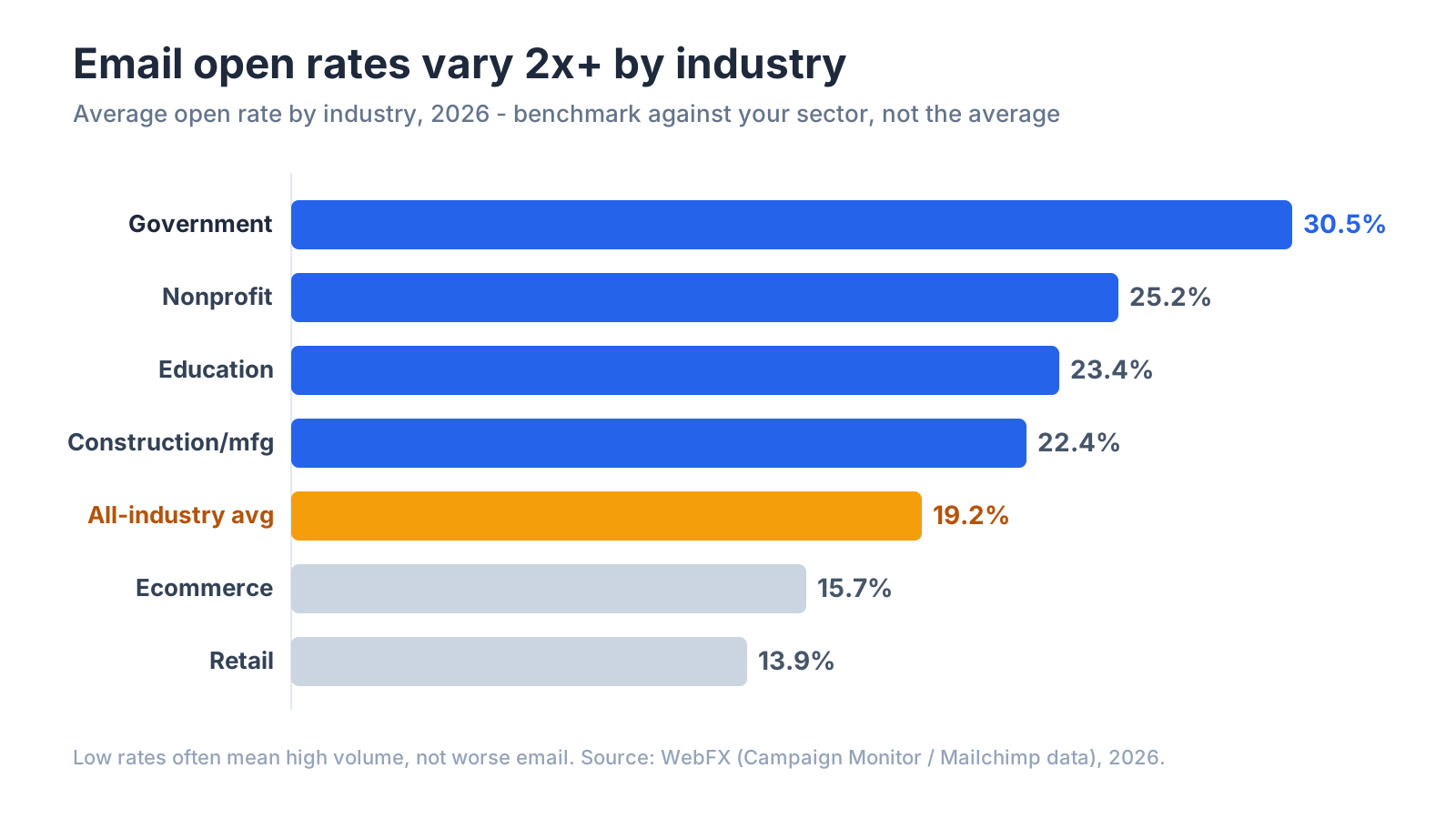
Read that table carefully, because it is easy to misread. It is not saying retail is worse at email than government. Retailers send far more often, to far larger and colder lists, chasing direct revenue — a completely different job than a government agency emailing a warm, opted-in list a few times a month. High open rates often just mean a small, engaged audience; low open rates often mean scale and frequency. The number alone tells you almost nothing until you know the context.
Two corollaries follow. First, benchmark against your own industry, using a table like the one above as your starting line — not the global average. Second, the metric that matters changes by industry too: for a retailer it is revenue per email, for a nonprofit it is donations per send, for a SaaS company it is activation or retention lift. Open rate is a diagnostic, not a goal.
This is really a point about relevance, and few make it better than Ann Handley, Chief Content Officer of MarketingProfs and a Wall Street Journal best-selling author. Her rule, in her own words: “Be valuable to your audience. Publish less. But publish with more integrity and intention and empathy for the audience.” Empathy for your specific audience — their industry context, their inbox habits, their reason for subscribing — is exactly what an industry-and-size lens gives you.
Part 1 — Email marketing by industry
Each of these is a topic in its own right; here is the strategic shape of each.
Ecommerce and retail
The job is revenue, and the workhorses are automated flows, not broadcasts: abandoned cart, browse abandonment, post-purchase, replenishment, and win-back. Benchmarks look low (15.7% open, 13.9% for retail) precisely because volume and list size are high — but automated flows triggered by real shopping behavior convert well above one-off campaigns. What wins: real-time store data, segmentation by purchase history, SMS alongside email, and a pricing model that does not punish you for storing years of past customers. Bluey fit: strong — pre-built cart, browse, and win-back flows ship out of the box, and because you pay by sends rather than stored contacts, a long customer history is an asset, not a line item. The deepest ecommerce data model still belongs to Klaviyo; if you live and die by granular Shopify flows, weigh that against cost.
SaaS and technology
The job is the lifecycle: activation, onboarding, adoption, retention, and expansion — email tied to what users actually do in the product. A welcome series that drives the first aha moment is worth more than any newsletter. What wins: event-triggered automations fed by product data, and a CRM (or built-in equivalent) that knows whether someone is a trial, paid, or churn-risk account. Bluey fit: good — the built-in CRM keeps lifecycle stage and email in one place, so there is no separate CRM sync to break.
B2B services and agencies
The job is nurture over long sales cycles — staying credible and top-of-mind for the months between interested and signed. For agencies there is a second job: running email across many client accounts without the admin or the bill spiraling. What wins: behavioral segmentation, lead scoring, clean reporting, and multi-account management. Bluey fit: good for predictable per-client economics — agencies feel per-contact bill shock acutely because each client list adds contacts.
Nonprofits
The job is donations, volunteers, and storytelling to a warm, mission-driven list — which is exactly why nonprofits sit near the top of the engagement table at 25.2% open. What wins: keeping cost low, donation- and event-platform integrations, and the freedom to email a large supporter base often without a penalty. Bluey fit: strong — send-based pricing means a 100,000-person supporter list you email a few times a month stays inexpensive, whereas per-contact pricing would tax you for the whole list every month.
Healthcare and wellness
The job is reminders, education, and retention to an audience that expects accuracy and discretion. What wins: deliverability and, above all, the correct compliance posture. Honest note: if you handle protected health information, do not assume any platform is compliant. Verify HIPAA support and the availability of a signed Business Associate Agreement before you commit, and treat that as a hard gate ahead of features or price. I will not claim a compliance status for Bluey here that I cannot verify for your use case — check it directly.
Real estate, hospitality, and local services
The job is to stay in front of a community-sized list for the long gaps between transactions. What wins: simple, reliable automations, CRM or booking-tool integrations, and pricing that stays affordable as your contact list slowly grows. Bluey fit: good — flat, predictable pricing suits long nurture cycles where you hold many contacts but send modestly.
Education
The job is enrollment, retention, and community to an engaged institutional audience that posts a healthy 23.4% open rate. What wins: segmentation by program and cohort, reliable bulk sending around term dates, and accessibility-minded templates.
Creators, media, and publishers
The job is the newsletter itself — engagement, and increasingly monetization, at large and growing list sizes. What wins: cheap-or-unlimited sending at scale, a genuinely good editor, and easy monetization. Bluey fit: strong on cost at scale — creators with big lists are precisely the people per-contact pricing punishes hardest.
Part 2 — Email marketing by business size
Industry tells you what to send; size tells you what to buy and what to worry about.
Solopreneurs and creators
Needs: a free or genuinely cheap start, easy templates, and frictionless list growth. Watch for: plans that are free until your list crosses a threshold, then jump. Fit: Bluey’s free tier plus flat pricing keeps early costs predictable; MailerLite and other budget picks are also worth a look in our software guide.
Small businesses
Needs: a handful of automations, a lightweight CRM, and cost that will not surprise you as the list grows. Watch for: per-contact bills that creep up as you collect more contacts. Fit: a platform with a built-in CRM (Bluey, Brevo, ActiveCampaign) saves you from buying and wiring up a second tool.
Mid-market
Needs: real segmentation, multi-channel (email plus SMS), integrations, roles and permissions, and approval workflows. Watch for: the scale-up bill — this is the stage where per-contact pricing bites hardest, because your list has grown large but you still do not email all of it every send. Fit: send-based pricing keeps cost tied to activity; this is also where Klaviyo alternatives and Mailchimp alternatives get searched most.
Enterprise
Needs: deliverability at high volume, security and compliance (SOC 2, SSO, data residency), dedicated support, SLAs, and deep custom integrations. Watch for: opaque contact-sales pricing and long contracts. Honest note: at true enterprise scale, evaluate Klaviyo, ActiveCampaign, and HubSpot alongside Bluey on compliance, support, and integration depth — not on price alone.
The thread connecting both axes: how your bill behaves
Across every industry and size, one structural choice keeps recurring: does your bill track how many contacts you store, or how much email you send? Look at who accumulates contacts faster than they increase sending — and it is almost everyone on this page. Nonprofits with huge supporter lists. Creators whose newsletters grow for years before they monetize. Ecommerce stores sitting on a decade of past customers. Agencies juggling many client lists. In every case the contact count climbs while sending stays flat or seasonal. On per-contact platforms, that means the bill rises even when your activity, and your revenue, does not.
On a send-based platform like Bluey, the bill tracks what you actually do. That is not the right answer for everyone — a low-volume enterprise with strict compliance needs may rightly weigh security and support above pricing model. But for the broad middle of the market, it is why send-based pricing keeps showing up as the smart default, and why I built Bluey on that model.
How to choose, by industry and size
- Benchmark against your industry, not the global average — then track your own trend over time.
- Match the tool to your core job — flows for ecommerce, CRM and lifecycle automation for SaaS and B2B, low-cost bulk for nonprofits and creators.
- Check compliance early if you are in healthcare, finance, or education — make it a gate, not an afterthought.
- Model your bill at 12 months, factoring how fast your list (not your sending) will grow.
- Right-size, do not over-buy — enterprise features you will never use are just cost.
Frequently asked questions
What is a good email open rate for my industry? It depends entirely on the industry — roughly 30.5% for government and 25.2% for nonprofits, but about 15.7% for ecommerce and 13.9% for retail. Compare to your sector, not the ~19% global average.
Does the best email tool change by industry? Yes. Ecommerce rewards deep store flows (Klaviyo, Omnisend, Bluey); B2B and SaaS reward CRM plus lifecycle automation; nonprofits and creators reward cheap-at-scale sending.
Does business size change the right tool? Yes — solopreneurs need free, cheap, and simple; enterprises need compliance, SSO, and support. The pricing model matters most for mid-market and for anyone with a large, lightly-emailed list.
Is a low open rate bad? Not necessarily. High-volume, high-frequency senders (retail, ecommerce) naturally post lower rates than small, warm lists. Judge yourself against your industry and your own trend, and weight revenue over opens.
The verdict
Stop comparing your email to a generic benchmark and start comparing it to your own industry and size — then pick tooling that fits that reality. Ecommerce and creators should weigh cost-at-scale and flows; B2B and SaaS should weigh CRM and lifecycle automation; nonprofits should weigh cheap bulk sending; enterprises should weigh compliance and support over price. Across most of these, the structural advantage of paying for sends, not stored contacts is why I built Bluey Email the way I did — but the honest move is always to match the tool to your game. New here? Start with the complete email marketing guide; comparing platforms? See Best Email Marketing Software in 2026.
— Shivam
Free tools for this
Put this into practice with our free, no-signup tools — everything runs in your browser:
Browse all 15 free tools →
1 thought on “Email Marketing by Industry and Business Size: The 2026 Playbook”