
Quick answer: For SaaS, email isn’t a newsletter channel — it’s the engine that turns free trials into paid accounts and keeps them from churning. The leverage point is onboarding: opt-in free trials convert to paid at about 18% on average, while credit-card (opt-out) trials hit roughly 49% (First Page Sage), and email is what moves users through that window. As SaaS email strategist Val Geisler puts it, “reducing churn starts with onboarding” (Intercom). Full disclosure: Bluey Email is my own product; this guide is tool-agnostic and I flag plainly where Customer.io and Intercom lead for SaaS.
If you run a SaaS product, email is the one lever that touches the entire lifecycle — trial, activation, expansion, and win-back. This is the practical playbook: the emails that convert trials, the lifecycle map, and how to pick a tool that sends both your product emails and your marketing on one bill.
Why does email matter more for SaaS than for most businesses?
Because SaaS lives and dies on two numbers: trial-to-paid conversion and churn — and email is the cheapest lever on both. Email marketing returns about $36 for every $1 spent on average across industries (EmailTooltester), but for SaaS the ROI is compounded: a single well-built onboarding sequence lifts conversion on every cohort that follows. The trial window is where it’s won. Val Geisler, who has run lifecycle email for SaaS and subscription businesses for years, is blunt: “Customer experience all starts with onboarding, and actually, reducing churn starts with onboarding, because the more powerful your customer onboarding is, the less likely they are to churn” (Intercom).
The gap is real. Opt-in trials convert around 18.2% and credit-card-required trials around 48.8% (First Page Sage) — but most of that swing comes down to whether users reach their “aha” moment before the trial ends. That’s an email job, not a pricing job.
What email flows does a SaaS product actually need?
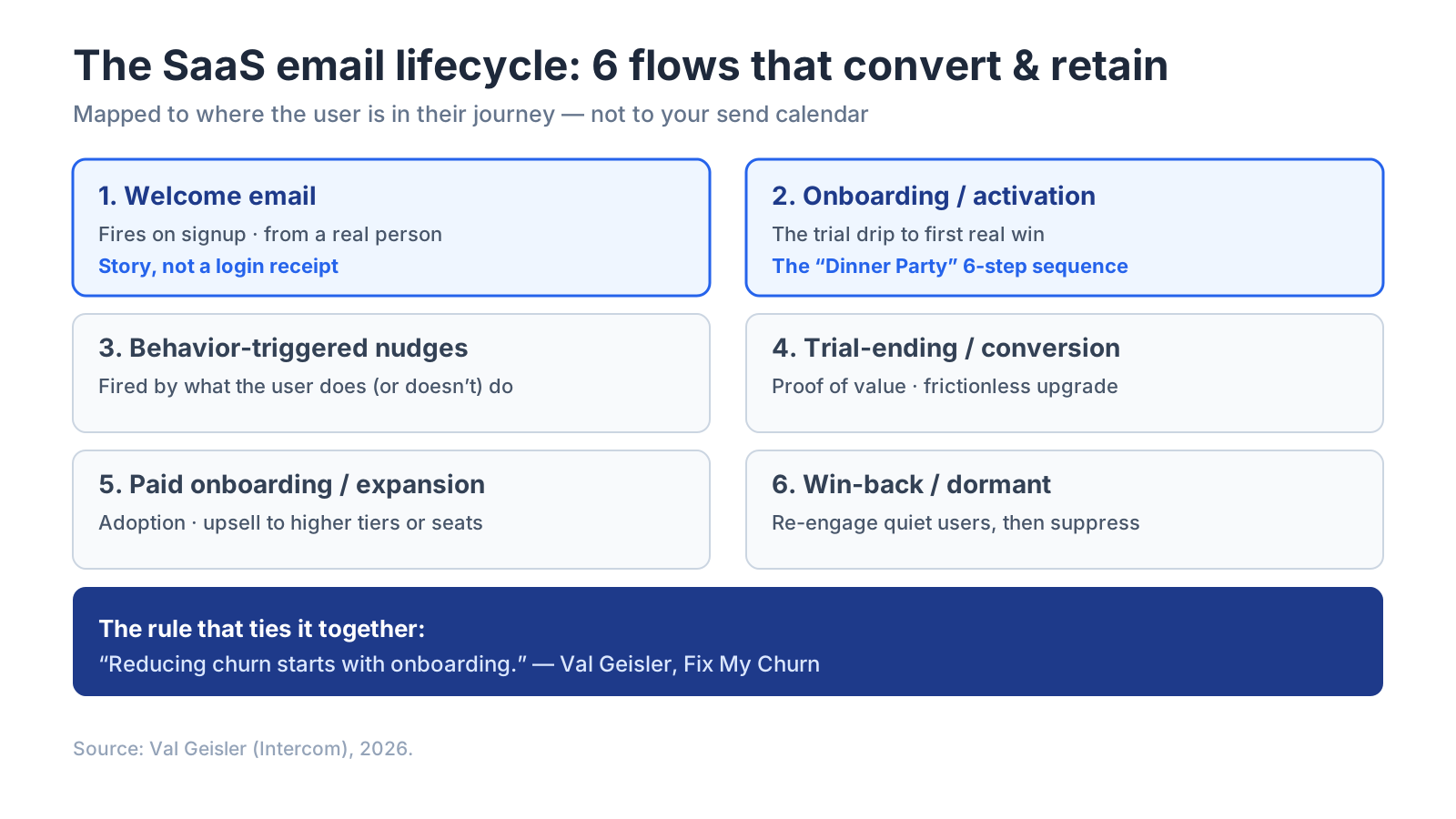
Six lifecycle flows carry a SaaS email program. They map to where a user is in their journey, not to your send calendar.
- Welcome email — fires the moment someone signs up. Not the “here’s your login” receipt — a real email from a person. Geisler is emphatic: it should come “from a person, preferably the founder or CEO… telling a little bit of a story about how the company got started.”
- Onboarding / activation series — the trial drip that walks a user to their first real win. Geisler structures this as the “Dinner Party Strategy”: you don’t shove the main course at guests the second they walk in — you settle them, serve appetizers, then the meal, then dessert. Six steps, layered with behavior-based triggers.
- Behavior-triggered nudges — fired by what the user does (or doesn’t) inside the product. Segment by activity so you’re not sending dessert to someone who hasn’t touched their soup.
- Trial-ending / conversion — the sequence around the trial deadline that handles the upgrade decision, with proof of value and a clear next step.
- Onboarding-for-paid / expansion — once they convert, retention begins. Feature adoption, tips, and upsell to higher tiers or seats.
- Win-back / dormant — re-engages users who’ve gone quiet, then suppresses the truly dead to protect deliverability.
Geisler’s most repeated tactical advice: “Email more often than you think you should. Not enough companies are emailing often enough. But you have to make it personal. You have to make it about them” (Intercom). And flip every product update from features to benefits — “nobody cares about the new dashboard”; they care what it does for them.
How much does SaaS email cost — and which platform?
SaaS has a specific requirement most industries don’t: you send transactional email (password resets, receipts, alerts) and marketing email (onboarding, lifecycle). The honest, by-need breakdown:
Bluey Email — best for running product + marketing email on one bill. Send-based pricing, so storing contacts is free: a free plan (500 contacts / 500 sends), Spark from $7/mo (~$14 to email 10,000 contacts), and Grow at $30/mo with unlimited contacts. Crucially for SaaS, transactional and marketing email run on the same account and invoice, with a built-in CRM and API. Best for founders and small SaaS teams who want lifecycle email without stitching together two vendors. Where it’s not the pick: for the deepest event-based behavioral segmentation, Customer.io goes further.
Customer.io — deepest behavioral / event-triggered messaging. Built around product events and data pipelines, it’s the power tool for SaaS teams with an engineer to wire it up and complex trigger logic. Pricier and steeper to learn; best for scaled products with a dedicated lifecycle operator.
Intercom — best when email lives next to in-app. If your onboarding leans on in-product messages, tooltips, and support chat, Intercom keeps email and in-app in one system. Best for product-led teams who want messaging embedded in the app; email alone is not its strength.
The meta-point: match the tool to your stage. A seed-stage SaaS does not need enterprise event pipelines — it needs a welcome email that sounds human and an onboarding drip that ships this week.
How do I start SaaS email from scratch?
- Connect signups to your tool so every new trial triggers an automation.
- Turn on the welcome email first — from a real person, with a story, not a receipt.
- Build the onboarding drip to one “aha” moment, not a feature tour.
- Add behavior triggers so users who stall get a nudge and users who race ahead get the next step.
- Set up the trial-ending sequence with proof of value and a frictionless upgrade.
- Layer in expansion and win-back as you grow, and audit the whole lifecycle quarterly.
Frequently asked questions
What’s the most important SaaS email? The welcome email — sent from a real person (ideally the founder), telling a short story rather than just handing over login details.
How much can email improve trial conversion? Trial-to-paid rates range from about 18% (opt-in) to 49% (credit-card trials) on average (First Page Sage); a strong onboarding sequence is the main lever for moving users to activation inside that window.
What is the Dinner Party Strategy? Val Geisler’s six-step onboarding framework that paces emails like courses at a dinner party — welcome, appetizers, main, sides, dessert, invite back — layered with behavior-based triggers (Intercom).
Do I need a separate tool for transactional email? Not necessarily. Platforms like Bluey Email run transactional and marketing email on one account, which keeps SaaS billing and deliverability simpler than splitting across two vendors.
What’s the best email platform for SaaS? For deepest event-based behavior, Customer.io; for email beside in-app messaging, Intercom; for running product and marketing email together on predictable send-based pricing, Bluey Email. Match the tool to your stage.
The verdict
For SaaS, email is the highest-leverage channel you own because it works the whole lifecycle — converting trials and cutting churn on every cohort. Start with a human welcome email and an onboarding drip aimed at one activation moment, email more than feels comfortable, and make every message about the user. For the tool: Customer.io for enterprise behavioral depth, Intercom for in-app-plus-email, and Bluey Email for running product and marketing email on one predictable send-based bill. New to the fundamentals? Read the complete email marketing guide and email marketing by industry; comparing tools? See Best Email Marketing Software in 2026. Run a store instead? See email marketing for ecommerce.
— Shivam
Free tools for this
Put this into practice with our free, no-signup tools — everything runs in your browser:
Browse all 15 free tools →
1 thought on “Email Marketing for SaaS in 2026: Onboarding, Lifecycle & Retention”