
Quick answer: An abandoned cart email is an automated reminder sent to a shopper who added items to their cart but left without buying. It’s the single highest-earning automation in ecommerce: across 143K+ flows, abandoned cart emails drove the highest revenue per recipient of any flow at $3.65 (top 10% of brands: $28.89), with a 50.5% average open rate (Klaviyo 2024 Benchmark Report). Since roughly 70% of online carts are abandoned (Baymard Institute), recovering even a slice is real money. Full disclosure: Bluey Email is my own product; the tactics below work on any platform.
Seven in ten shoppers who fill a cart walk away — but many just got distracted, not turned off. A well-timed reminder brings a big share of them back. This guide covers what to send, when to send it, the benchmarks to aim for, and how to build the flow.
Why do abandoned cart emails work so well?
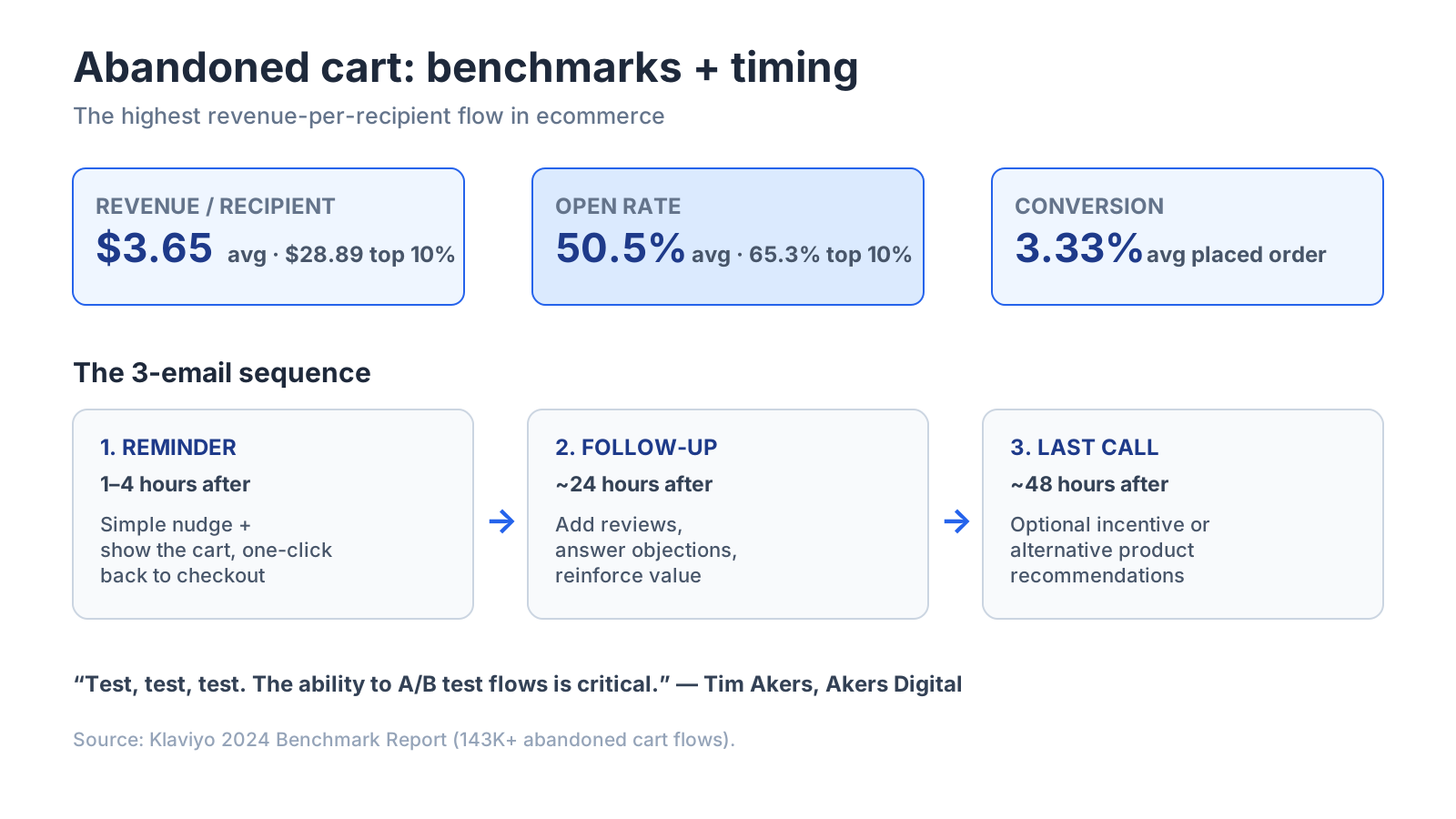
Because the shopper already showed intent. Adding to cart is the strongest buying signal short of checkout, so a reminder meets a warm lead, not a cold one — which is why abandoned cart flows post the highest revenue per recipient of any automated flow ($3.65 average, 37.7% higher than the next-best flow) (Klaviyo). Open rates run about 50.5% on average and 65.3% for the top 10% of brands (Klaviyo), roughly triple a normal campaign.
The recovery opportunity is enormous because abandonment is the norm: the average documented cart abandonment rate is about 70%, based on a meta-analysis of 49 studies (Baymard Institute). Every recovered cart is revenue you’d otherwise have lost after already paying to acquire the visitor.
When should each abandoned cart email send?
Timing is the biggest lever, and a three-email sequence outperforms a single reminder. Klaviyo’s own recommended cadence is a simple reminder 2–4 hours after abandonment, a follow-up after ~24 hours, and a final message around 48 hours (Klaviyo):
| Timing | Job | |
|---|---|---|
| 1. Reminder | 1–4 hours after | Simple nudge: “You left something behind” + cart contents |
| 2. Follow-up | ~24 hours after | Add reviews, answer objections, reinforce value |
| 3. Last call | ~48 hours after | Optional incentive or alternative product recommendations |
The exact best window varies by brand — which is exactly why testing matters. As Tim Akers, founder of Akers Digital, puts it in Klaviyo’s report: “Test, test, test. The ability to A/B test flows is critical. Test out different offers and the timing of the sequence to see what version works best for your brand” (Klaviyo).
What should an abandoned cart email say?
Each email has one job; together they rebuild momentum:
Show the cart. Display the exact products left behind, with images, and a one-click link straight back to checkout. Reducing friction is the whole point.
Personalize the subject line. Klaviyo recommends including the shopper’s first name and cart details — a strong subject line is what earns that 50%+ open rate. (See our email subject line formulas guide.)
Handle objections. Add reviews, a shipping/returns reassurance, or an FAQ in email two — often the block isn’t price, it’s doubt.
Use incentives carefully. A discount works, but Klaviyo warns it can “train shoppers to wait for a discount before buying” (Klaviyo). Reserve incentives for higher-value carts or the final email.
Should I use a discount in every abandoned cart email?
No. Discounting every cart erodes margin and teaches customers to abandon on purpose to trigger a coupon. Segment instead: send the reminder and objection-handling emails with no discount, and only introduce an incentive on the final email or for high-value carts where the recovered revenue justifies it. Test discount vs. no-discount, since some brands recover just as well by removing friction and adding reassurance.
How do I set up abandoned cart emails in Bluey?
The flow depends on real-time store events, so a native store integration beats middleware here. Connect Bluey to your store with the native Shopify or WooCommerce integration so cart events fire instantly — a polling tool like Zapier can lag minutes, and for cart recovery minutes cost conversions. Then build a three-email automation triggered by “cart abandoned,” set the delays above, and let it run. Bluey’s Business plan ships with pre-built ecommerce flows, including abandoned cart, so you can start from a template. New to store email? See email marketing for ecommerce.
Frequently asked questions
How many abandoned cart emails should I send? Three is the common sweet spot — a reminder, a follow-up, and a last call. Multi-email sequences recover materially more than a single reminder (Klaviyo).
When should the first email send? Within a few hours — Klaviyo suggests 2–4 hours, and testing earlier (30–60 minutes) often lifts conversion. Test it for your brand.
What open rate is good for abandoned cart emails? About 50% on average, up to ~65% for top performers (Klaviyo).
Do I need a discount? No — reserve incentives for the final email or high-value carts to protect margin (Klaviyo).
Why use a native integration instead of Zapier? Cart events must fire in real time; native Shopify/WooCommerce connections avoid the polling delay that makes recovery emails fire late.
The verdict
The abandoned cart email is the highest-ROI automation in ecommerce because it meets a shopper who already wanted to buy. Send three: a fast reminder, an objection-handling follow-up, and a last call with an optional incentive — and, in Tim Akers’s words, test the offers and timing relentlessly. Wire it to a real-time store integration so it fires the moment a cart is left. Build the full picture with email marketing for ecommerce, sharpen your opens with email subject line formulas, and start from the complete email marketing guide.
— Shivam
Free tools for this
Put this into practice with our free, no-signup tools — everything runs in your browser:
Browse all 15 free tools →Need the actual copy? See our 4 abandoned cart email templates you can copy.
1 thought on “Abandoned Cart Email: Templates, Timing & Benchmarks (2026)”