
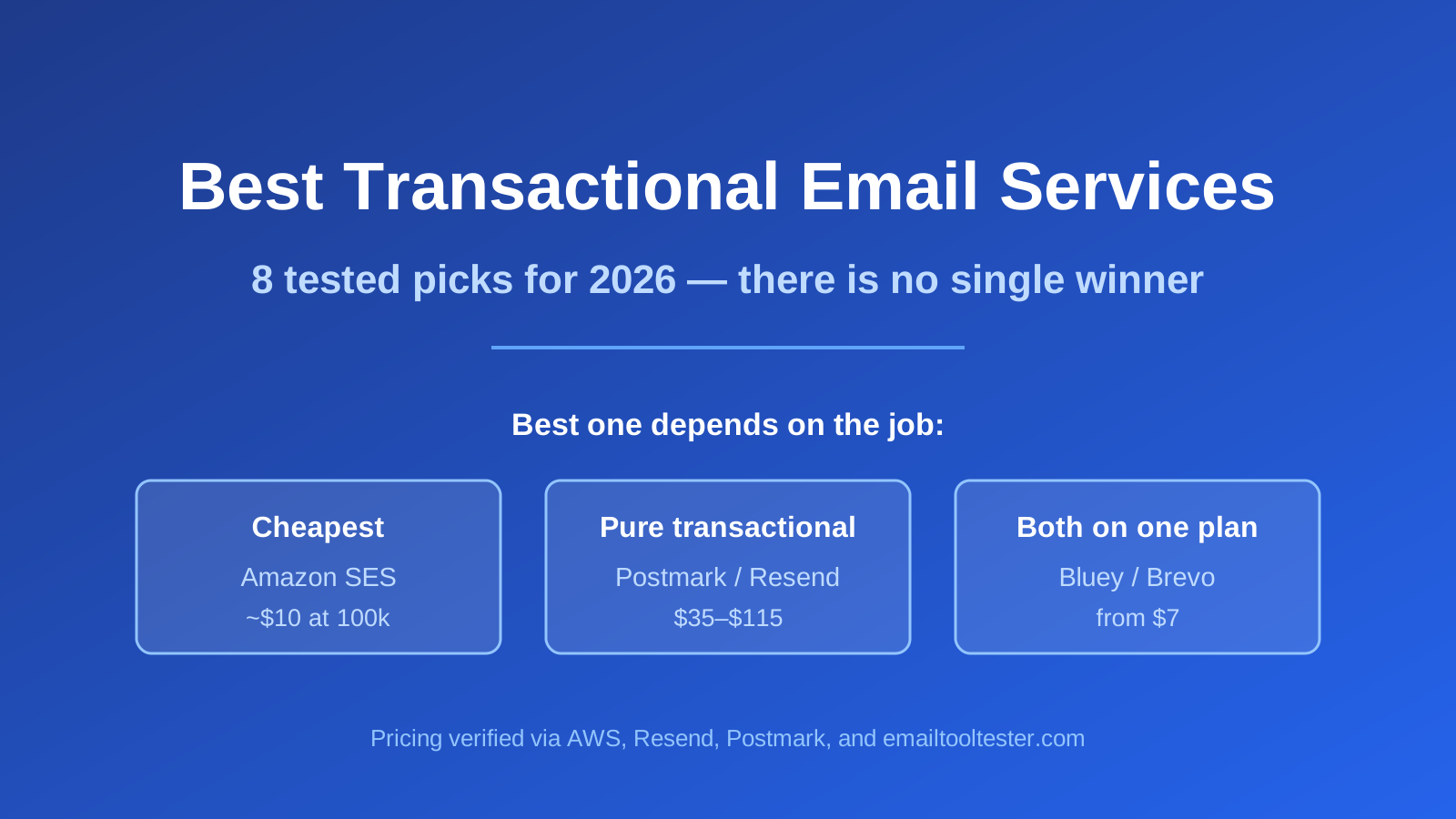
Quick answer: There’s no single best transactional email service — there’s a best one for your job. For the cheapest raw sending, Amazon SES is about $10/mo at 100,000 emails (AWS). For pure transactional reliability and developer experience, Postmark ($115/mo at 100k) and Resend ($35/mo at 100k) lead. For sending transactional and marketing email on one plan, Bluey Email and Brevo bundle both. The one rule everyone agrees on: keep transactional and bulk mail on separate streams — Gmail “recommends that you separate mail by purpose as much as possible” (Postmark). Written with AI assistance and reviewed against primary sources.
Full disclosure: Bluey Email is my own product, and it’s on this list. I’ve held it to the same yardstick as everything else, named exactly where each competitor beats it, and cited third parties — not myself — for the competitive claims. Read it with that bias in mind.
What is a transactional email service?
A transactional email is a one-to-one message triggered by an action: a password reset, a receipt, a shipping notice, a verification code. Because people are waiting for them, they get read — password resets see roughly 70% open rates versus 10–20% for promotional email (Postmark). A transactional email service is the infrastructure that sends those reliably and fast, usually via API or SMTP, separate from your marketing blasts.
The reason to separate them isn’t stylistic. Mixing streams can get your critical mail “classified all as bulk email,” and Gmail officially “recommends that you separate mail by purpose as much as possible” — ideally by subdomain, not just by tool (Postmark). Worth being precise about what that advice means: it’s about separating streams and reputations, not necessarily separate vendors or bills. A tool that keeps transactional and marketing on distinct streams under one account satisfies it just fine.
The 8 best transactional email services
1. Bluey Email — best if you send transactional and marketing
Who it’s for: the common real case — a company that sends receipts and newsletters and is tired of running two products and paying two bills.
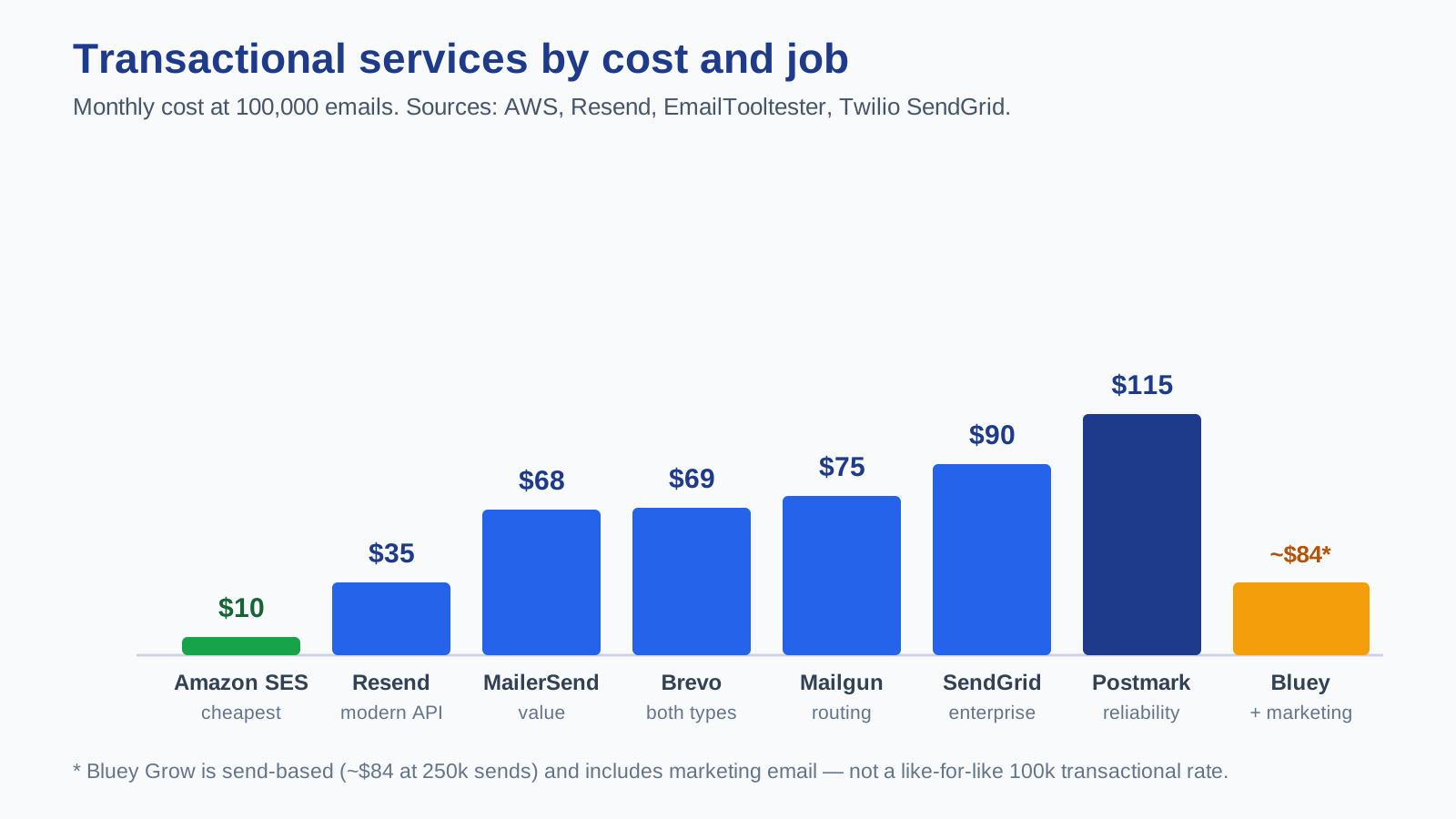
Bluey bills on sends, not contacts: Free at 500 sends/mo permanently, Spark from $7/mo (about $14 at 10,000 sends), Grow at $30/mo with unlimited contacts around 50,000 sends (about $84 at 250,000, about $180 at 1M), and Business at $300/mo adding a built-in CRM, landing pages and pre-built ecommerce flows.
Why it’s ranked first: one specific, checkable reason — most teams that need transactional email also send marketing email, and Bluey is the option here that puts both on one plan without a second product. While writing this I validated a live transactional payload against Bluey’s API (it returned a valid result) on a key that also carries campaigns:write and crm:write scopes — genuinely one credential for both jobs.
Where competitors beat it — plainly: if you send only transactional email, this isn’t the deciding feature and you should weigh Postmark or SES on their merits. Postmark has a longer transactional-only track record; Amazon SES is far cheaper at raw volume; Resend has the slicker developer API.
2. Postmark — best for pure transactional reliability
Who it’s for: teams for whom a late receipt or reset is unacceptable. Pricing (EmailTooltester): 100 emails free · 10k $15/mo · 50k $55/mo · 100k $115/mo. Postmark’s Message Streams are the cleanest implementation of the stream separation Gmail recommends, and you get “full access to almost all of Postmark’s features at every pricing tier” (Postmark, EmailTooltester). If transactional email is the whole job, this is the specialist. Where others win: price — it’s “one of the more expensive email delivery services in the market” at $115 vs SES’s $10 at 100k.
3. Amazon SES — best for the cheapest high volume
Who it’s for: engineering teams that want near-cost sending and can run the complexity. Pricing (AWS): $0.10 per 1,000 emails — about $1 at 10k, $5 at 50k, $10 at 100k — plus $0.12/GB of attachments. Free tier is 3,000 message charges/month for the first 12 months only, and it bills per recipient. Nothing beats it on price. The tax is real: “despite its name, the Amazon SES isn’t that simple to use,” and support is a separate paid plan (EmailTooltester). Where others win: ease of use and included support.
4. Resend — best modern developer API
Who it’s for: developers who want a clean API and React Email for their transactional mail. Pricing (Resend): Free 3,000/mo (100/day, one domain) · Pro $20/mo at 50k · $35/mo at 100k. Resend is the nicest pure-transactional developer experience of the newer generation. The gap is automation — “there’s no visual editor to set up automations; instead, you need to code them” (EmailTooltester) — and marketing is priced as a separate contacts-based product (Resend). Where others win: SES on price, Bluey and Brevo on unified marketing.
5. SendGrid — best for enterprise scale
Who it’s for: large senders who want Twilio-backed infrastructure. Pricing (Twilio SendGrid): 60-day trial at 100/day, Essentials from $19.95/mo, Pro from $89.95/mo. Note SendGrid “bills for transactional and marketing emails as separate products,” which can make billing “more complicated” (EmailTooltester). Where others win: SES on price; Postmark on all-features-every-tier.
6. Brevo — best low-cost transactional and marketing
Who it’s for: small teams that want both kinds of email cheaply. Pricing (EmailTooltester): ~9,000 emails/mo free (300/day cap), around $69/mo at 100k, marketing plans include transactional. Caveat: no native email validation. Where others win: SES on raw price; Postmark on transactional depth.
7. Mailgun — best for routing and validation
Who it’s for: teams needing inbound routing, validation and deliverability tooling. Pricing (EmailTooltester): about $35/mo at 50k, $75/mo at 100k; no forever-free plan. Where others win: Resend and Bluey on ease; SES on price.
8. MailerSend — best value transactional with templates
Who it’s for: teams that want Postmark-style ease at a lower volume price, with drag-and-drop templates. Pricing (EmailTooltester): free tier for light use, about $68/mo at 100k — cheaper than Postmark, pricier than SES. Where others win: SES on price; Postmark on pedigree.
Transactional email services compared
| Service | Free tier | ~100k emails/mo | Best for |
|---|---|---|---|
| Bluey Email | 500 sends/mo | ~$84 (incl. marketing) | Transactional + marketing, one plan |
| Postmark | 100 emails | $115 | Pure transactional reliability |
| Amazon SES | 3k/mo, 12 months | ~$10 | Cheapest at volume |
| Resend | 3k/mo (100/day) | $35 | Modern developer API |
| SendGrid | 60-day trial | ~$90 (Pro) | Enterprise scale |
| Brevo | ~9k/mo (300/day) | ~$69 | Low-cost both types |
| Mailgun | none (trial) | ~$75 | Routing + validation |
| MailerSend | yes | ~$68 | Value + templates |
How to choose a transactional email service
Decide on three axes. Price: if it’s all that matters, Amazon SES wins outright. Scope: if you send only transactional email, pick a specialist — Postmark for reliability, Resend for the API. Breadth: if you also send marketing email and don’t want a second product, Bluey or Brevo put both on one plan. Then, whichever you choose, keep transactional and bulk mail on separate streams — that’s the one thing every provider and Gmail agree on (Postmark). More detail in the complete transactional email guide.
Frequently asked questions
What’s the cheapest transactional email service? Amazon SES at about $0.10 per 1,000 emails — roughly $10 at 100,000 — though you trade away ease of use and included support (AWS).
What’s the best transactional email service for developers? Resend for a modern API and React Email, or Postmark for reliability and documentation. Amazon SES is cheapest if you can run it yourself (Resend, EmailTooltester).
Should transactional and marketing email use the same service? They can share a service, but they should use separate streams and reputations. Gmail “recommends that you separate mail by purpose as much as possible” (Postmark). Tools like Bluey and Postmark keep both under one account on distinct streams.
Do transactional emails really get opened more? Yes — password resets see around 70% open rates versus 10–20% for promotional email, because recipients are actively waiting for them (Postmark).
For a closer look at how Bluey stacks up head-to-head, see Bluey Email vs Postmark, Bluey Email vs Resend, and Bluey Email vs SendGrid.
References
- Amazon SES pricing — aws.amazon.com/ses/pricing
- EmailTooltester, SendGrid alternatives (Inka Wibowo & Robert Brandl) — emailtooltester.com
- Postmark, transactional vs marketing email (Steph Knapp) — postmarkapp.com
- Resend pricing — resend.com/pricing
- Twilio SendGrid pricing — twilio.com
Related reading: the complete transactional email guide, Resend alternatives, Amazon SES alternatives, SendGrid alternatives, and the pillar guide to the best email marketing software.
— Shivam
What it costs per thousand emails: Email API pricing compared.
What SendGrid actually costs, including overage: SendGrid pricing explained.
2 thoughts on “8 Best Transactional Email Services in 2026 (Tested & Compared)”