
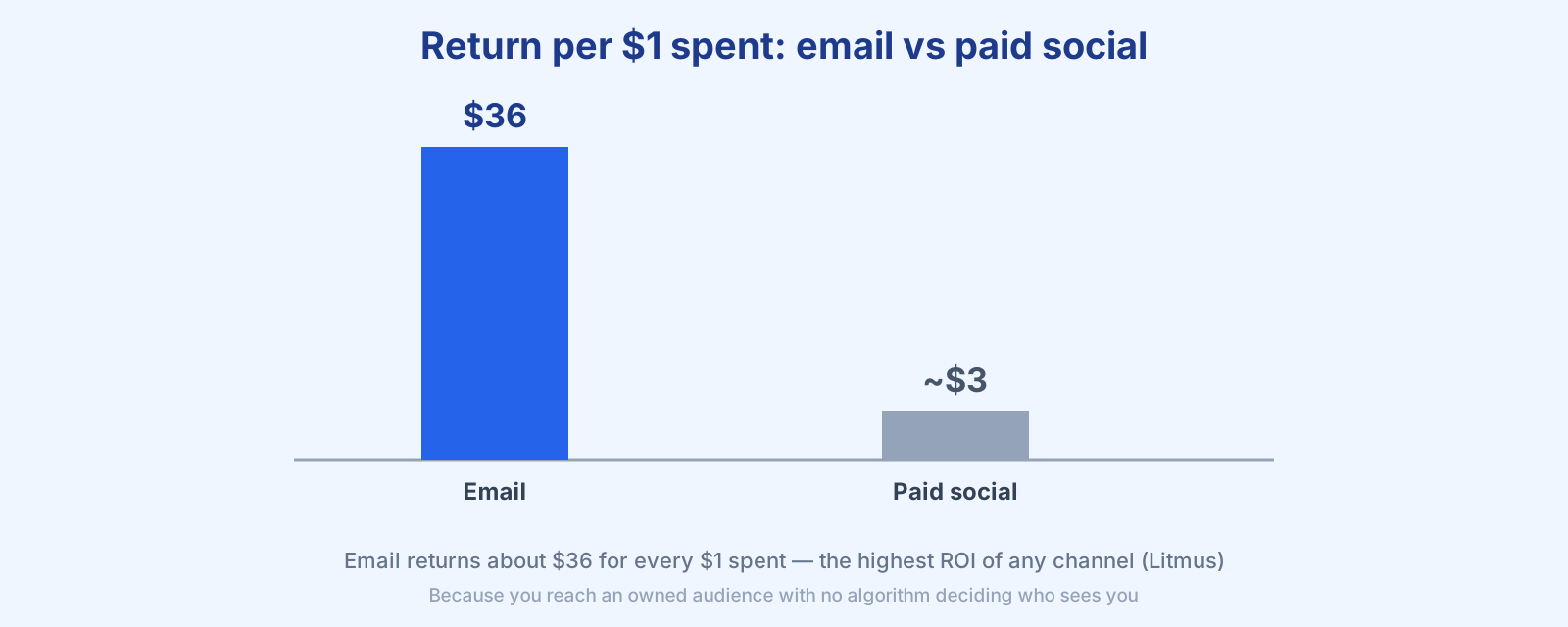
Quick answer: Email marketing returns about $36 for every $1 spent — the highest ROI of any channel (Litmus) — because you reach an audience you own, with no algorithm deciding who sees you. For a small business the winning moves are simple: build a permission-based list, send a welcome series, segment, and keep a steady cadence. You can start for free.
Email is the most cost-effective channel a small business has, and it is not close. Yet most owners either never start or send sporadically and give up. This guide covers what actually moves the needle — without jargon, and without a big budget.
Disclosure: Bluey Email, mentioned near the end, is my own product; the advice here is platform-agnostic and applies whatever tool you choose.
Why email beats social for small businesses
The reason is structural, not magical: with email you reach an owned audience. A social follower is rented — the platform’s algorithm decides how many of your followers ever see a post, and organic reach on the big networks is now a small single-digit percentage. An email subscriber is yours: when you hit send, it goes to everyone on the list. That is why Litmus continues to measure email’s return at roughly $36 per $1 spent, higher than any other channel. It is also durable — that figure has held steady through the rise of social, mobile and AI.
What should a small business actually send?
Start with three things, in order. First, a welcome email series — the automated messages a new subscriber gets after signing up. They are opened more than any other email you will send, so they are where trust is won. Second, a regular newsletter at a cadence you can sustain (weekly or monthly beats daily-then-nothing). Third, segmentation: send different messages to different groups rather than one blast to everyone. For a benchmark, Mailchimp’s data puts the all-industry average open rate at 35.63% and click rate at 2.62% — a useful yardstick once you are sending, but do not obsess over it early. Our email marketing metrics guide explains which numbers matter.
Build your list the right way
Never buy a list — it wrecks your deliverability and breaks the law in most places. Instead, collect subscribers with permission: a signup form on your site, a lead magnet (a discount, a checklist, a short guide), and a clear promise of what they will get. Our full walk-through is in how to build an email list. Quality beats quantity every time: 300 people who asked to hear from you outperform 3,000 who did not.
Choosing a platform on a budget
You do not need to pay to start. Most major tools have a free tier — and for a general small business, EmailTooltester’s Sarah Baxter and Inka Wibowo note that “Mailchimp is better if you’re a small business wanting to build your list, reach them with a welcome series and other basic flows, with a gentle learning curve.” Compare free options in our best cheap email service round-up. Bluey Email, for transparency, offers a free plan (500 contacts, 500 sends) and a $7/mo Spark plan — useful if you want a CRM and email in one place — but the right pick depends on your goals; a store on Shopify may be better served by an ecommerce-native tool, and a pure newsletter by a newsletter platform.
A four-step starter plan
- Pick a free tool and verify your domain (SPF and DKIM) so your mail reaches inboxes.
- Add a signup form to your website and offer one clear reason to subscribe.
- Write a three-email welcome series that introduces you and delivers on the promise.
- Send one useful newsletter on a fixed schedule and review opens, clicks and unsubscribes each time.
Frequently asked questions
Is email marketing worth it for a very small business? Yes — arguably more so, because the ROI is high and the cost can be zero to start. An owned list is one of the few marketing assets a small business fully controls.
How often should a small business email? Choose a cadence you can keep — weekly or monthly is plenty. Consistency matters more than frequency, and a predictable rhythm protects your sender reputation.
Do I need to pay for an email tool? Not to begin. Several platforms have genuine free tiers; upgrade only when your list or sending outgrows them.
Can I just buy an email list to get started faster? No. Purchased lists tank your deliverability, generate spam complaints, and violate laws like GDPR and CAN-SPAM. Always collect subscribers with permission.
References
- Litmus — Email Marketing ROI: https://www.litmus.com/resources/email-marketing-roi
- Sarah Baxter & Inka Wibowo, EmailTooltester — Klaviyo vs Mailchimp: https://www.emailtooltester.com/en/blog/klaviyo-vs-mailchimp/
- Mailchimp — Email marketing benchmarks: https://mailchimp.com/resources/email-marketing-benchmarks/
— Shivam