
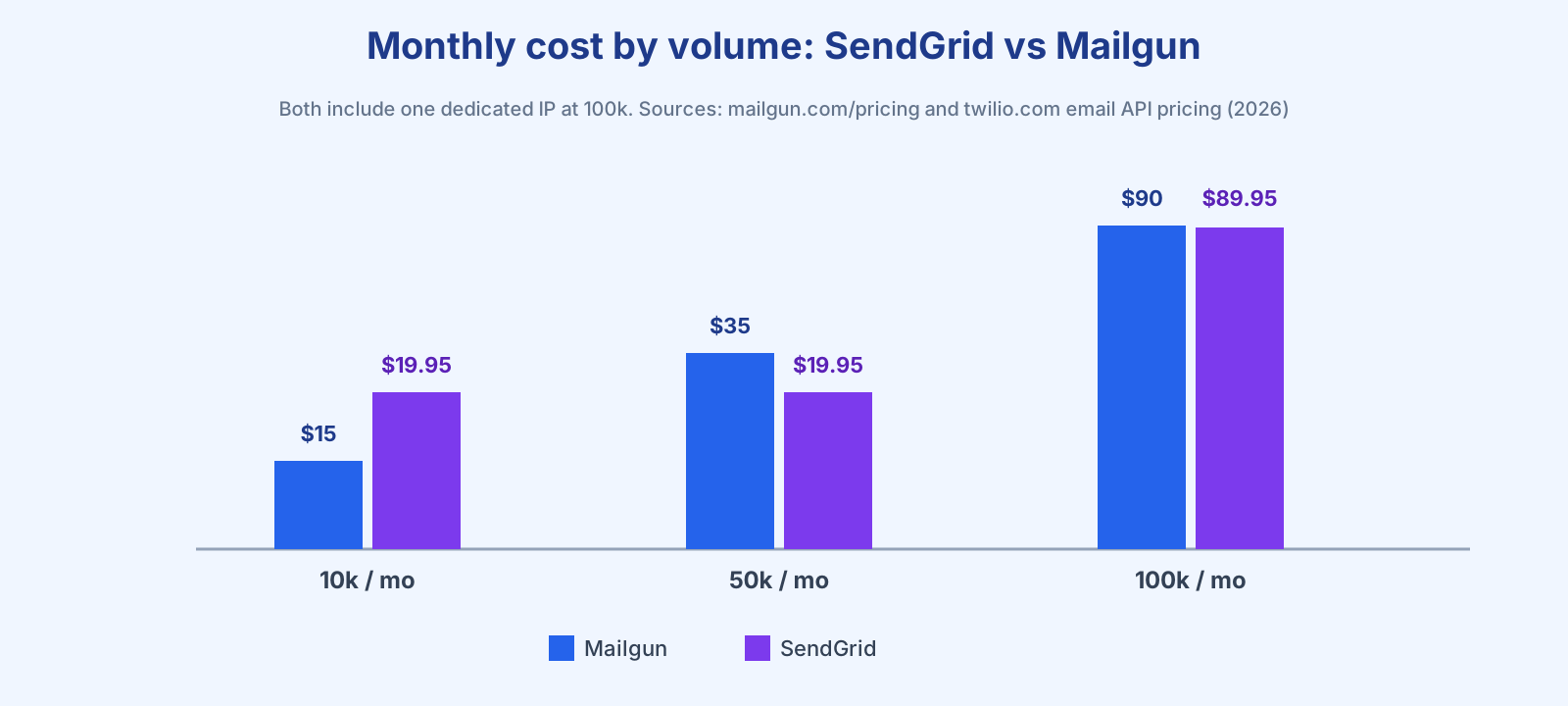
Quick answer: Mailgun has a permanent free tier (100 emails/day) and cheaper entry — $15/mo for 10,000 emails — while SendGrid’s free option is only a 60-day trial, but its Essentials plan gives far more volume at $19.95/mo for 50,000. At 100,000 emails they converge: Mailgun Scale is $90/mo and SendGrid Pro is $89.95/mo, both with one dedicated IP included. Both offer an HTTP API and SMTP (Mailgun, Twilio).
SendGrid and Mailgun are the two default answers when a developer needs to send transactional email — password resets, receipts, notifications — at scale. They look similar on paper. The differences that matter are the free tier, the entry price, and how each one treats data residency and billing. Here is the 2026 comparison, with every figure taken from the vendors’ own pricing pages.
Disclosure: Bluey Email, mentioned near the end, is my own product; it is judged on the same criteria as both services here.
SendGrid vs Mailgun at a glance
| Mailgun | SendGrid | |
|---|---|---|
| Free option | Permanent: 100 emails/day | Trial only: 100/day for 60 days |
| Entry paid plan | Basic: $15/mo for 10,000 | Essentials: $19.95/mo for 50,000 |
| At 100,000/mo | Scale: $90/mo (1 dedicated IP) | Pro: $89.95/mo (1 dedicated IP) |
| Extra dedicated IP | $59/mo | Available on Pro/Premier |
| Sending methods | HTTP API + SMTP | HTTP API + SMTP |
| Owner / data | Sinch; choose US or EU region | Twilio |
Free plans and pricing
This is the clearest split. Mailgun keeps a genuine free plan — 100 emails a day, no credit card, one custom domain — confirmed on mailgun.com/pricing. SendGrid no longer has a permanent free plan; its pricing page now offers a Free Trial of 100 emails/day for 60 days, after which you must pay. If you want to run a small side project forever at no cost, that difference decides it.
On paid plans the winner flips by volume. Mailgun’s Basic is cheaper in absolute terms ($15/mo) but only includes 10,000 emails, with overages from $1.80 per 1,000. SendGrid’s Essentials costs a little more ($19.95/mo) but bundles 50,000 — five times the volume — so past about 10,000 sends SendGrid is often cheaper per email. By 100,000 they are effectively level: Mailgun Scale at $90/mo (with one dedicated IP and 5,000 email validations) versus SendGrid Pro at $89.95/mo (with one dedicated IP). Additional dedicated IPs on Mailgun cost $59/mo each.
API, SMTP and data residency
Both give you an HTTP API and an SMTP relay, so you can integrate either way. Mailgun’s own guidance is worth quoting because it applies to both: “SMTP is easy to setup and often plug and play, but API is much more reliable at scale. If you’re building an application, we recommend using our HTTP API.” For a deeper look at that choice, see SMTP vs email API.
The quieter differentiator is data residency. Mailgun (now part of Sinch) lets you send from US or EU infrastructure on a single account, which matters for GDPR-bound senders. SendGrid is part of Twilio, which is convenient if you already send SMS or voice through Twilio and want one vendor across channels. For the wider field, see our SendGrid alternatives and Mailgun alternatives, and the developer-focused best email API round-up.
Which should you pick?
Pick Mailgun if you want a permanent free tier, EU data residency, or the lowest absolute entry price for low volumes. Pick SendGrid if you send 50,000+ transactional emails a month (its Essentials volume is hard to beat) or you already live in the Twilio ecosystem for SMS and voice.
One caveat sits above both: they are pure transactional senders. If you also run marketing campaigns, you will end up buying and billing that separately. As EmailTooltester’s Inka Wibowo and Robert Brandl put it about SendGrid, “SendGrid bills for transactional and marketing emails as separate products. As a result, you’d potentially need to pay more to send both types of emails.” Bluey Email takes the opposite approach — transactional and marketing on one bill, alongside a CRM — which is the specific case where it wins; for pure high-volume developer sending, Mailgun and SendGrid remain the sharper tools. See our transactional email guide and Bluey Email vs SendGrid for the full picture.
Frequently asked questions
Is Mailgun or SendGrid cheaper? Mailgun is cheaper at low volumes and has a permanent free tier; SendGrid is often cheaper per email from about 10,000 to 50,000 sends because Essentials bundles 50,000 for $19.95/mo. At 100,000 they are near-identical (~$90/mo).
Does SendGrid still have a free plan? Not a permanent one. Its current free option is a 60-day trial of 100 emails/day; after that a paid plan is required. Mailgun’s 100/day free plan has no time limit.
Do both support SMTP as well as an API? Yes. Both offer an HTTP API and an SMTP relay. Mailgun and others recommend the API for reliability at scale, with SMTP handy for quick or legacy integrations.
Can I send marketing campaigns through them? They are built for transactional email. Marketing is a separate product and bill on SendGrid, so all-in-one platforms can be cheaper if you need both streams.
References
- Mailgun — Pricing: https://www.mailgun.com/pricing/
- Twilio SendGrid — Email API pricing: https://www.twilio.com/en-us/products/email-api/pricing
- Inka Wibowo & Robert Brandl, EmailTooltester — SendGrid alternatives: https://www.emailtooltester.com/en/blog/sendgrid-alternatives/
— Shivam
What it costs per thousand emails: Email API pricing compared.
What SendGrid actually costs, including overage: SendGrid pricing explained.