

Quick answer: Connecting Bluey Email to Zapier lets your email platform talk to the long tail of apps that don’t have a native integration — your billing system, a webinar tool, a Google Sheet, a Slack channel, a scheduler — with no code. Zapier connects 8,000+ apps and is used by over 3 million people (Zapier), which makes it the universal glue for any stack. Full disclosure: Bluey Email is my own product; I flag plainly below where a native integration or the direct API beats Zapier.
No email platform integrates natively with everything. Zapier is the pressure-release valve for the thousands of tools nobody builds a native connector for. This guide covers what the Bluey + Zapier integration does, how to set up your first Zap, the automations worth building, and — honestly — when you should not use Zapier at all.
What does the Bluey + Zapier integration do?
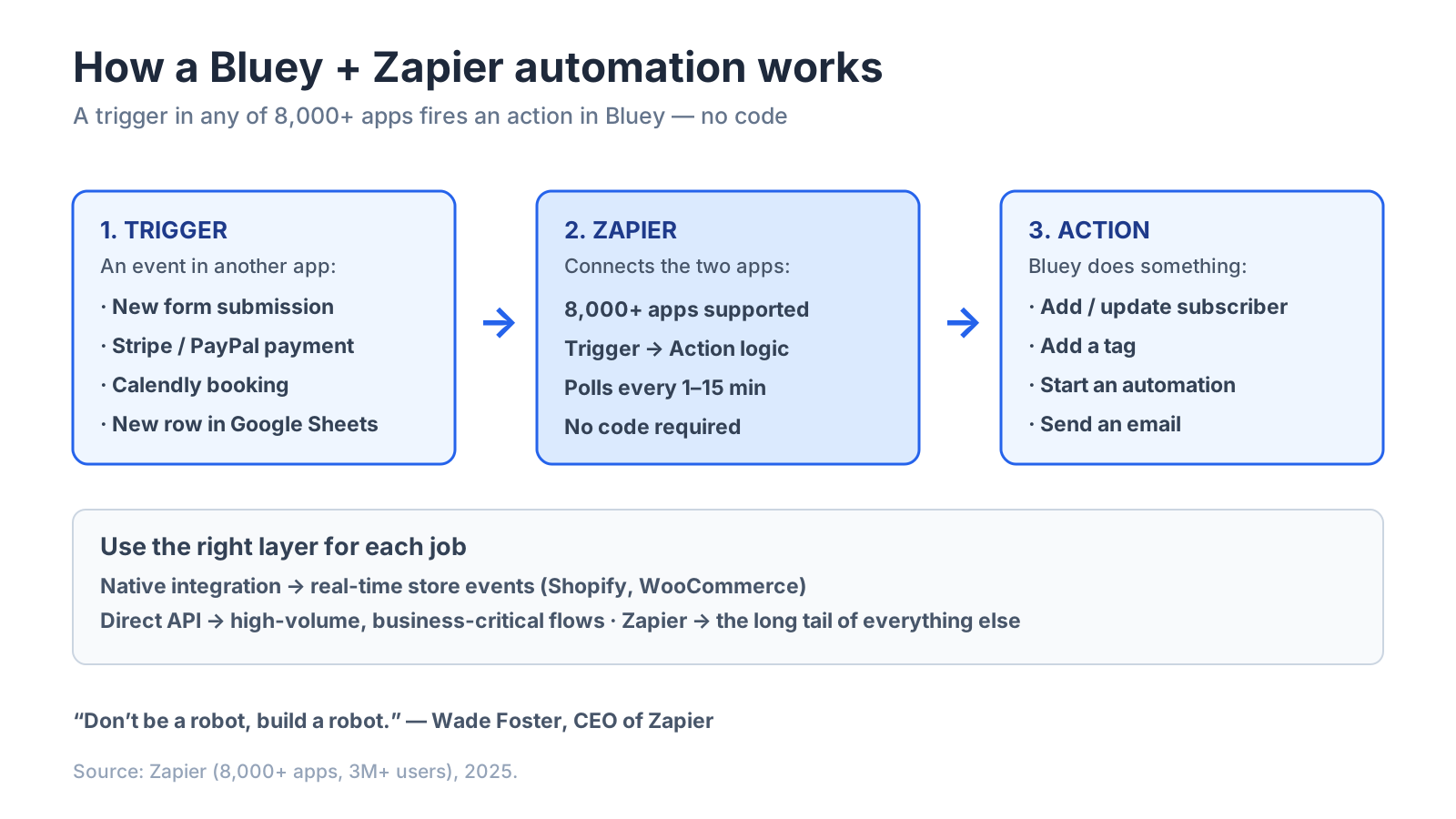
It connects Bluey to any of Zapier’s 8,000+ supported apps using a simple trigger → action model: an event in one app automatically causes an action in another, with no code. A new form submission adds a subscriber to Bluey; a new Bluey subscriber posts an alert to Slack; a Stripe payment tags a contact and starts a flow.
Zapier’s own CEO Wade Foster describes the value plainly: automation lets you “take some of this mundane stuff that you’re doing every day… and allow you to focus on the creative parts of your job, focus on the things that really deliver value, and leave the stuff that computers are good for to the computers” (How to Be Awesome at Your Job). His company mantra captures it in five words: “Don’t be a robot, build a robot.”
The scale is why this matters: Zapier serves over 3 million users and more than 100,000 paying customers (Zapier statistics, 2025), and roughly 69% of Fortune 1000 companies use it in their stacks. If a tool exposes solid Zapier triggers and actions — as Bluey does — it can effectively connect to anything you already run.
How do I set up my first Bluey + Zapier automation?
A Zap takes minutes to build:
- Create a Zapier account and click Create Zap.
- Pick your trigger app and event — for example, “New submission” in Typeform, or “New payment” in Stripe.
- Connect Bluey as the action app using your Bluey API key, and choose the action — add or update a subscriber, add a tag, or start an automation.
- Map the fields so the trigger’s data (name, email, purchase amount) lands in the right Bluey fields.
- Test and turn on. Zapier runs the test, and once it passes, your automation runs in the background.
The trigger/action logic is deliberately simple — Foster notes many use cases are “out-of-the-box where you don’t even have to understand what a trigger and action is.”
Which Bluey + Zapier automations are worth building?
The most valuable Zaps close gaps a native integration doesn’t cover:
Form-to-list capture — push subscribers from Typeform, Google Forms, or a webinar tool straight into the right Bluey segment with tags applied, so the welcome flow fires automatically.
Payment-triggered flows — when Stripe, PayPal, or a billing tool records a payment, tag the contact and start a post-purchase or onboarding flow.
Internal alerts — post a Slack or email alert to your team when a VIP subscribes, a big order lands, or a key automation completes.
Cross-tool sync — log new subscribers to a Google Sheet or Airtable, or sync contact data with tools outside your CRM.
Scheduling and events — when someone books via Calendly, add them to a segment and trigger a reminder sequence.
When should I NOT use Zapier?
This is the honest part, and it’s where Zapier is not the right tool. Zapier is middleware — it sits between two apps — so it introduces three trade-offs:
Lag. Zaps run on a polling schedule (as often as every 1–2 minutes on paid plans, up to every 15 minutes on lower tiers), so a Zapier-driven “abandoned cart” email can fire minutes late — and for cart recovery, minutes cost conversions. Use Bluey’s native Shopify or WooCommerce integration for real-time store events instead.
Cost at volume. Zapier bills per task (each action run), so a high-volume sync — thousands of contacts a day — gets expensive fast compared with a native connector or the API.
Fragility. Complex multi-step Zaps get hard to debug and break silently when an app changes its API.
The rule of thumb: native for your core, real-time systems; the direct API for high-volume, business-critical flows; Zapier for the long tail of everything else. That layered approach is exactly the “experiment at low risk” posture the complete integrations guide recommends.
| Connection method | Speed | Best for |
|---|---|---|
| Native integration | Real-time | Core systems (store, CRM) |
| Direct API / webhooks | Real-time | High-volume, custom, business-critical |
| Zapier / Make | Polling (minutes) | The long tail of apps with no native connector |
Frequently asked questions
Does Bluey have a Zapier integration? Yes. Bluey exposes triggers (new subscriber, tag added) and actions (add/update subscriber, tag, start automation) on Zapier, so it can connect to any of Zapier’s 8,000+ apps.
How many apps can Bluey reach through Zapier? Zapier connects 8,000+ apps (Zapier), so any of them can be wired to Bluey without code.
Is Zapier free? Zapier has a free tier for basic single-step Zaps; multi-step Zaps and faster update times require a paid plan billed per task.
Should I use Zapier for abandoned cart emails? No — use Bluey’s native Shopify or WooCommerce integration for real-time cart events. Zapier’s polling delay can make recovery emails fire minutes late.
What’s the difference between Zapier and Make? Both are no-code automation middleware; Make offers more visual, complex multi-step scenarios, while Zapier has the larger app directory. Bluey works with both.
The verdict
Zapier is the universal glue that lets Bluey connect to the 8,000+ apps no one builds a native connector for — form tools, billing systems, schedulers, Slack, spreadsheets — with no code. Use it for the long tail, and heed the trade-offs: for real-time store events, use Bluey’s native Shopify and WooCommerce integrations; for high-volume, business-critical syncs, use the direct API. Build the right layer for each job, and, in Foster’s words, don’t be a robot — build a robot. New here? Start with the complete email marketing integrations guide; comparing platforms? See Best Email Marketing Software in 2026 and the complete email marketing guide.
— Shivam
3 thoughts on “Bluey + Zapier Integration: Connect Email to 8,000+ Apps (2026)”