
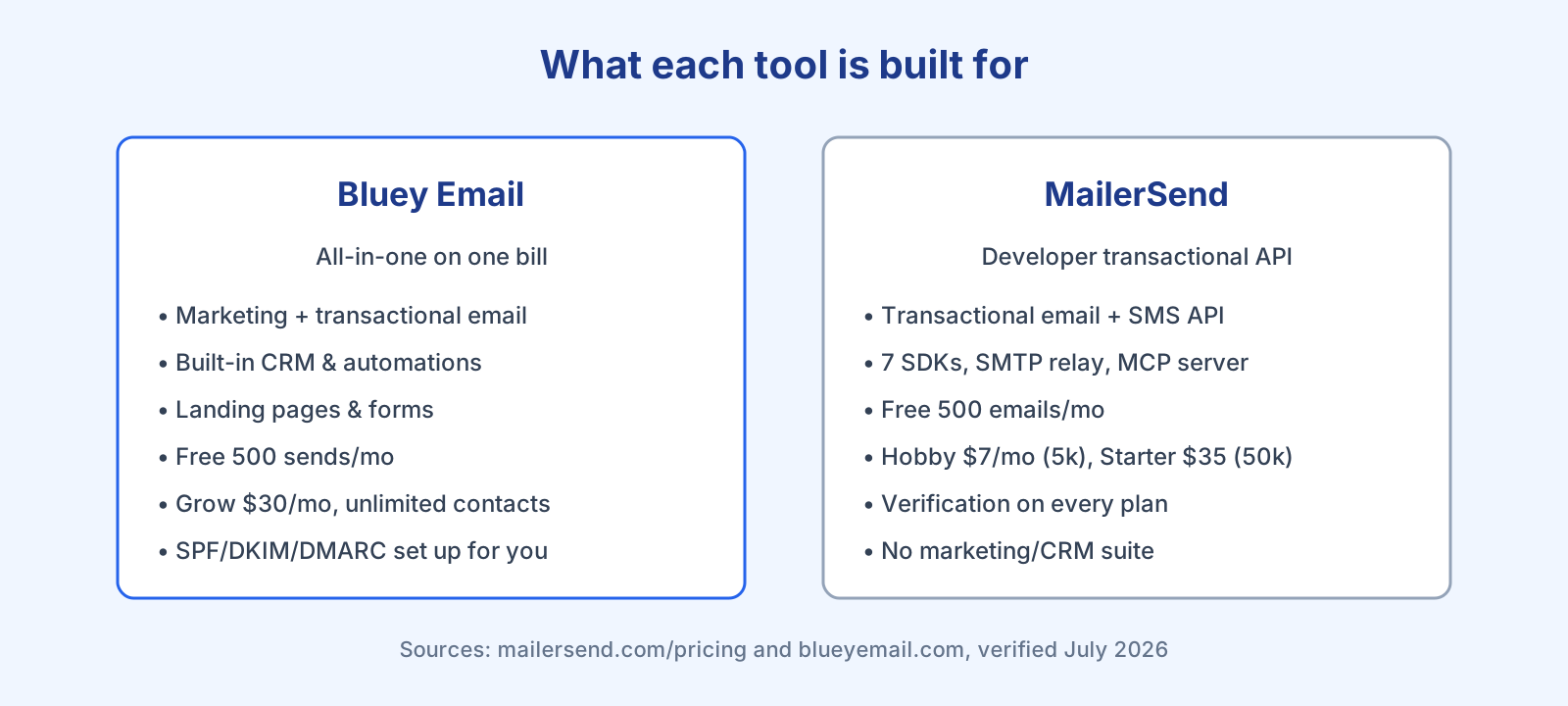
Quick answer: MailerSend is a developer-first transactional email and SMS API (Free 500 emails/mo, Hobby $7/mo for 5,000, Starter from $35/mo for 50,000, per MailerSend). Bluey Email is an all-in-one platform that puts marketing email, transactional email, and a CRM on one bill. Pick MailerSend if you only need a lean transactional API; pick Bluey if you want your product emails and your marketing living in one place.
Full disclosure: Bluey Email is my own product, so I have an obvious bias. I have reviewed MailerSend on the same yardstick I would use for any tool, and I will say plainly below where MailerSend is the better choice.
MailerSend vs Bluey Email at a glance
| Bluey Email | MailerSend | |
|---|---|---|
| Best for | Marketing + transactional in one place | Developer transactional API/SMTP |
| Free tier | 500 sends/mo | 500 emails/mo |
| Entry paid | Spark from $7/mo | Hobby $7/mo (5,000 emails) |
| Mid tier | Grow $30/mo, unlimited contacts | Starter from $35/mo (50,000 emails) |
| Marketing campaigns | Yes | No |
| Built-in CRM | Yes | No |
| Transactional API + SMTP | Yes | Yes |
| SMS | No | Yes (US/CA) |
MailerSend pricing verified on the MailerSend pricing page (July 2026): Free is 500 emails/month, Hobby is $7/month for 5,000 emails ($1.50 per extra 1,000), Starter starts at $35/month for 50,000 emails ($1.30 per extra 1,000), and Professional starts at $110/month with unlimited domains and templates plus a deliverability consultation. Email verification credits ship on every plan.
What MailerSend is (and who built it)
MailerSend is a transactional email service — password resets, receipts, shipping notifications, the mail your app sends automatically. It was built by the team behind MailerLite as their developer-focused sibling; as MailerLite puts it, MailerSend “focuses primarily on transactional emails while MailerLite focuses on email marketing” (MailerLite). It ships an email API, SMTP relay, seven SDKs, webhooks, an MCP server, and transactional SMS for the US and Canada. If you are a developer wiring email into a product, it is a clean, well-documented tool.
The catch is scope. MailerSend does not run marketing campaigns, does not include a CRM, and its marketing sibling MailerLite is a separate product with a separate bill. That separation is exactly the seam Bluey is built to remove — and it echoes the wider transactional vs marketing email question every growing sender eventually hits.
Where Bluey Email is different
Bluey runs marketing email, transactional email, and a CRM on one bill. Pricing is send-based: Free is 500 sends, Spark starts at $7/month, Grow is $30/month with unlimited contacts (about 50,000 sends), and Business is $300/month with the CRM, landing pages, and pre-built ecommerce flows. One workspace covers both your product emails and your newsletters.
I can show that this is real rather than a slogan. Testing Bluey’s own API today, a single key carried the scopes to send transactional email, manage marketing campaigns, and write to the CRM at the same time. Bluey’s domain setup also handles authentication end to end: across five live sending domains I checked, SPF, DKIM, DMARC, and return-path all showed a passing status, with 2048-bit DKIM keys and a DMARC policy of quarantine already in place — the exact stack Google requires of bulk senders. See our SPF, DKIM and DMARC explainer for why that matters.
Deliverability: the part that actually decides this
For transactional mail, deliverability beats features. Gmail is explicit that senders should “separate mail by purpose as much as possible” and keep spam complaints below 0.10%, never reaching 0.30% (Google). Note that Google’s advice is to separate mail streams — different subdomains or IPs for receipts versus promotions — not necessarily to buy two different products. Bluey lets you run separate streams inside one account, which keeps the deliverability hygiene without the second invoice.
Postmark’s Steph Knapp frames the stakes well: password resets see roughly “70%” open rates versus 10–20% for promotional email, and mixing the two streams risks having them “all classified as bulk email” (Postmark). Whichever tool you choose, keep the streams clean.
Which should you choose?
Choose MailerSend if you only need transactional email or SMS, you want mature SDKs and an API-first workflow, and your marketing (if any) lives elsewhere. Its Hobby and Starter tiers are genuinely competitive for pure transactional volume, and verification-on-every-plan is a nice touch for list hygiene.
Choose Bluey Email if you want transactional and marketing email plus a CRM on a single bill, and you would rather not stitch two vendors together. That is the specific, substantiated reason I rank Bluey first here — not that it is mine, but that it collapses a two-tool setup into one. If you are a developer who will never send a newsletter, MailerSend is the leaner fit. Compare more options in our best transactional email services roundup and the best email API for developers guide.
Frequently asked questions
Is MailerSend good for marketing emails? Not on its own — MailerSend is transactional-focused. Its sibling MailerLite handles marketing, but that is a separate product and bill. Bluey combines both.
How much is MailerSend? Free for 500 emails/month, $7/month (Hobby) for 5,000, from $35/month (Starter) for 50,000, and from $110/month (Professional) with unlimited domains and templates, per MailerSend’s pricing page (July 2026).
Does Bluey Email do transactional email? Yes — transactional and marketing email share one workspace, verified first-hand: a single API key carries send, campaign, and CRM scopes together.
Which has better deliverability? Both authenticate properly. Deliverability depends more on your list quality and stream hygiene than the vendor; keep complaint rates under 0.30% for Gmail either way.
References
- MailerSend — Pricing: https://www.mailersend.com/pricing
- MailerLite — MailerSend transactional email service: https://www.mailerlite.com/blog/mailersend-transactional-email-service
- Google — Email sender guidelines: https://support.google.com/a/answer/81126
- Postmark (Steph Knapp) — Transactional vs marketing emails: https://postmarkapp.com/blog/transactional-vs-marketing-emails
— Shivam