
Quick answer: Amazon SES is the cheapest way to send transactional email at scale — $0.10 per 1,000 emails, pay-as-you-go (AWS) — but it’s raw infrastructure you assemble and support yourself. Postmark costs more (from $15/mo for 10,000 emails, then $1.80 per extra 1,000 on Basic) but ships deliverability, analytics, templates, and human support out of the box (Postmark). Choose SES if you have engineers and want the lowest unit cost; choose Postmark if you want speed-to-inbox and support without building the plumbing. Written with AI assistance and reviewed against primary sources.
Full disclosure: I build Bluey Email, which also sends transactional email. This is a head-to-head between SES and Postmark; I’ve held both to the same yardstick and note at the end where Bluey fits and where it doesn’t.
Amazon SES vs Postmark at a glance
| Amazon SES | Postmark | |
|---|---|---|
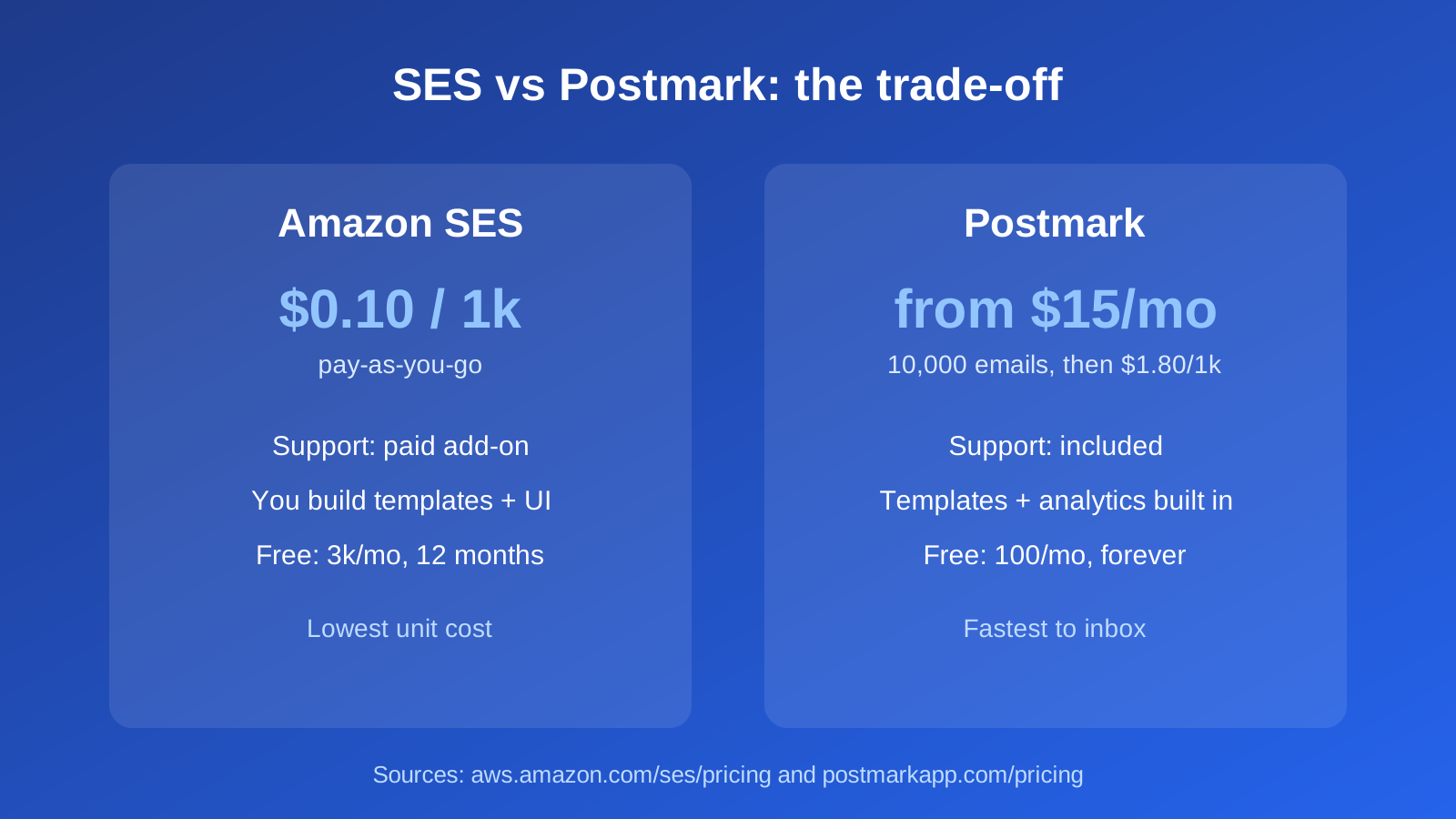
| Pricing model | Pay-as-you-go, $0.10/1,000 emails | Monthly tier, from $15/mo (10k) |
| Free tier | 3,000 message charges/mo, first 12 months only | 100 emails/mo, forever |
| Overages | $0.10/1,000 (flat) | $1.80/1,000 (Basic), $1.30 (Pro) |
| Support | Paid AWS Support plan (separate) | Included, human, fast |
| Setup | You build templates, tracking, UI | Built-in templates, analytics, streams |
| Owned by | Amazon (AWS) | ActiveCampaign |
How much does Amazon SES cost?
Amazon SES is pay-as-you-go with no minimums: $0.10 for every 1,000 emails you send or receive, plus $0.12 per GB of attachments (AWS). That’s $10 for 100,000 emails and $100 for a million — the lowest headline unit cost in the category. The free tier is 3,000 message charges per month, but only for your first 12 months (the old always-free EC2-linked tier is gone), so budget for the per-email rate from month 13. Dedicated IPs are extra: $24.95/mo standard or $15/mo for managed dedicated IPs.
The catch is what the price doesn’t include. SES gives you an API and SMTP endpoint — nothing else. Templates, open and click tracking, a sending dashboard, suppression handling, and deliverability tooling are things you build or bolt on. Support is a separate paid AWS Support plan, not part of the $0.10.
How much does Postmark cost?
Postmark charges a flat monthly fee by volume tier. The Basic plan is $15/mo starting at 10,000 emails, with extra emails at $1.80 per 1,000; Pro is $16.50/mo (extras at $1.30/1,000, adds inbound processing and longer retention); Platform is $18/mo (extras at $1.20/1,000, unlimited domains) (Postmark). There’s a permanent free Developer tier of 100 emails/month that never expires. Dedicated IPs start at $50/mo per IP and are aimed at senders doing 300,000+ emails/month.
Postmark’s pitch isn’t price — it’s that everything is included: high-quality shared IPs, 45-day content history, detailed bounce and open data, responsive templates, message streams that separate transactional from broadcast, and support that answers. Postmark is owned by ActiveCampaign, which folded it into its wider messaging stack.
Which one has better deliverability?
This is where Postmark earns its premium, and the strongest evidence is on Postmark’s own customers — with names attached. Postmark publishes a testimonial from Dave Marshall, CTO at Childcare.co.uk: “I was shocked to see Postmark open rates were an 11% improvement over SES in our test. Needless to say we started sending all of our transactional email through Postmark” (Postmark). Cliff Chang, a Product Engineer at Asana, adds that they chose Postmark for its “clear documentation and transparent roadmap” and wanted to “invest in a platform that would continue to grow along with our needs” (Postmark).
Those are vendor-hosted quotes, so read them as such — but the underlying point is real: SES gives you a deliverability toolkit and expects you to manage reputation, warm-up, and separation yourself, while Postmark manages a curated transactional-only network for you. If your team can’t dedicate engineering time to deliverability, that difference shows up in the inbox.
When should you pick Amazon SES?
Pick SES when: you have engineering resources, you send high volume where $0.10/1,000 compounds into real savings, you’re already on AWS and want SES inside your existing infrastructure and IAM, and you’re comfortable building or integrating your own templating, tracking, and dashboards. SES is the right answer for a lot of developer-heavy teams — it’s the cheapest reliable pipe in the market. See Amazon SES alternatives if the do-it-yourself burden is the sticking point.
When should you pick Postmark?
Pick Postmark when: you want fast time-to-inbox without a deliverability project, you value included support and analytics over the lowest unit price, your volume is modest-to-mid (the flat $15–$18 base is cheap until overages stack up), and you want transactional and broadcast streams cleanly separated. For a wider field, see Postmark alternatives and our best transactional email services roundup.
Where does Bluey fit (and where it doesn’t)?
Both SES and Postmark are transactional-only tools — they send receipts, password resets, and notifications, but they are not where you run your newsletter, your marketing automation, or your CRM. Bluey Email is built differently: it runs transactional and marketing email from one account, on one bill, with a built-in CRM on the Business plan. I confirmed the single-workspace setup first-hand — one Bluey API key carries `emails:send`, `campaigns:write`, and `crm:write` at once, and a transactional receipt payload validates through the same key that sends campaigns.
Where Bluey is not the answer: if all you need is a raw, rock-bottom-cost transactional pipe at scale, SES beats everyone on unit price; if you want a specialist transactional service with best-in-class deliverability support and nothing else, Postmark is more focused. Bluey wins specifically when you’d otherwise pay two vendors — one for marketing, one for transactional — and want them unified. See Bluey Email vs Postmark for that head-to-head.
Frequently asked questions
Is Amazon SES cheaper than Postmark? Yes, on unit price: SES is $0.10 per 1,000 emails flat (AWS), while Postmark starts at $15/mo for 10,000 then $1.80 per extra 1,000 on Basic (Postmark). But SES doesn’t include support, templates, or analytics, which Postmark bundles.
Does Amazon SES have a free tier? Yes, but limited: 3,000 message charges per month for your first 12 months only. Postmark’s free Developer tier is 100 emails/month and never expires.
Is Postmark just for transactional email? Primarily, yes. It separates transactional and broadcast into distinct message streams, and its reputation is built on transactional deliverability. It’s not a full marketing-automation platform.
Who owns Postmark? ActiveCampaign. Postmark operates as part of ActiveCampaign’s messaging portfolio (Postmark).
Can one tool do both transactional and marketing email? Yes — platforms like Bluey Email run both from one account and one bill. SES and Postmark are transactional-focused; you’d pair either with a separate marketing tool.
References
- Amazon SES pricing — aws.amazon.com/ses/pricing
- Postmark pricing (Basic/Pro/Platform, dedicated IPs, customer testimonials) — postmarkapp.com/pricing
Related reading: Bluey Email vs Postmark, Postmark alternatives, Amazon SES alternatives, the transactional email guide, and best transactional email services.
— Shivam