
Quick answer: An SMTP relay lets you send email by pointing your app at a provider’s mail server with credentials — no real code changes. An email API sends over HTTP and unlocks the provider’s full feature set (batch sending, templates, webhooks, per-message response codes). Both are equally reliable for deliverability; as Postmark puts it, “it all depends on what you need” (Postmark). Use SMTP for a fast drop-in; use the API for new, high-volume apps.
If you are wiring email into an application, you will hit this fork: send through SMTP, or through the provider’s HTTP API? Here is the difference, the trade-offs, and how to choose — grounded in what the providers themselves recommend.
Disclosure: Bluey Email, mentioned below, is my own product; it is assessed on the same terms as the others.
What is an SMTP relay?
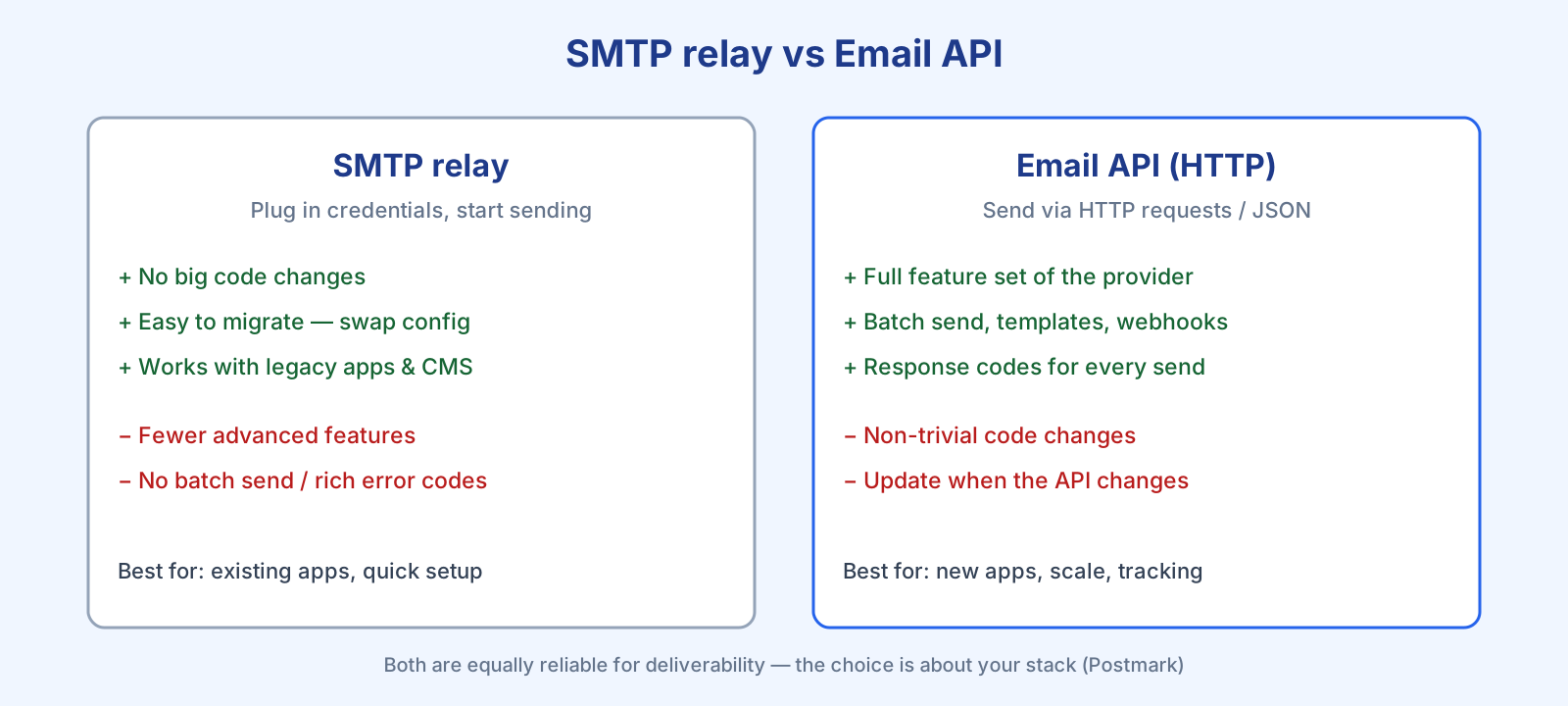
SMTP — Simple Mail Transfer Protocol — is the decades-old standard for moving email between servers. An SMTP relay is a provider’s hosted SMTP endpoint: you configure your application or server with the host, port, username, and password, and it hands your mail off for delivery. Because almost every framework, CMS, and off-the-shelf tool already speaks SMTP, this is often a five-minute change. As Postmark’s Bettina Specht, its Product Lead, writes, with SMTP “all you need to do is pick an SMTP service, plug in your credentials, and you’re ready to start sending” (Postmark).
What is an email API?
An email API is an HTTP interface that lets your code call the provider’s functionality directly — sending mail, but also creating templates, batch-sending, pulling stats, and receiving delivery events via webhooks. You send a request with a JSON payload and get back a structured response, including a per-message status you can act on. It requires writing integration code (usually with an official SDK), but in return you get the provider’s complete toolkit. See best email API for developers for a field guide.
SMTP vs API: which should you choose?
The honest answer is that deliverability is the same either way — the decision is about your stack and needs. Reach for SMTP when you have an existing application or a tool that already sends over SMTP, when you want the fastest possible setup, or when you would rather not maintain integration code. Reach for the API when you are building something new, need advanced features like batch sends or template management, want firewall-friendly delivery over standard web ports, or need per-message tracking. Mailgun sums up the practical rule on its own pricing FAQ: “SMTP is easy to setup and often plug and play, but API is much more reliable at scale. If you’re building an application, we recommend using our HTTP API” (Mailgun).
A common pattern is to start on SMTP to ship quickly, then move to the API once you need its richer features. Many providers — Bluey Email included — expose both, so you are not locked into one path; I validated a transactional payload through Bluey’s API while writing this. Whichever route you take, the same rules about separating transactional vs marketing email and getting authentication right still apply.
Does SMTP or API affect deliverability?
No. Deliverability is determined by your sending reputation, authentication (SPF, DKIM, DMARC), list hygiene, and engagement — not by whether the bytes left over SMTP or HTTP. Both transports hand off to the same delivery infrastructure. If inbox placement is your worry, invest there: read the transactional email guide and the best transactional email services roundup. For a head-to-head on two popular APIs, see Amazon SES vs Mailgun.
Frequently asked questions
Is an email API faster than SMTP? For most apps the practical difference is negligible — both are fast. APIs shine at scale and give you richer, structured responses; SMTP is simpler to wire up.
Can I use both SMTP and an API with the same provider? Usually yes. Providers like Mailgun, Postmark, and Bluey Email offer an SMTP relay and an HTTP API on the same account, so you can mix them.
Which is better for transactional email like password resets? Either works. For new applications that need templates, batching, and event webhooks, an API is the usual recommendation; for a quick drop-in, SMTP is fine.
References
- Bettina Specht, Postmark — What are email APIs: https://postmarkapp.com/blog/what-is-an-email-api
- Mailgun pricing FAQ (SMTP vs API): https://www.mailgun.com/pricing/
— Shivam
What it costs per thousand emails: Email API pricing compared.
1 thought on “SMTP Relay vs Email API: Which Should Developers Use? (2026)”