
Quick answer: A spam trap is an email address with no real human user, planted by inbox providers and anti-spam groups such as Spamhaus to catch senders who mail people without permission. Hitting one signals poor list hygiene and can damage your sender reputation or get you blocklisted. As Spamhaus advises, treat a trap hit as “proof of a data collection or hygiene issue” — not something to hunt down and delete (Spamhaus).
Spam traps are the tripwires of the email world. You cannot see them, you will never be told where they are, and landing on one can quietly wreck your deliverability. The good news: if you collect and maintain your list properly, you will never hit one. Here is what they are and how to stay clear.
Disclosure: Bluey Email, mentioned near the end, is my own product; the advice here applies to any sender on any platform.
What is a spam trap?
Spamhaus defines it simply: “A spamtrap is an email address traditionally used to expose illegitimate senders who add email addresses to their lists without permission. They effectively identify email marketers with poor permission and list management practices.” Crucially, trap owners never reveal them — partly because they are “a component of the secret sauce of their filtering,” and partly because a sender who learns a trap address will just suppress it instead of fixing the underlying data problem. That is why Spamhaus urges senders to “view spamtraps as proof of a data collection or hygiene issue and not be misled into conducting a hunt for spamtraps. Attempting to locate and remove traps only treats the symptom and not the underlying problem.”
What are the types of spam trap?
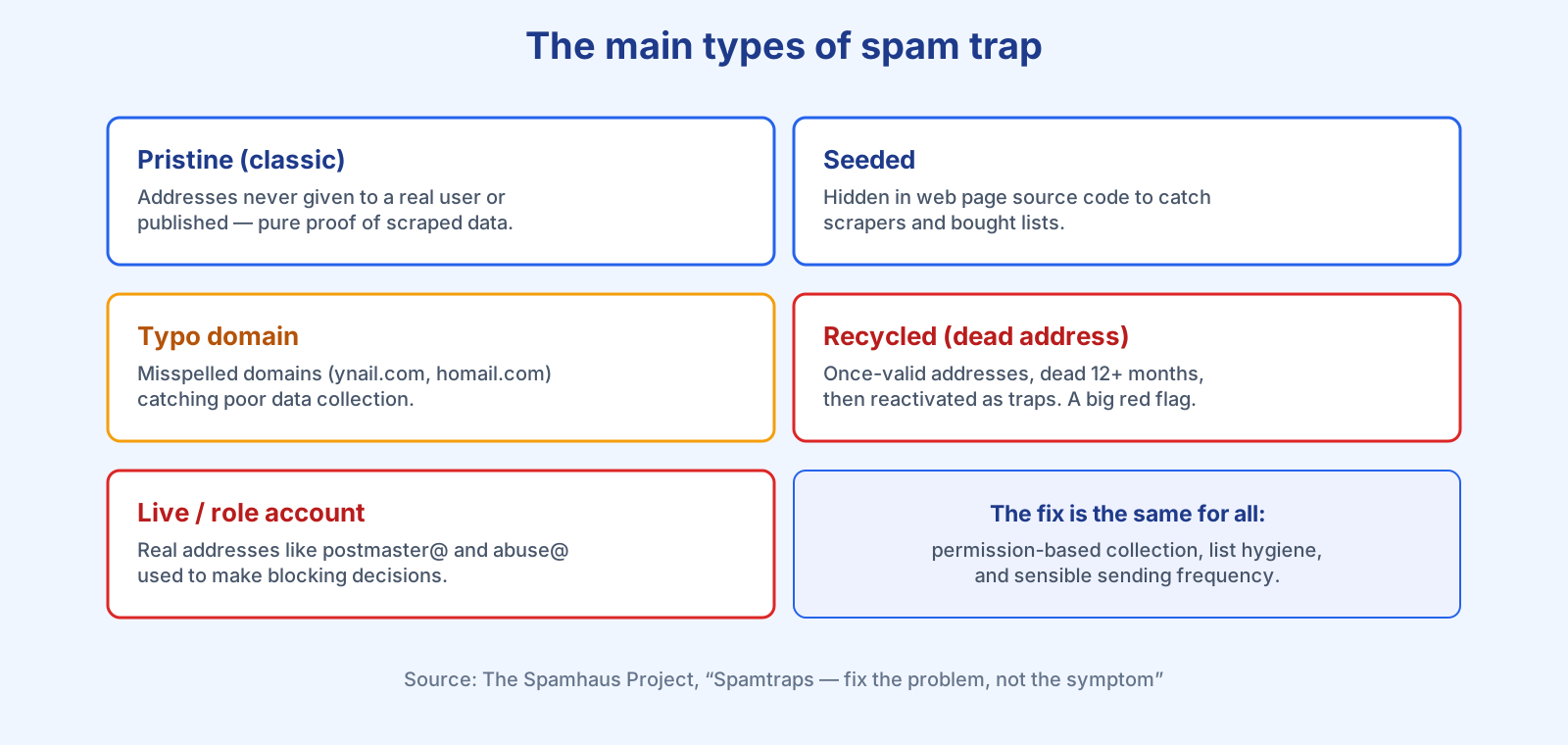
Spamhaus outlines several kinds, each catching a slightly different mistake:
| Type | What it is and what it catches |
|---|---|
| Pristine (classic) | Addresses never given to a live user or published anywhere, yet receiving mail. Pure evidence of scraped or guessed data. |
| Seeded | Addresses deliberately scattered in non-obvious places like web-page source code, to catch scrapers and bought lists. |
| Typo domain | Look-alike misspelled domains (yaaho.com, homail.com). Catches poor data collection; often mixed with real mail. |
| Recycled / dead address | Once-valid addresses ISPs switched off, hard-bounced for “12 months or more,” then quietly reactivated as traps. Hitting one is “a significant red flag.” |
| Live / role account | Real addresses such as postmaster@ and abuse@ whose owners use incoming unsolicited mail to make blocking decisions. |
The recycled trap is the one that catches otherwise-honest senders. An address someone gave you years ago can be abandoned, hard-bounce for a year, and come back as a trap — which is exactly why you cannot keep mailing people who never engage. Role accounts like postmaster@ and abuse@, Spamhaus notes, “should almost NEVER be on a marketing mailing list.”
How do you avoid spam traps?
You do not hunt traps; you remove the conditions that lead to them. Four habits cover it. First, never buy or scrape a list — that is what pristine and seeded traps exist to catch. Second, use confirmed (double) opt-in so a real person verifies each address; see double opt-in explained. Third, clean your list regularly, removing hard bounces and long-inactive subscribers before they decay into recycled traps — our list-cleaning guide walks through it. Fourth, build the list correctly from the start, covered in how to build an email list.
Do all that and traps stop being a worry. Spamhaus ends its own guide the same way it begins: “Sending correctly authenticated, desired, well-targeted email to an engaged and active audience is the key to ongoing successful email delivery.” Traps are really just a symptom of getting one of those things wrong. For the bigger context, spam-trap hits are one input into your sender reputation, and repeated hits can land you on an email blocklist. A well-run platform helps by handling authentication and bounce processing automatically — on Bluey Email, for instance, hard bounces are suppressed for you — but the permission discipline is always yours.
Frequently asked questions
What happens if I hit a spam trap? It depends on the type and how often. A single typo-trap hit may barely register; repeated hits — especially pristine or recycled traps — can damage your reputation and get your IP or domain listed on a blocklist, hurting inbox placement for all your mail.
Can I find and remove spam traps from my list? No, and trying is the wrong goal. Traps are never disclosed, and suppressing a known one just hides the symptom. Fix the root cause — how you collect and maintain addresses.
Does double opt-in prevent spam traps? It is the strongest single safeguard against typo and pristine traps, because a real person must confirm the address before it joins your list.
Are role addresses like info@ spam traps? Some role and registration addresses (postmaster@, abuse@) function as live traps and should never be marketed to. Avoid adding generic role accounts to marketing lists.
References
- The Spamhaus Project — Spamtraps: fix the problem, not the symptom: https://www.spamhaus.org/resource-hub/deliverability/spamtraps-fix-the-problem-not-the-symptom/
- The Spamhaus Project — How does email reputation work?: https://www.spamhaus.org/resource-hub/deliverability/how-does-email-reputation-work/
— Shivam