
Quick answer: Amazon SES is the cheapest way to send at scale — $0.10 per 1,000 emails on its a-la-carte plan (AWS) — but you assemble deliverability yourself from AWS parts. Mailgun costs more — $90/mo for 100,000 emails on Scale (Mailgun) — and gives you a ready-made API, dashboard, and deliverability tooling. Pick SES if you have engineers and want the lowest per-email price; pick Mailgun if you want to ship faster.
Both send billions of transactional emails, but they solve the problem at opposite ends. Here is how they compare on price, developer experience, and deliverability in 2026 — verified on each vendor’s own pricing page.
Disclosure: I run Bluey Email, an all-in-one platform mentioned at the end. I have held SES and Mailgun to the same yardstick as everything else here.
Pricing: how much do SES and Mailgun cost?
Amazon SES changed its pricing in July 2026. New accounts now default to three plans — Essentials at $0.16 per 1,000 emails, Pro at $0.22 per 1,000 plus $105/month, and Enterprise at $0.23 per 1,000 plus $500/month — but the classic pay-as-you-go a-la-carte rate of $0.10 per 1,000 outbound emails is still available, and you can switch to it at any time (AWS SES pricing). Dedicated IPs are $24.95/month (standard) or $15/month plus usage (managed).
Mailgun is plan-based and verified on its official pricing page (updated June 2026): a Free tier of 100 emails/day, Basic $15/month for 10,000 (overage from $1.80/1,000), Foundation $35/month for 50,000 (from $1.30/1,000), and Scale $90/month for 100,000 (from $1.10/1,000), which includes one dedicated IP and 5,000 email validations. Extra dedicated IPs are $59 each per month.
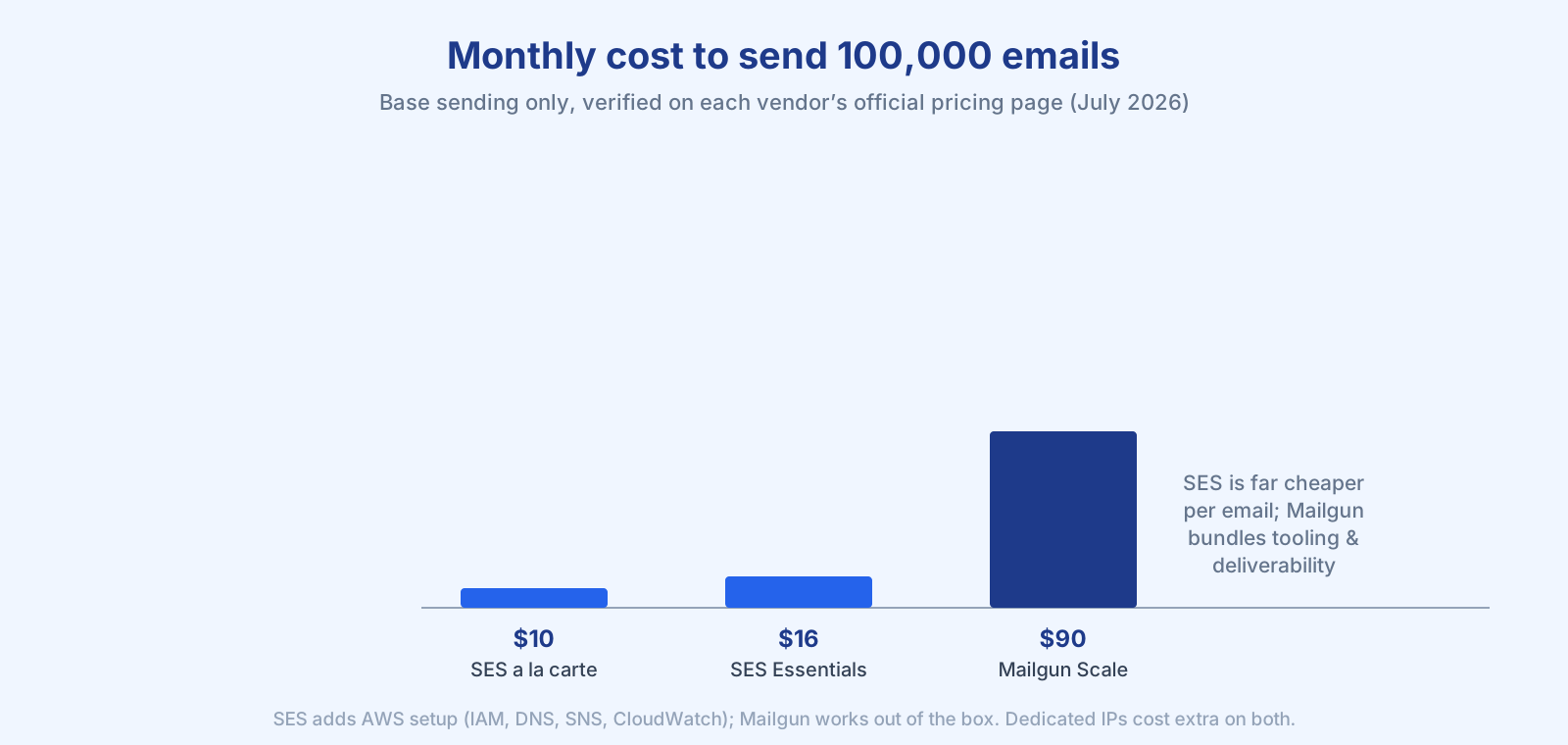
At 100,000 emails a month the raw gap is stark: roughly $10 on SES a-la-carte (or $16 on Essentials) versus $90 on Mailgun Scale. But raw send price is not total cost. SES leaves bounce handling, suppression, analytics, and IP warm-up for you to build; Mailgun ships them. Factor in engineering time and the gap narrows.
Developer experience: which is easier to ship?
This is where Mailgun earns its premium. Sign up, verify your domain, and you have a REST API, an SMTP relay, a dashboard with delivery visibility, and webhooks that work immediately. SES requires more assembly: IAM permissions, domain verification through Route 53 or manual DNS, SNS topics for bounce and complaint notifications, and CloudWatch for monitoring. If your team already lives in AWS, that is routine; if not, it is a learning curve. For a broader field see best email API for developers and the transactional email guide.
Deliverability: does one land in the inbox more often?
Both can deliver well — deliverability depends more on your sending practices than the vendor. SES gives you the raw pipe and expects you to manage reputation; Mailgun adds automatic suppression, bounce processing, and reputation monitoring. One named practitioner data point on SES’s hands-off approach: Dave Marshall, CTO of Childcare.co.uk, who tested alternatives against SES, reported that switching gave “an 11% improvement over SES in our test” on open rates, verified on Postmark’s pricing page. The lesson is not that SES is bad — it is that SES gives you less deliverability help out of the box, so results track how much work you put in. Whichever you choose, get authentication right first: our SPF, DKIM and DMARC explainer and domain warm-up guide cover the basics.
Verdict: SES or Mailgun?
Choose Amazon SES if you have engineering resources, already use AWS, and want the lowest possible per-email price at high volume. Choose Mailgun if you want a faster integration, built-in deliverability tooling, and a dashboard without stitching AWS services together. Still weighing options? See Amazon SES alternatives and Mailgun alternatives.
Where does Bluey Email fit? It is not a raw email API like these two — it is an all-in-one platform that runs transactional and marketing email plus a CRM on one bill. If your only need is high-volume developer email, SES or Mailgun is the better, more focused pick. Bluey earns its place when you want app email and newsletters and contact data in one workspace instead of three vendors; I confirmed transactional and marketing send from a single API key while writing this.
Frequently asked questions
Is Amazon SES really cheaper than Mailgun? On raw sending, yes — about $10 versus $90 to send 100,000 emails a month. But SES has no built-in deliverability tooling, so total cost of ownership depends on the engineering time you add.
Does Mailgun offer SMTP as well as an API? Yes. Mailgun exposes both an HTTP API and an SMTP relay on every paid plan, so you can integrate whichever way suits your stack.
Do SES and Mailgun have a free tier? Mailgun has a permanent free tier of 100 emails/day. SES offers new AWS customers Free Tier credits and a free plan for six months after account creation; the old always-on free tier no longer applies.
References
- Amazon SES pricing: https://aws.amazon.com/ses/pricing/
- Mailgun pricing: https://www.mailgun.com/pricing/
- Dave Marshall (Childcare.co.uk) testimonial, Postmark: https://postmarkapp.com/pricing
— Shivam
What SendGrid actually costs, including overage: SendGrid pricing explained.