
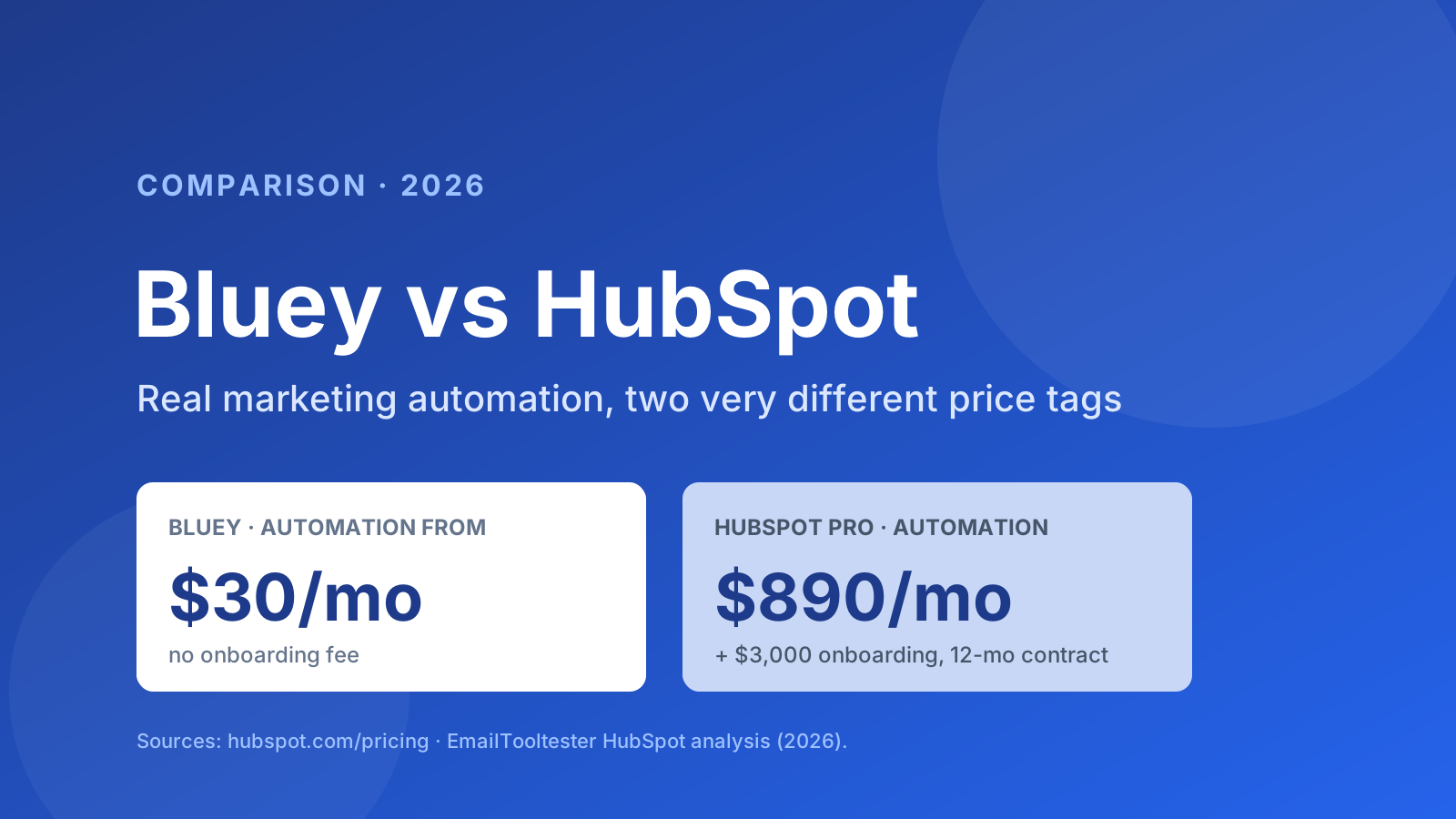
Quick answer: HubSpot’s free tier and $20/mo Starter are fine for small teams, but its real marketing power — automation, A/B testing, dynamic personalization — is locked behind Professional at $890/mo with a mandatory $3,000 onboarding fee and a 12-month contract (EmailTooltester). Bluey Email bills by emails sent: about $14/mo at 10,000 sends, $30/mo on Grow with unlimited contacts, and $300/mo on Business for a full CRM. So HubSpot wins if you need a deeply integrated sales-and-marketing CDP with a budget to match; Bluey wins on price by a factor of 30 for the marketing job most businesses actually do. Full disclosure: Bluey is my own product; I score it on the same yardstick and say plainly where HubSpot wins.
HubSpot is not really an email tool — it is a CRM platform with email inside it. That framing matters, because it explains both why HubSpot costs what it does and why it is overkill for most people who land on this page.
How much does HubSpot Marketing Hub cost in 2026?
HubSpot Marketing Hub has four tiers, priced by contacts and seats:
| Plan | Price | Contacts | Notes |
|---|---|---|---|
| Free | $0 | Basic | Forms, email, basic chatbots |
| Starter | $20/mo (or $15/seat annual) | 1,000 | Basic automation, ad management |
| Professional | $890/mo | 2,000 (3 seats) | + $3,000 onboarding, 12-month contract |
| Enterprise | $3,600/mo | 10,000 (5 seats) | Predictive scoring, custom objects |
Sources: HubSpot pricing and EmailTooltester’s HubSpot analysis. Extra marketing contacts run roughly $45–50 per additional 1,000/mo, and the custom-reporting add-on is another $200/mo on Professional.
The jump is the story. EmailTooltester’s Roberta Phillips and Charlotte Evans put it plainly: “if you want access to HubSpot’s pro marketing features such as omnichannel marketing automation, A/B testing, deal and company scoring, dynamic personalization and blog creation, you will need to fork out a hefty $890/month.” They add that “the Pro and Enterprise plans require a 12-month contract and very pricey onboarding fees” — the $3,000 is non-negotiable in year one.
How much does Bluey Email cost?
Bluey bills on emails sent, not contacts stored:
- Free — 500 contacts, 500 sends a month
- Spark — from $7/mo; roughly $14/mo at 10,000 sends
- Grow — $30/mo, unlimited contacts, ~50,000 sends
- Business — $300/mo, adds the built-in CRM, landing pages, transactional email and pre-built ecommerce flows
Which is cheaper?
For anything short of enterprise, it is not close.
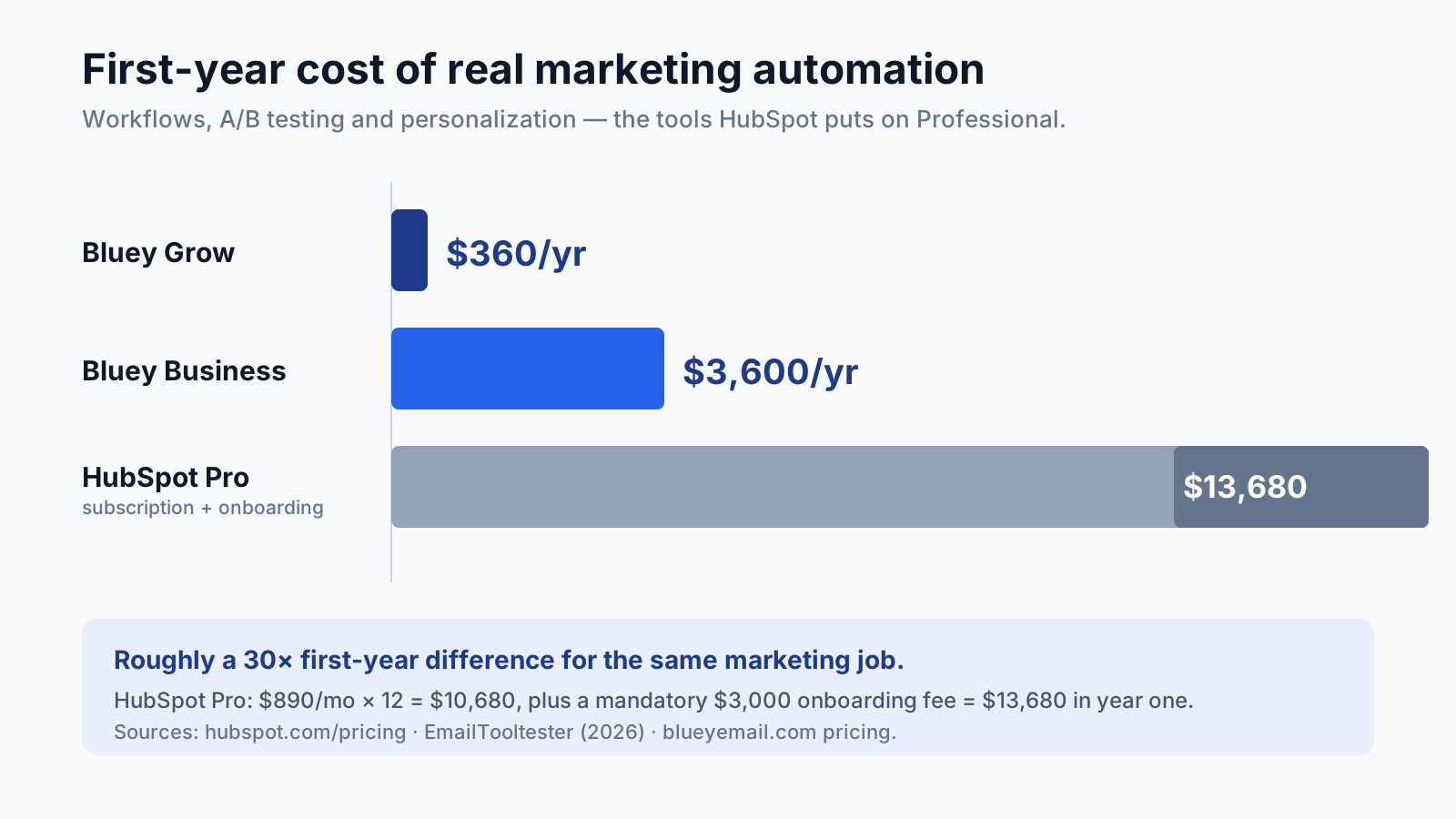
A business wanting real marketing automation — workflows, A/B testing, personalization — needs HubSpot Professional. That is $890/mo plus $3,000 onboarding = $13,680 in year one. The equivalent capability sits on Bluey Business at $300/mo = $3,600/year, no onboarding fee, or on Grow at $30/mo if your automations are standard.
A small team just sending campaigns can use HubSpot Starter at $20/mo for 1,000 contacts — genuinely reasonable — but crossing 1,000 contacts adds ~$45/mo per extra thousand, and the automation stays basic. Bluey Spark covers 10,000 sends for ~$14 with full automation included.
The rule with HubSpot: you are buying a CRM platform and paying for the marketing tools as a premium layer on top. If you need the platform, the price can be justified. If you just need to send good email, you are funding a lot of software you will never open.
Feature comparison
| Bluey Email | HubSpot Marketing Hub | |
|---|---|---|
| Pricing basis | Emails sent | Contacts + seats |
| Free plan | 500 contacts / 500 sends | Basic email + forms |
| Entry paid | $7/mo | $20/mo (Starter) |
| Real automation | Included | Professional ($890/mo) |
| A/B testing | Included | Professional ($890/mo) |
| Onboarding fee | None | $3,000 (Pro), $6,000 (Enterprise) |
| Contract | Monthly | 12-month on Pro+ |
| Built-in CRM | Yes (Business) | Yes — best in class |
| Transactional email | Yes, same bill | Limited |
| Sales + marketing alignment | Basic | Deep (its core strength) |
Where HubSpot plainly wins
- The CRM. HubSpot’s CRM is genuinely excellent and is the gravitational center of the product — sales, marketing, and service share one record. Nothing Bluey offers competes at that depth.
- Sales-and-marketing alignment. Lead scoring, deal stages, and marketing automation in one system is HubSpot’s reason to exist, and it does it better than almost anyone.
- Ecosystem. 1,500+ integrations, a huge partner network, an academy, and enterprise-grade reporting.
- Scale. For a 50-person revenue team, the platform value is real and the per-seat cost stops looking crazy.
- The free CRM genuinely is free for unlimited users — a strong on-ramp.
Where Bluey wins
- Price for the marketing job. Real automation for $30–300/mo against $890/mo-plus-$3,000. That is the single substantiated reason I rank Bluey first for the email use case.
- No onboarding fee, no annual lock-in. Bluey is monthly; HubSpot Pro is a 12-month contract with a four-figure setup charge.
- Send-based pricing. No per-contact escalator; no ~$45/mo surprise at 1,001 contacts.
- Transactional + marketing on one bill, which HubSpot handles only in a limited way.
- Simplicity. Most businesses use a fraction of HubSpot and pay for all of it. Bluey does the email job without the platform tax.
Frequently asked questions
Is HubSpot’s free plan really free? Yes — the CRM and basic email/forms are free for unlimited users. But the marketing automation that makes HubSpot worth choosing is not; that starts at $890/mo on Professional (EmailTooltester).
Why is HubSpot so expensive? You are paying for an integrated CRM platform, not an email tool. The pro marketing layer, mandatory onboarding, and 12-month contract stack up fast (EmailTooltester).
Does Bluey have a CRM? Yes, on the Business plan ($300/mo) — a real CRM, not a contacts list. It will not match HubSpot’s depth for a large sales org, but it covers most small and mid-sized needs.
Which is better for a sales team? HubSpot, clearly, if sales and marketing must share deal data and lead scoring. Bluey is the better pick when email is the job and the CRM is secondary.
Can I avoid HubSpot’s onboarding fee? Not on Professional or Enterprise — it is mandatory in year one ($3,000 and $6,000 respectively).
The verdict
Choose HubSpot if you are buying a CRM platform and want marketing, sales, and service on one system — and you have the budget for Professional. Its CRM and alignment are best-in-class and worth it at the right scale.
Choose Bluey Email if you need to send excellent, automated email without funding an enterprise platform. Real automation for $30–300/mo against HubSpot’s $890/mo-plus-$3,000 onboarding is roughly a 30× first-year difference for the marketing job — the specific reason I rank it first here.
Compare the wider field in Best Email Marketing Software in 2026, the ranked swap list in HubSpot alternatives, the sibling head-to-head Bluey Email vs ActiveCampaign, or start with the complete email marketing guide.
— Shivam