
In the rapidly evolving digital landscape of 2026, the traditional methods of capturing leads are no longer sufficient. Static forms that simply demand a user’s email in exchange for a generic newsletter are becoming “invisible” to a savvy, protective audience. Today, potential subscribers face over 5,000 marketing messages daily and are increasingly selective about who gets access to their inbox.
To succeed, you must shift from a “demand” mindset to a “value” mindset, creating invitations for interaction rather than barriers to engagement. This blog provides a comprehensive, step-by-step guide to mastering lead generation and conversion rate optimization (CRO), with Blueyemail serving as your preferred tool for managing the high-impact email marketing and delivery strategies discussed.
If you are new to email marketing, please read our comprehensive email marketing guide.
Part 1: The Strategic Foundation of Lead Generation
1. The Core Principles of High-Converting Assets
Before building any tool, you must understand the three pillars that drive users to share their information:
- Immediate Value: Consumers take action when they see results right away, even small “quick wins”.
- Trust Signals: Proof that your brand is credible (testimonials, photos, or “used by X users”) increases the willingness to share data.
- Relevance: Your offer must match what your audience struggles with right now.
2. SMART Goals vs. Stretch Goals
To grow your business quickly, you should pair Stretch Goals (ambitious, seemingly impossible objectives like hitting $1,000,000 in year one) with SMART Sub-goals (Specific, Measurable, Attainable, Relevant, Timely). This framework forces innovation while keeping tasks manageable.
Part 2: High-Impact Lead Magnets and Content Upgrades
A lead magnet is anything you give away in exchange for contact information. In 2026, the trend has shifted toward hyper-specificity.
Proven Lead Magnet Ideas
- Plug-and-Play Templates: These allow users to skip the learning curve and solve a problem instantly.
- “What Not To Do” Lists: Highlighting common mistakes creates urgency and feels more relatable than a standard guide.
- Interactive Quizzes: Quizzes act as automated gatekeepers, filtering leads while providing personalized recommendations.
- Private Communities: Offering access to a shared goal builds loyalty before the first sale.
Content Upgrades: The Secret Weapon
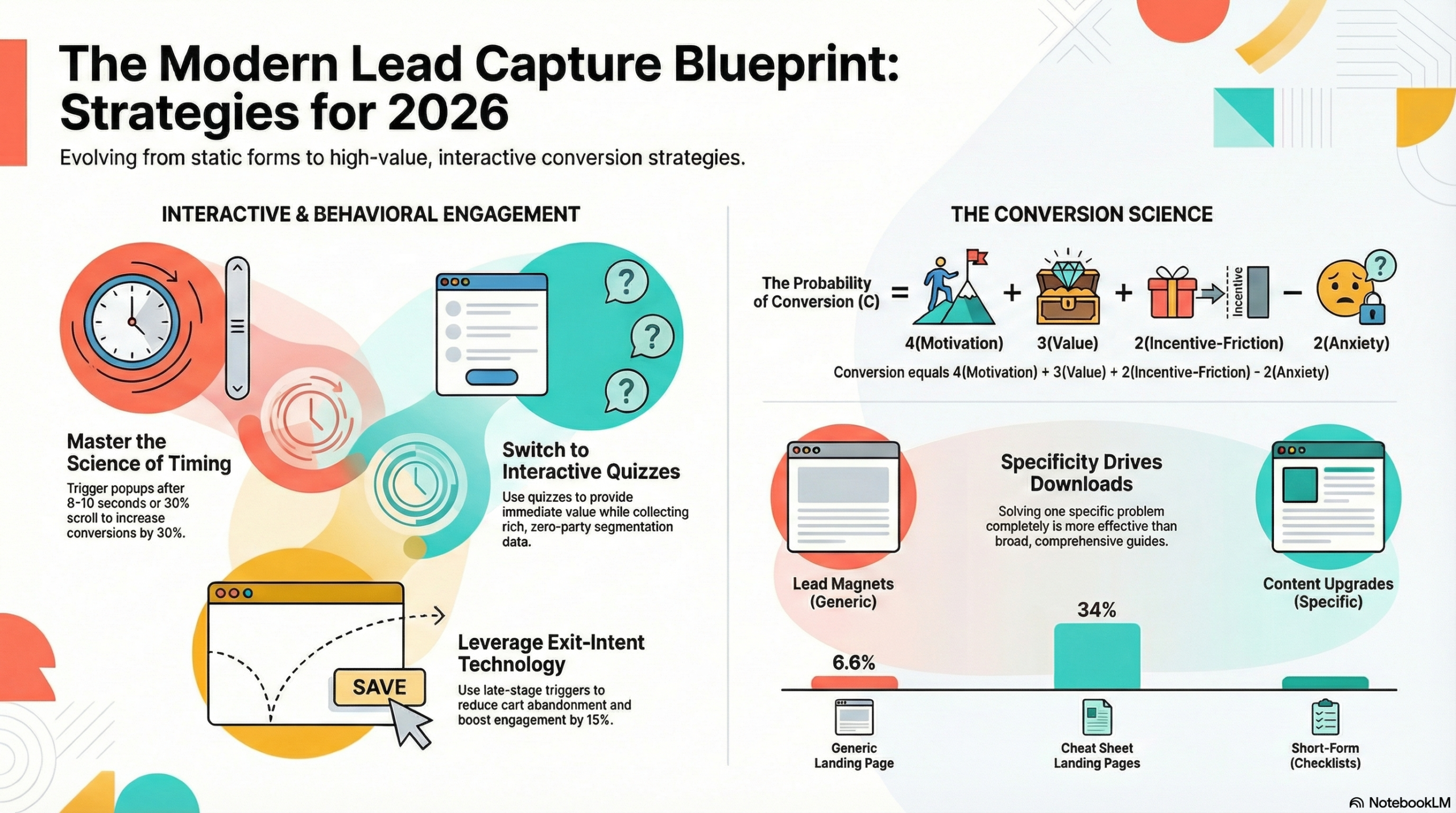
A content upgrade is a lead magnet designed for one specific blog post (e.g., a “lighting setup cheat sheet” for a post about photography). Because they are contextually relevant, content upgrades often convert at much higher rates than generic site-wide offers.
Part 3: Designing Effective Popups for 2026
Popups remain a powerhouse for CRO, provided they are not intrusive.
The 21 Best Practices
- Timing: Display popups after 8–10 seconds or 30–50% scroll.
- Exit-Intent Technology: Trigger offers just as a user is about to leave, which can increase engagement by 10-15%.
- Clarity: Use one or two sentences to communicate value instantly.
- Minimalism: Limit form fields to one or two (e.g., just an email) to increase completion rates by 30%.
- Multi-Step Forms: For more data, break the process into digestible steps to boost completion by up to 86%.
- Strong CTAs: Use action verbs like “Get,” “Unlock,” or “Claim” to create urgency.
- Mobile Optimization: Ensure popups do not cover the entire screen on mobile devices to avoid Google penalties.
- A/B Testing: Regularly test headlines, colors, and timing to optimize conversions.
- Urgency: Use countdown timers for limited-time offers.
- Non-Intrusiveness: Utilize slide-ins or sticky bars.
- Social Proof: Mention user counts or testimonials within the popup.
- Fast Loading: Compress images to prevent user frustration.
- Easy Exit: Always provide a clear “X” or “No thanks” option.
- Incentives: Experiment with discounts, free trials, or exclusive content.
- Behavioral Targeting: Show offers based on browsing history.
- Analytics: Use tools to track impressions, clicks, and conversions.
- Compliance: Ensure GDPR/CCPA compliance and link to your privacy policy.
- Contextual Content: Match the popup to the page’s specific topic.
- Interaction: Use polls or quizzes to encourage engagement.
- Visual Contrast: Use contrasting colors for CTA buttons.
- Personalization: Tailored popups convert 42% better than generic ones.
The SPROUT Framework for Exit Popups
To maximize results, follow the SPROUT methodology: Segment, Personalize, Recommend, Optimize, Urgency, Test.
Part 4: The Science of Conversion (The Conversion Sequence)
Marketing is not just art; it is a heuristic. The MarketingExperiments Conversion Sequence helps you understand the visitor’s psychology:
C = 4m + 3v + 2(i-f) – 2a
- C = Probability of conversion.
- m = Motivation of the user (the “when”).
- v = Clarity of the value proposition (the “why”).
- i = Incentive to take action.
- f = Friction (process difficulty/length).
- a = Anxiety about entering info.
To improve conversion, you must maximize Motivation and Value while minimizing Friction and Anxiety (e.g., by adding security seals or testimonials).
Part 5: Step-by-Step Guide to Launching Your Campaign
Follow this step-by-step roadmap to build a lead-generating machine.
Step 1: Define Your Goal and Audience
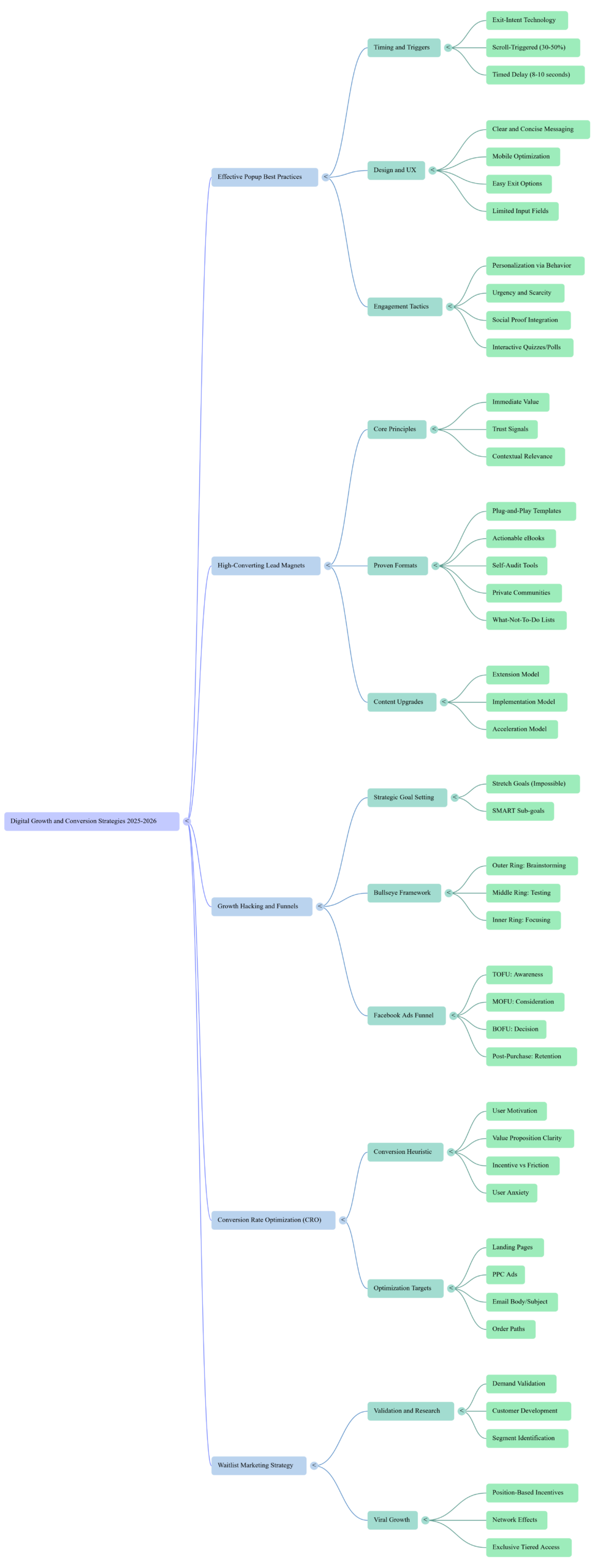
Use the Bullseye Framework to brainstorm traction channels (SEO, Email, Social Ads). Select one channel to focus on and set your SMART goals. Segment your audience by Cohort (e.g., first-time visitors) or Context (e.g., the specific page they are viewing).
Step 2: Create a Specific Lead Magnet
Choose a format that solves one specific problem.
- Templates/Checklists: Great for cold traffic.
- Quizzes: Excellent for segmenting “warm” leads based on their specific needs.
- Waitlists: Use these for pre-launch demand validation, leveraging scarcity and social proof.
Step 3: Set Up Delivery with Blueyemail
Once a user opts in, you must provide instant gratification.
- Integrate: Connect your lead capture tool (like a popup or quiz) to Blueyemail (https://blueyemail.com).
- Automate: Set up a nurture sequence. The first email should immediately deliver the promised asset.
- Nurture: Follow up with educational content that builds trust. At Blueyemail, you can manage these sequences to ensure you stay top-of-mind without being overwhelming.
Step 4: Design Your Landing Page or Popup
- Headline: Focus on the benefit to the user (e.g., “Lower your payments” instead of “We can help”).
- Minimalist Design: Keep the eyepath clear and avoid distracting links.
- Trust Elements: Include 1–2 real testimonials and a professional visual mockup of the lead magnet.
Step 5: Implement Exit-Intent and Behavioral Triggers
Don’t let visitors leave empty-handed. Use an exit-intent popup to offer a “last chance” discount or a high-value piece of gated content. Use behavioral targeting to ensure the offer is relevant to the products or pages the user just viewed.
Step 6: Test and Optimize
Use A/B Testing to experiment with:
- Button colors and headlines.
- Number of form fields.
- Lead magnet types (e.g., a “what not to do” list vs. a template).
- Blueyemail analytics to track open rates and click-through rates for your nurture sequence.
Part 6: Deep Dive into Interactive Lead Generation: Quizzes
If you want to move beyond the standard 1-3% conversion rate of static forms, quizzes are the answer.
Why Quizzes Work
Quizzes transform a passive data request into a helpful conversation. They leverage the Sunk Cost Fallacy; once a user spends 2-3 minutes answering questions, they are highly committed to seeing the results, making them more likely to provide an email at the end.
How to Build a Quiz
- Engaging Questions: Solve a real user problem (e.g., “Find Your Perfect Skin Routine”).
- Logic Jumps: Route users to different questions based on their answers to keep the experience personalized.
- Scoring: Categorize respondents so you can send them targeted follow-up emails via Blueyemail.
- The Results Page: This is where the sales process starts. Link directly to a product or a booking calendar that solves the user’s specific problem revealed by the quiz.
Part 7: Managing the Post-Purchase Experience
The relationship doesn’t end at the first sale. In fact, existing customers are your most profitable segment.
- Upsell and Cross-sell: Use Blueyemail to send personalized recommendations based on past purchases.
- Replenishment Reminders: If you sell a consumable product (like a 30-day supply of tea), set an automated email at day 25 to remind the customer to reorder.
- Referral Programs: Encourage your most loyal fans to promote your brand in exchange for rewards.
If you need to learn more about the general setup for email marketing, read our email marketing setup guide.
If you are a B2C and want to improve your revenue using email marketing, then go through the practical step-by-step B2C Email Marketing Guide.
Conclusion: Start Small, Scale Fast
Building a conversion ecosystem in 2026 is about building relationships first and products second. Do not try to build everything at once. Pick 2–3 lead magnet ideas—perhaps a “What Not To Do” list or a simple template pack—and set a one-week timeline to ship the first version.
As you collect data and refine your strategy using the Conversion Sequence and SPROUT framework, use Blueyemail (https://blueyemail.com) as your central hub for communication and automation. By consistently delivering high-quality, relevant value, you will transform anonymous web traffic into a loyal, high-lifetime-value audience.
Disclaimer: This guide is based on source materials current for 2025/2026. Always verify local regulations like GDPR/CCPA for compliance in your specific region.
2 thoughts on “Mastering High-Conversion Lead Generation in 2026: The Ultimate In-Depth Guide”