
The Invisible Erosion: 5 Critical Truths Reshaping Your Email Strategy
1. Introduction: The High-Stakes Game of the Inbox
The era of passive tracking is over. Marketers work tirelessly to cultivate robust subscriber lists, but beneath the surface, a “Double Blindness” is taking hold. Not only is your data actively “rotting” due to natural turnover, but sweeping privacy changes are obscuring your view of the data that remains.
While email marketing continues to be a powerhouse—generating an unmatched average return on investment (ROI) of 36:1—most current strategies are built on a crumbling foundation of decaying contacts and legacy metrics. To maintain a high-performing revenue machine, you must move beyond tracking “invisible pixels” and start auditing the hidden realities of your database.
If you are new to email marketing, please read our comprehensive email marketing guide.
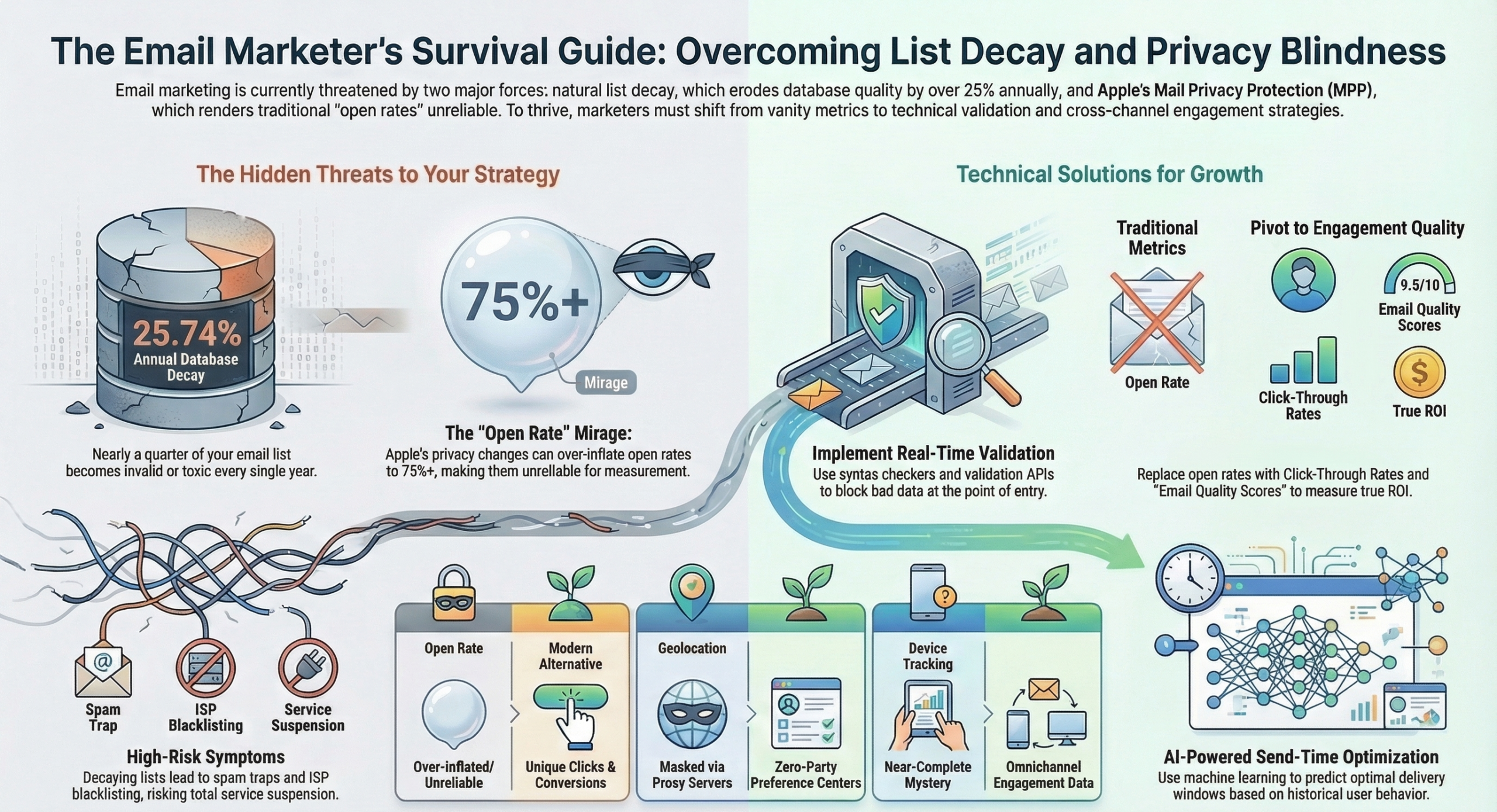
2. The Silent Killer: Your Marketing List is Eroding by 25.74% Every Year
A significant threat to your marketing lifecycle is “list decay”—the gradual degradation of contact quality. This isn’t just a minor administrative hurdle; it is a direct drain on your bottom line.
Research from Salesforce Ben reveals a stark statistical reality: an average email list decays by 25.74% annually. Nearly a quarter of your Salesforce CRM can become “dirty” in just twelve months through fake, expired, or disposable addresses. While basic syntax checkers are a start, the strategic “gold standard” is the implementation of real-time validation APIs. These block bad data at the point of entry, preventing the high bounce rates and ISP blocks that lead to service suspension.
“Your email database is the lifeblood of your business… But, here’s the critical question: is there someone on the receiving end of the email address in your Salesforce CRM?”
3. The Open Rate Illusion: Navigating the “Double Blindness”
Apple’s Mail Privacy Protection (MPP) has fundamentally dismantled the open rate as a reliable KPI. By masking IP addresses and blocking invisible pixels, Apple prevents marketers from knowing when or where an email is opened. This is no small disruption; Apple Mail holds over 49% of the market share.
Under MPP, Apple routes emails through proxy servers to pre-load content. However, as a strategic note, this 75% “inflated” open rate only triggers if the device is on WiFi with the Mail app running in the background. If those conditions aren’t met, the data stays dark. This creates a “Double Blindness” where you can neither see the list decay nor trust the engagement of the remaining list. We are at a crossroads: while 76% of buyers expect personalized attention, the very tools they use to protect their privacy make that personalization invisible to traditional tracking.
“Mail Privacy Protection stops senders from using invisible pixels to collect information about the user. [It prevents] senders from knowing when they open an email.”
4. The 10% Engagement Lift: The Precision of AI “Heat Maps”
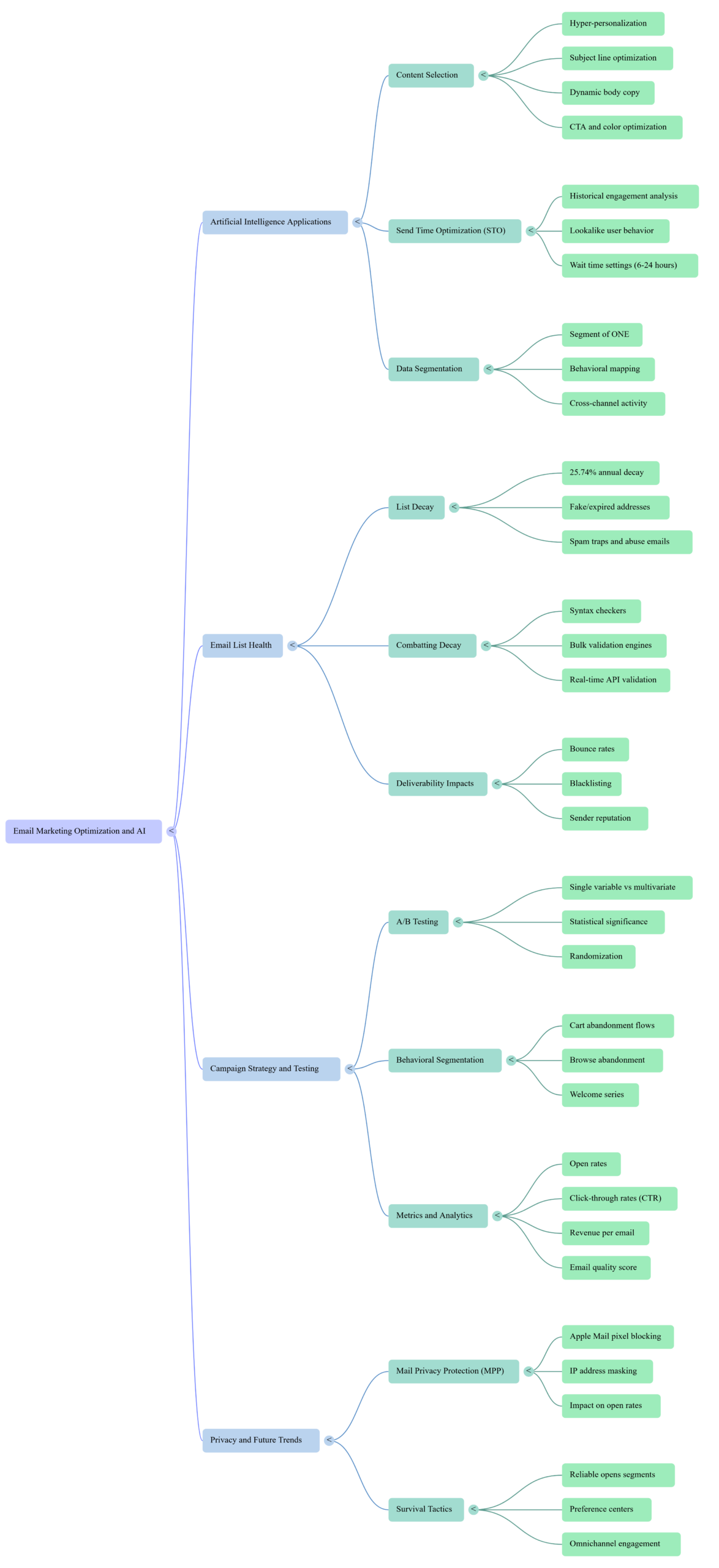
To reclaim visibility, sophisticated marketers are pivoting to Send-Time Optimization (STO). Instead of mass broadcasting, STO uses a “Bayesian approach” to analyze user behavior, lookalike data, and global trends, landing your message in the inbox at the exact moment a user is likely to engage.
Using Adobe Journey Optimizer, STO creates an individual “Heat Map” for every subscriber. This isn’t an overnight fix; the model requires 30 days of initial data collection and a full 16 weeks to reach peak optimization. The AI operates on a high-level logic where 5% of sends are “exploration” (testing new times at random) and 95% are “optimized” based on the heat map. While STO can drive a 2% to 10% lift in engagement, it must be reserved for non-urgent marketing like weekly ads, never for time-sensitive operational messages like password resets.
5. The “One Objective” Rule: Strategic Rigor in A/B Testing
A/B testing is the engine of a revenue-generating machine, but it is often muddied by poor execution. To find a true winner between promotion, creative, and segment, you must adhere to the “One Objective” rule: never optimize for opens and conversions in the same test.
For a test to be statistically significant, you need a sample size of at least 1,000 subscribers per testable design. Furthermore, a strategic consultant’s secret is the use of “Blocking” during the analysis phase. By grouping similar cohorts—such as mobile users vs. desktop users—post-test, you prevent specific device behaviors from skewing your results. This “like-for-like” comparison ensures that you aren’t just winning a single campaign, but narrowing your focus to match your audience’s true expectations.
“Testing multiple goals within the same campaign will muddy results and eliminate clarity… stay focused and you’ll be much better off.”
6. The New North Star: The “Email Quality Score”
As open rates fade into vanity metrics, the “Email Quality Score”—popularized by Lucas Chevillard, a former email specialist at Airbnb—has emerged as the new North Star for engagement quality. This metric provides a more honest view of audience sentiment by weighing positive engagement against negative signals.
The formula is: Email Quality Score = (1 - [unsubscribers / responders]) x 100
In this framework, “responders” are strictly measured by unique clicks, as opens are no longer a trustworthy signal. A score of 80 or higher is the benchmark for success. This metric identifies how many subscribers were genuinely interested versus how many were genuinely annoyed, providing a clearer picture of your “engagement health” than a proxy server ever could.
7. Conclusion: From Legacy Approaches to Intelligent Engagement
The future of email marketing requires an evolution from passive tracking to active, intelligent engagement. Success no longer lives in the invisible pixel; it lives in explicit data from preference centers, website visits, and holistic quality scores. By leveraging tools like STO and rigorous A/B testing, you can respect subscriber privacy without sacrificing your bottom line.
If nearly half of your audience is now invisible to your tracking pixels, are you still marketing to people—or just to proxy servers?
Explore BlueyEmail for your email marketing needs.
What is the “Segment of ONE”?
The Segment of ONE represents the future of data segmentation where marketers focus on individual customer needs rather than broad demographic buckets. By leveraging AI and machine learning, brands can move from “segments of many” to creating unique, personalized experiences for every single subscriber based on their specific behavior.
How does AI optimize email content?
AI can generate and adjust multiple subject lines in seconds, a task that once took marketers hours. It also optimizes email body copy on the fly; for example, a news site can automatically lead with politics for one user and sports for another based on their past consumption patterns.
How long should I wait before using Send-Time Optimization (STO)?
You should use the email or push action within your marketing platform for a minimum of 30 days before enabling STO. This allows the system to collect enough data on sends, opens, and clicks to make accurate predictions.
Will STO send messages to users in the middle of the night?
It can happen in specific circumstances, such as when a user’s behavior indicates they are likely to interact with messages at night or during “Exploration” sends designed to test new times. To avoid this, you can schedule batch sends for the morning and set a shorter maximum wait duration
What is the difference between CTR and CTOR?
CTR (Click-Through Rate) measures the number of people who clicked divided by the total number of emails delivered, showing overall campaign performance. CTOR (Click-to-Open Rate) compares the number of people who opened an email to those who actually clicked, which measures the performance of the content itself without being skewed by subject lines or timing.
How does Apple’s Mail Privacy Protection (MPP) affect my metrics?
MPP stops senders from using invisible pixels to track when a user opens an email and masks their IP address. This results in over-inflated open rates (often around 75%) because Apple may pre-load and cache email content on a proxy server regardless of whether the subscriber actually opened it.
Is the open rate a “dead” metric?
While MPP makes open rates less reliable, they are not completely useless yet. However, marketers are encouraged to emphasize clicks and conversions in their reporting and use non-Apple Mail segments as a “proxy” audience to identify real engagement trends.
What is the difference between email churn and list decay?
Churn (or attrition) is the pace at which subscribers join and leave your list through unsubscribes or disengagement, quietly consuming about 30% of the average list annually. List decay is the gradual degradation of data quality, such as addresses becoming invalid because users changed jobs or domains.
How do I calculate my churn rate?
The formula is: (Unsubscribes + Soft Bounces + Hard Bounces + Spam Complaints + Inactive Subscribers) / Total Subscribers x 100.
How can I combat email list decay?
Marketers should use syntax checkers to block invalid formats at signup and regularly upload their lists to validation engines to identify fake or expired addresses. Implementing a real-time validation API on your forms can automatically block bad data before it enters your database.
How can I improve my landing page conversion rate?
Five effective strategies include auditing user behavior with heatmaps, using only one clear call-to-action (CTA), enhancing visuals, leveraging social proof (like testimonials), and exhaustively testing new elements.
What is the “sweet spot” for A/B testing?
The most effective A/B tests are those that are easy to implement but have a large potential impact on conversion. For emails, you generally need a sample size of at least 1,000 subscribers for the results to be statistically meaningful.
Does behavioral segmentation really work?
Yes. Research shows that behaviorally segmented campaigns (triggered by actions like cart abandonment) can achieve significantly higher engagement, including nearly double the click-through rates and over double the conversion rates of generic “batch-and-blast” emails.
Free tools for this
Put this into practice with our free, no-signup tools — everything runs in your browser:
Browse all 15 free tools →
ghflqornhvdjxnxmurgteugwquisdt