
The marketing technology landscape is entering a new era in 2026, where executives increasingly expect platforms to deliver real strategic impact and measurable business outcomes. Over two-thirds of companies have already deployed generative AI, shifting the core question from “How can we work faster?” to “What can we do now that was impossible before?”. As brands navigate this convergence of AI, unified data, and privacy-first strategies, the fundamental ways they drive growth are being reshaped.
AI-Driven Growth and the Rise of Intelligent Agents
Leading brands in 2026 are moving beyond using AI solely for efficiency and are instead using it to unlock new growth at scale. Instead of merely automating routine tasks, marketers are leveraging AI to perform complex functions like propensity scoring to adjust offers dynamically for each unique customer. For instance, a European telecom provider saw conversions jump 27% using this method without increasing staff or spending. Organizations investing in AI report average sales ROI improvements of 10–20%, with top performers achieving 1.5× higher revenue growth over three years.
The multiplication of intelligent AI agents is a defining trend of this era. Inside marketing departments, these agents automate content creation, audience segmentation, and competitive analysis, allowing teams to launch campaigns up to 10× faster. On the consumer side, “agents of customers” like ChatGPT and Gemini are being used to research products before a shopper ever visits a brand’s site. It is estimated that by 2028, some $750 billion of consumer spending will flow through AI search and assistants.
The Power of Data Gravity and Context Engineering
“Data gravity” is the force pulling marketing teams toward unified, cloud-based architectures. Leading organizations are collapsing data silos by centralizing customer information in single data warehouses like Snowflake or BigQuery and bringing tools to the data rather than moving data to the tools. New MarTech tools are now evaluated by how well they natively connect to these data clouds.
As AI agents proliferate, winning marketers are shifting from hoarding data to engineering context. AI underperforms when fed irrelevant information; therefore, winners are those who streamline data so AI tools get exactly what they need at the instant a decision is required. This involves breaking down silos where valuable data is locked in 7–25 different tools and leveraging new standards like the Model Context Protocol (MCP) to query interaction history in real time.
The Personalization Revolution: Real-Time and Privacy-First
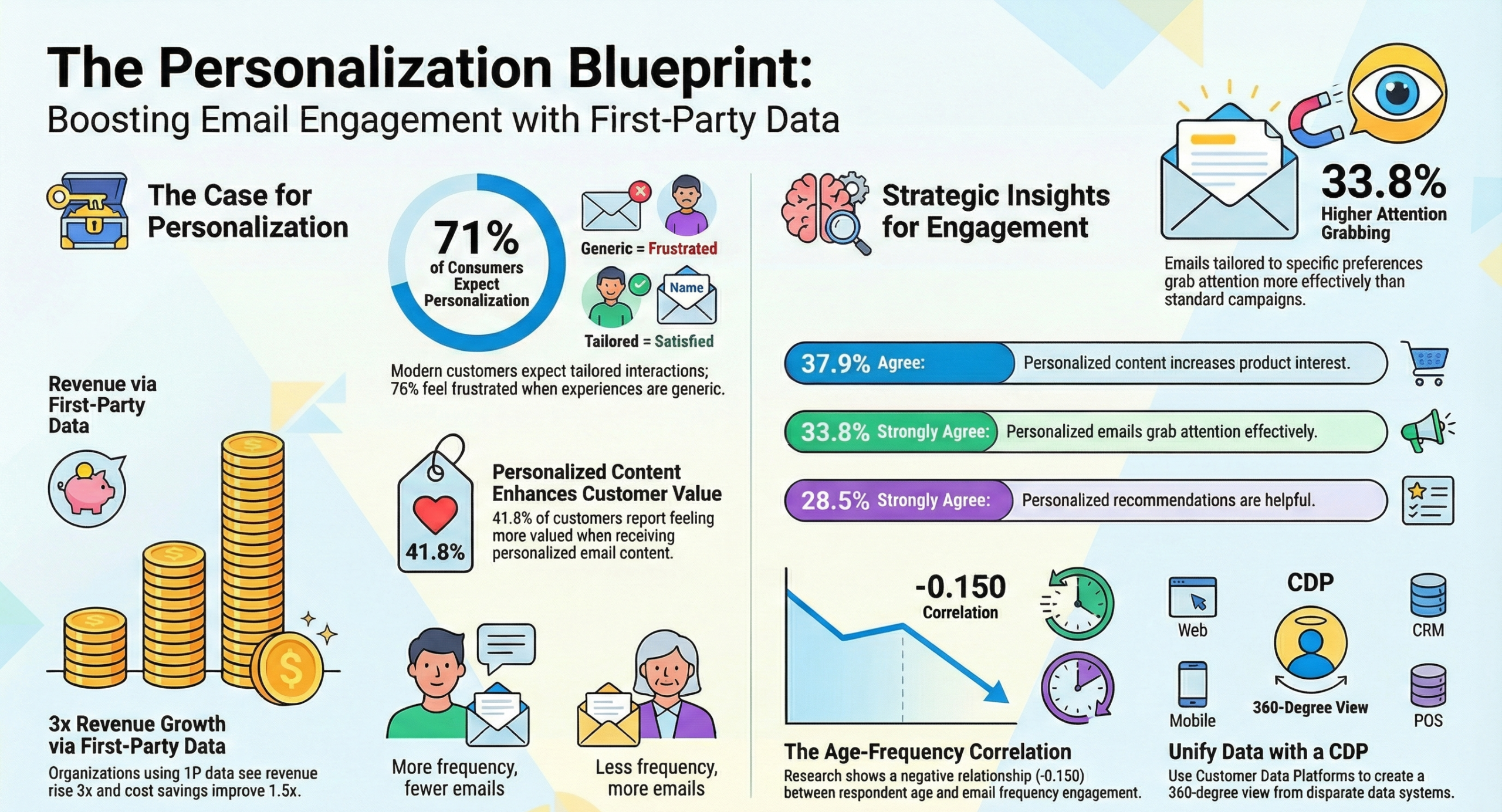
In 2026, relevance has a half-life measured in minutes, not days. Static campaigns are being replaced by real-time, adaptive personalization. Today, 71% of consumers expect personalization, and 76% get frustrated when they don’t receive it. Adaptive personalization allows brands to pivot offers and content on the fly, with top companies seeing roughly 40% more revenue than their slower peers.
Crucially, this personalization is becoming privacy-first, relying on zero- and first-party data. With 77% of Americans distrusting social media companies with their data, brands are moving toward transparent, opt-in data collection. “Zero-party” data—information a customer voluntarily provides through quizzes or preference centers—is surging in importance. One beauty brand saw a 318% increase in ROI by using a skincare quiz to prioritize tailored recommendations. Organizations are learning that data earned through trust is more valuable than data collected through shadowy third-party tactics.
Owned Media: The Resilient Foundation
Platforms often change algorithms and costs, leading 64% of brands to increase their investment in owned media channels like blogs, email lists, and mobile apps in 2026. Unlike “rented” media on social platforms that can vanish overnight due to policy shifts, owned channels compound in value. For example, a retailer facing rising social ad costs launched a loyalty content hub that became its highest-converting channel at one-tenth the cost of paid ads.
Email remains the pillar of this owned media strategy. Despite frequent “email is dead” headlines, it remains a powerhouse because it is permission-based and lands directly in a space that is both personal and attention-sensitive. Email volume has tripled since 2020 began, and it is projected to generate $13.69 billion in revenue worldwide by the end of 2025.

The “Answer Engine” Era and AI-Led Discovery
Discovery is undergoing a quiet revolution as shoppers use AI assistants to compare products. Roughly 50% of consumers now trust AI search or chatbots to research purchases, putting half of traditional search traffic at risk. To remain visible, brands must practice Answer Engine Optimization (AEO), structuring content with schema markup so AI bots can confidently extract and cite it. Early adopters of AEO are seeing tangible results, staying top-of-mind in a new funnel where if your content isn’t the “answer,” the AI simply won’t mention you.
The Strategic Shift in Marketing Operations
The role of Marketing Operations (MarOps) has evolved from “tech plumbers” to business value engineers. In 2026, MarOps leaders sit alongside executives, designing AI-driven campaigns and speaking the language of revenue. They own the pipeline between innovation and production, deciding which AI experiments should graduate to large-scale deployment. However, a significant gap remains, as 34% of MarTech buyers cite under-skilled teams as a primary barrier to value.
ROI Mastery: Email vs. Social Media
When comparing return on investment, email marketing consistently outperforms social media. On average, email marketing delivers a return of $36 to $44 for every $1 spent, compared to just $2.80 for social media. While social media excels at brand visibility, email marketing is ideal for driving direct sales and building customer loyalty. Email subscribers are 3 to 5 times more engaged than social media audiences, spending an average of 11.1 seconds per opened email compared to just 1.7 seconds per social media post.
Studies show that personalized subject lines can increase open rates by up to 50%. Furthermore, adding the recipient’s name to a subject line has been shown to increase open probability by 20%, translating into a 31% increase in sales leads. However, some recent studies suggest that the effectiveness of first names in subject lines may be diminishing as users grow accustomed to the tactic.
AI as the Great Equalizer
Finally, AI is leveling the playing field, making advanced analytics and automation accessible to midsize and smaller brands. Survey data shows that 98% of mid-market marketers believe AI will make them more effective. By automatically analyzing disparate data, AI can replace roles that mid-tier teams could previously not afford, allowing a small SaaS vendor to run sophisticated recommendation engines and optimize ad bids with the same precision as a large enterprise.
Not to Dos in 2026 MarTech
- Don’t rely on “copy-and-paste” integration: Avoid fragmented data by moving away from syncing data between silos; instead, centralize data and bring your tools to it.
- Don’t “hoard” data without context: AI will underperform if fed “rotten ingredients”; focus on context engineering rather than sheer volume.
- Don’t ignore machine-readability: Failing to optimize for Answer Engine Optimization (AEO) means your brand will be invisible to consumers using AI assistants for purchase research.
- Don’t neglect owned channels: Rented media on social platforms is volatile; don’t treat your email lists or communities as afterthoughts.
- Don’t use “one-size-fits-all” campaigns: Modern AI allows for individual propensity scoring; treating customers as a monolith leads to missed growth.
- Don’t ignore privacy consent: Distrust in data misuse is at an all-time high; do not use shadowy third-party tactics when zero-party data is more effective.
- Don’t over-saturate inboxes: 9 out of 10 respondents feel they receive too many marketing emails; sending more than once a week can lead to “email fatigue” and unsubscribes.
- Don’t include GIFs as internal email content indiscriminately: While emojis in subject lines are often positive, GIFs can be deterrents for over a quarter of users who may stop reading the email as a result.
- Don’t settle for “tech plumber” MarOps: Do not treat your operations team as admins; empower them as strategists who connect tools to business outcomes.
- Don’t ignore mobile optimization: With mobile accounting for up to 77% of email opens, failing to optimize for small screens is a critical error.
10 FAQs on 2026 MarTech and Email Growth
1. What is the expected ROI for email marketing in 2026? Email marketing continues to be the highest ROI channel, typically returning $36 to $44 for every $1 spent.
2. How much of consumer spending will be influenced by AI agents? McKinsey estimates that by 2028, approximately $750 billion of consumer spending will flow through AI search and assistants.
3. What is the difference between zero-party and first-party data? First-party data is information an organization collects from its audience with consent (like purchase history), while zero-party data is information a customer voluntarily shares (like preferences and intent).
4. How does Answer Engine Optimization (AEO) differ from traditional SEO? While SEO focuses on ranking in traditional search engines, AEO focuses on making content machine-readable so AI bots can extract and cite it as a direct answer to consumer queries.
5. Why are brands shifting back to “owned media”? Algorithm changes and rising costs on “rented” social platforms make owned media (email, blogs, apps) a more stable and high-converting foundation.
6. What is “data gravity” in a marketing context? Data gravity is the shift toward centralizing customer data in a single cloud warehouse and bringing MarTech tools directly to that data source.
7. How does real-time, adaptive personalization impact revenue? Top-performing companies using adaptive personalization see roughly 40% more revenue than their competitors.
8. Can AI really help smaller brands compete with enterprises? Yes. 98% of mid-market marketers believe AI makes them more effective by automating roles and analytics that were previously too expensive to hire for.
9. What is the optimal frequency for marketing emails according to consumers? 8 out of 10 consumers prefer receiving emails from a mailing list once a week or less.
10. What is the role of a “business value engineer” in MarOps? These are MarOps leaders who align technology and data strategies directly with executive goals and revenue outcomes, moving beyond simple platform configuration.