
Let’s be real for a second—most of us are tired of the “spray and pray” garbage hitting our inboxes. If you’re a founder or running a service agency, you’ve probably noticed that the old playbook of sending 10,000 generic emails a month is essentially a one-way ticket to the spam folder. In 2026, the game has shifted. Between AI-powered filters at Gmail and Microsoft and buyers who can spot a “fake personalized” email from a mile away, we have to be smarter.
If you want to actually book calls and grow your business this year, you need to stop thinking like a “sender” and start thinking like an “engineer.” Here is exactly how to build a bulletproof infrastructure using Bluey Email and what you need to avoid to stay out of “email jail.”
Step 1: The Foundation (Authentication and Domains)
Before you write a single subject line, you need to get the “un-glamorous” technical stuff right. If your foundation is shaky, you won’t land in the inbox, period.
The “Triple Threat” Authentication Google and Microsoft now require three specific records to prove you aren’t a scammer:
- SPF (Sender Policy Framework): This tells the world which servers are allowed to send mail for you.
- DKIM (DomainKeys Identified Mail): This adds a digital signature so the receiver knows the email wasn’t messed with in transit.
- DMARC: This is the “instruction manual” for what happens if SPF or DKIM fails.
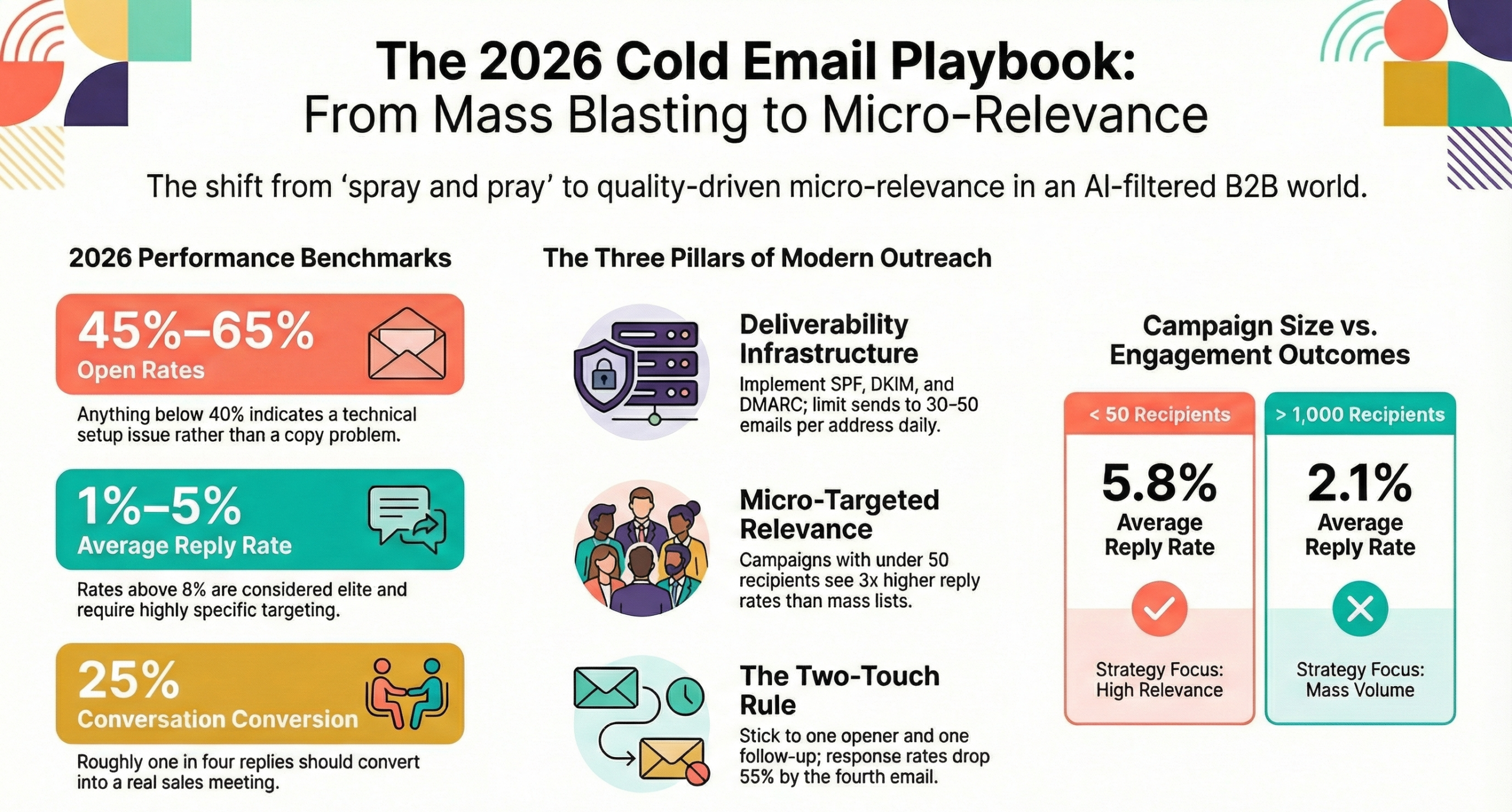
The 1:5 Rule One of the biggest mistakes we see is people using their primary business domain (e.g., yourname@company.com) for cold outreach. Don’t do this. If you get flagged for spam, your entire company’s internal email system can go down. Instead, buy “lookalike” domains. The gold standard in 2026 is one domain for every five email addresses.
Volume Control Limit each email address to 30–50 sends per day. If you have one domain with five emails, that’s 250 emails a day max per domain. Using Bluey Email, you can automate the purchase and setup of these domains so the technical records are handled for you instantly.
Step 2: The Warm-Up Phase (Be Patient)
You can’t just buy a domain on Monday and start blasting on Tuesday. That is a massive red flag to AI filters.
The Two-Week Rule You need to “warm up” your accounts for at least 14 days before sending real campaigns. During this time, Bluey Email sends simulated emails between accounts in a private network to build your sender reputation.
- The Goal: You want a “Health Score” of 100%.
- The Maintenance: Keep the warm-up running even while you are sending active campaigns. This acts as a buffer for your reputation.
Step 3: Micro-Targeting and AI Enrichment
In 2026, relevance is the new personalization. People are seeing through “Personalization Theater”—you know, those emails that say, “I saw your LinkedIn post about X,” but then pivot to a generic pitch.
Relevance > Personalization Data shows that campaigns with under 50 recipients get a 5.8% reply rate, while campaigns with over 1,000 recipients drop to 2.1%. Why? Because smaller lists are usually more relevant. Use Bluey Email’s AI features to enrich your leads. Instead of just a name, the AI can pull LinkedIn summaries and company data to help you write a prompt that actually solves a specific problem for that specific person.
Realistic Benchmarks: What “Good” Looks Like in 2026
Don’t listen to the “guru” screenshots showing 50% reply rates. Here is the real-world data from the trenches:
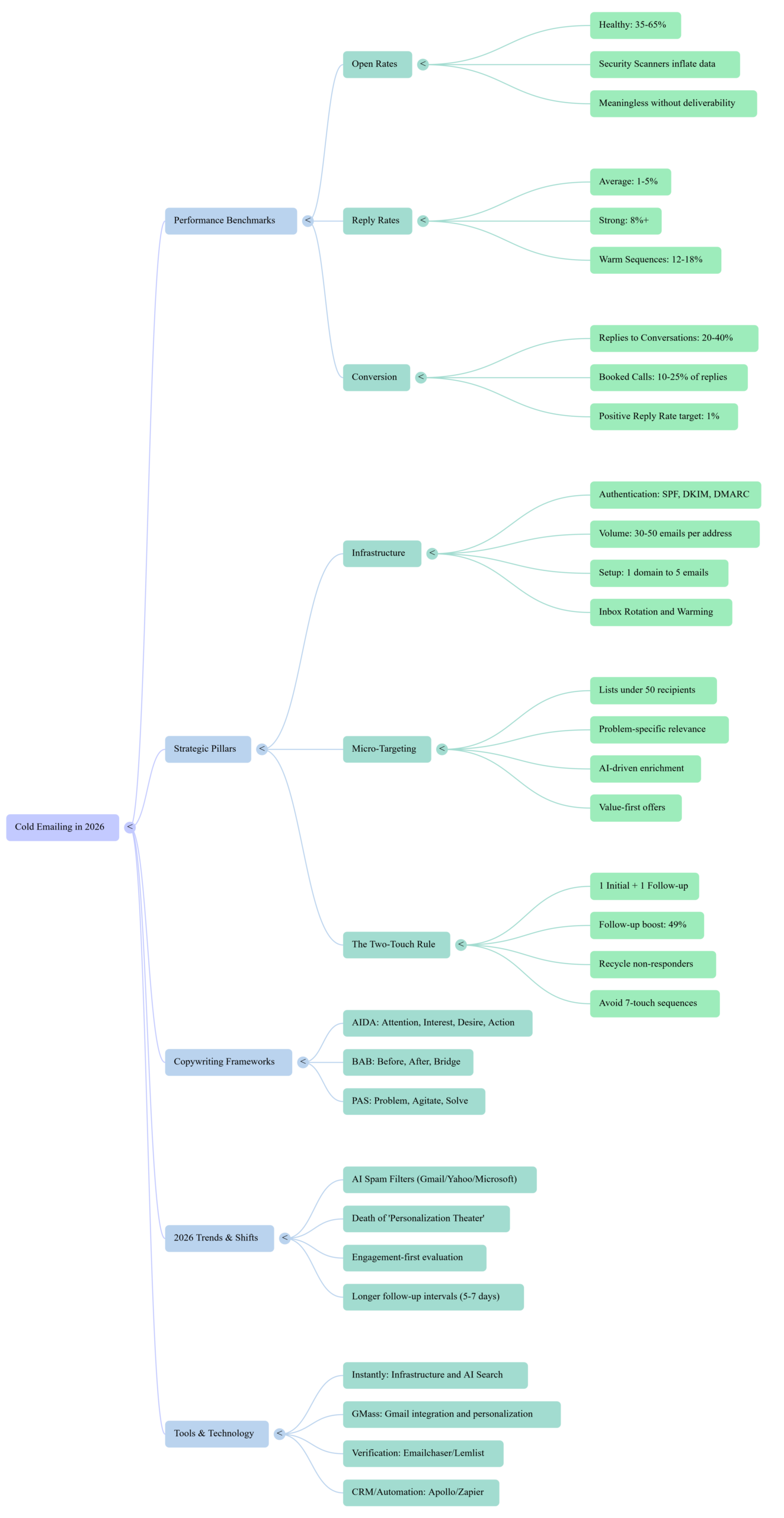
- Open Rates: Aim for 35% to 55%. If you’re below 40%, your infrastructure is likely broken. If you’re seeing 80%+, it might be security bots clicking your links, not real humans.
- Reply Rates: 1% to 3% is considered solid. If you hit 5% to 8%, your targeting and copy are exceptional.
- Booked Call Rate: Expect 20% to 30% of your positive replies to actually turn into a meeting.
- Spam Complaints: This is the most important metric. Keep your complaint rate below 0.1% or your deliverability will tank permanently.
The “NOT TO DO” List for 2026
If you want to keep your domains alive, avoid these common traps:
- Don’t use “Fake Personalization”: Mentioning someone’s college or a random tweet doesn’t work anymore. If it’s not relevant to their business pain, it’s fluff.
- Don’t do the “7-Touch Sequence”: In 2026, the data supports a “Two-Touch Rule”. Send one great initial email and one follow-up. Long sequences train spam filters to see you as a bulk sender and annoy your prospects.
- Don’t ignore Link Tracking: If you include a link in your first email, make sure it’s a “clean” link. Using Bluey Email’s link checker can ensure your URLs aren’t blacklisted before you send.
- Don’t “Ask” for a Call immediately: Asking a stranger for 15 minutes of their time isn’t valuable to them. Instead, offer a “Lead Magnet”—a free audit, a sample list, or a helpful video. Give value first.
Step 4: Launching and Managing with Bluey Email
Once your infrastructure is ready, Bluey Email handles the heavy lifting:
- Inbox Rotation: It cycles through your various email accounts so no single inbox gets “overworked”.
- Uni-box: All your replies from 50+ different email addresses land in one central inbox so you can respond in seconds.
- A/B Testing: Always test two versions of your copy. Bluey Email will show you which one is actually getting replies, not just opens.
FAQs: Everything You’re Still Wondering About
Q: Why shouldn’t I just use my personal Gmail? A: Because if you get marked as spam, your personal email is toast. You need a dedicated setup of secondary domains to protect your brand’s main communication line.
Q: Is cold email actually spam? A: No. Spam is sent indiscriminately to thousands of people. Cold email is a 1-to-1 message sent to a qualified lead with a relevant solution to their problem.
Q: How do I know if my emails are landing in “Promotions” or “Spam”? A: Use Bluey Email’s deliverability portal. It allows you to run tests to see exactly where your emails land before you launch the full campaign.
Q: What if someone doesn’t reply after two emails? A: Move on. Don’t trash the lead, though. Recycle them. Put them in a new campaign with a totally different angle or offer three months later.
Q: Do I really need to wait two weeks for warm-up? A: Yes. If you rush it, you will burn your domains, and you’ll have to spend more money buying new ones and starting over. In cold email, patience is profit.
Q: Does industry matter for benchmarks? A: Absolutely. Tech companies are the hardest to reach because they are flooded with pitches. Traditional industries like manufacturing often have much higher reply rates because they get less “noise” in their inboxes.
Final Thought: Cold email isn’t getting harder; it’s just getting more professional. If you build your infrastructure correctly with Bluey Email, focus on high-relevance targeting, and stop pestering people with 10 follow-ups, you’ll be in the top 1% of senders this year.
Ready to stop hitting the spam folder? Let’s get to work.