
Beyond the Inbox: 5 Surprising Truths About Email Marketing That Actually Move the Needle
1. The Ghost in the Machine
The industry is currently reeling from the “silent exit”—that specific, hollow frustration when high-value users simply vanish. You’ve spent quarters perfecting your product and weeks refining your copy, yet your engagement metrics are flatlining. Most teams respond with the “old way”: a generic “We miss you” blast coupled with a desperate discount. In the modern landscape, this isn’t just ineffective; it’s a brand-damaging admission that you aren’t paying attention.
The math of modern SaaS is brutal: with churn rates hovering between 4% and 8%, your “Growth” is a leaky bucket if you aren’t plugging the silent exit. Despite the noise of social media, email remains the undisputed heavyweight of digital communication, boasting three times more accounts than Facebook and Twitter combined. However, the needle only moves when we stop treating the inbox as a megaphone and start treating it as a precision-guided instrument for user success.
2. The “Silent Exit” is Predictable (and Often Your Fault)
Customers rarely “forget” about a tool that solves a genuine pain point. When they ghost you, it’s usually the result of Product-Market Drift or a fundamental Value Disconnect. They entered your ecosystem expecting a specific outcome that remained unachieved. Because retention is 5x more cost-effective than acquisition, identifying these exit signals before the “cancel” button is clicked is the highest-ROI activity a Growth Lead can perform.
To stop the exit, you must monitor the four hallmarks of relationship decay:
- Unmet Expectations: The gap between the “Aha!” moment promised in your marketing and the actual friction of the user experience.
- Value Disconnect: A failure to communicate ongoing ROI, leading the customer to view your invoice as a cost rather than an investment.
- Relationship Decay: Your product has evolved, but your user is stuck in 2023, utilizing only 20% of your current feature set.
- Feature Chase: The user’s needs have shifted, and they are now auditing your roadmap against a competitor’s current capabilities.
3. Stop Nagging: The Shift from “Just-in-Case” to “Just-in-Time”
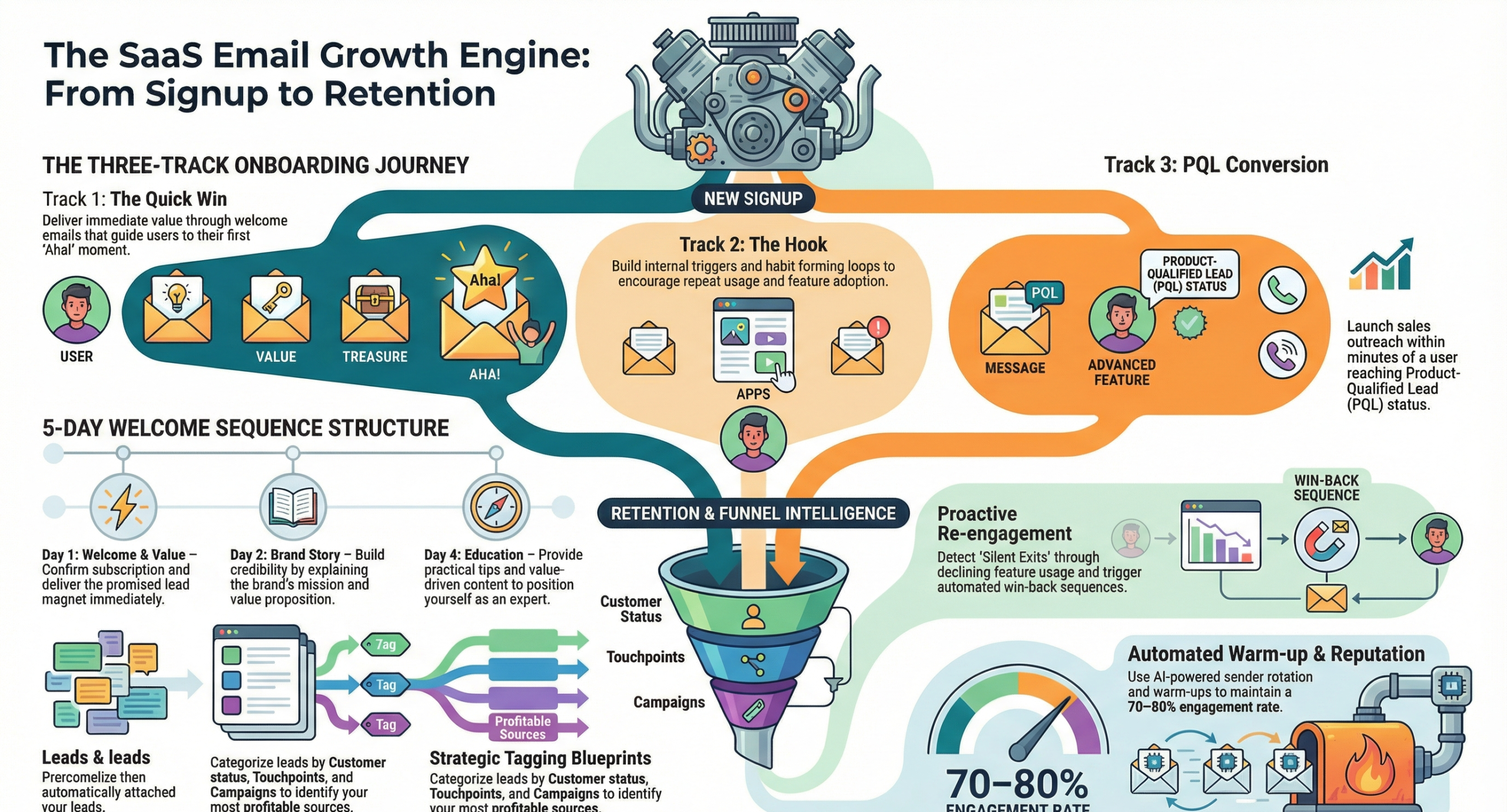
Most onboarding sequences are essentially “nagging” engines. They operate on rigid, time-based schedules—sending a “Day 3” email regardless of whether the user has even logged in. This “just-in-case” approach ignores the actual state of the user. To build a resilient growth engine, we must transition to “just-in-time” delivery, where the system reacts to behavioral triggers.
We can look to lean manufacturing for the blueprint:
“Toyota operates an exemplary just-in-time system. When someone buys a car, they go out to design and buy the specific parts for each order rather than having a huge inventory sitting around. The whole system starts with the user signal.”
In our world, the “user signal” is a specific data point: an app login, a feature click, or a reached threshold. This informs a three-track journey:
- The Quick Win: Relentless focus on the first success. No sales pitches—just guidance to the “Aha!” moment.
- The Hook: Using external triggers to build internal habits, moving the user from a single win into a repeat loop of investment and reward.
- The Conversion: Engaging only when a user becomes a Product-Qualified Lead (PQL).
If a user hasn’t achieved value in the first seven days, a “Upgrade Now” email isn’t marketing—it’s noise.
4. Deliverability is an Invisible Technical Dance
Even the most sophisticated email marketing tools fail if they never reach the primary tab. Deliverability in 2026 is no longer about avoiding “spammy” keywords; it’s a high-stakes technical dance involving domain reputation and authentic engagement pools.
The baseline for any serious email marketing platform is a rigorous authentication layer. For teams outgrowing basic outreach and looking for a robust instantly alternative or a more deliverability-focused klaviyo alternative, Blueyemail.com has filled the gap. It solves the technical debt that plagues most senders by providing one-click fixes for SPF, DKIM, and DMARC protocols—the “holy trinity” of domain trust.
To protect your domain health, Bluey leverages:
- Smart Sender Rotation: Automatically distributing volume across multiple inboxes to stay under provider radar.
- Authentic Engagement Pools: Using an AI-powered warm-up system that maintains a 70–80% reply rate, simulating natural human interaction to keep your “Safe Engagement” score high.
- AI-Powered Sequences: Ensuring the content itself is high-quality enough to avoid engagement-based spam filters.

5. Tagging is the “X-Ray Vision” of Growth
If your email list is just a flat CSV of addresses, you are flying blind. Tagging is what Eben Pagan of SegMetrics calls the “X-Ray vision” of your funnel—it turns a list into a dynamic Knowledge Center. A sophisticated tagging blueprint categorizes users into three buckets:
- Customer Tags: Tracking repeat buyers, new cohorts, and payment health (like delinquent cards).
- Touch Point Tags: Monitoring which specific whitepapers, webinars, or sales calls actually correlate with long-term LTV.
- Campaign Tags: Identifying exactly where a user sits in your “Campaign Orbit.”
The “Campaign Orbit” is the peak of automation. It uses if/then logic to move a lead from Funnel A to Funnel B only after specific conditions are met. This prevents “colliding sequences”—the primary cause of over-messaging—ensuring your automation feels like a guided conversation rather than a barrage of disjointed offers.
6. The “Business Moat” of Successful Users
In the software world, features are easily replicated, but a successful customer base is a “business moat” that no competitor can easily breach. The ultimate goal of your email marketing tool should not be an “open” or a “click,” but the movement of the user toward their “Better Life.”
When a user achieves their “Better Life”—the state where your product has solved their primary pain and become an integral part of their workflow—your marketing is no longer perceived as an interruption. Because retention is significantly more cost-effective than acquisition, your highest-ROI strategy is to stop selling features and start engineering success.
7. Conclusion: From Inbox to Impact
The transition from 2023-style “blast” tactics to a 2026-ready strategy requires a shift in focus from volume to depth. For those seeking a modern mailchimp alternative, the criteria must be more than just a drag-and-drop editor. You need a platform that understands smart rotation, AI safety, and behavior-based depth.
Are you currently nagging your customers to pay you, or are you actually guiding them to the success they signed up for? The answer to that question will define your growth for the next decade.
Experience the next generation of deliverability at Blueyemail.com.