
The Logic Fallacy
Modern marketing often founders on the “rationality myth”—the persistent delusion that consumers are primarily logical actors who weigh features and benefits with clinical objectivity. Neurobiology, however, has dismantled this assumption.
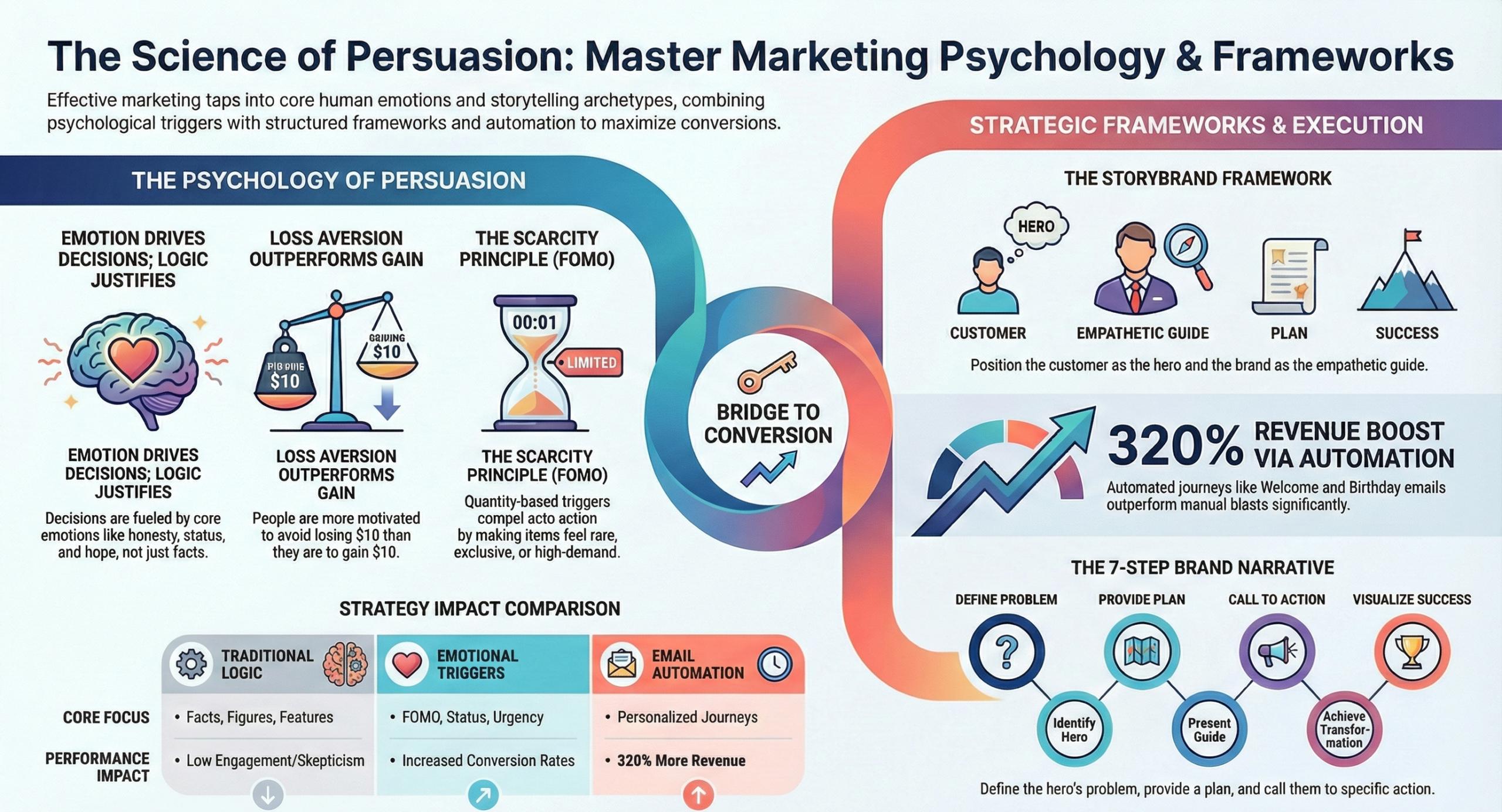
As noted by the elite negotiator Jim Camp, top doctors and psychologists have observed a startling phenomenon in patients with specific types of brain damage: individuals who lost the ability to process emotion, while retaining their full cognitive and logical faculties, became completely incapable of making simple decisions. They could describe the logic of a choice but lacked the emotional “fuel” to commit to it. This reveals a fundamental behavioral imperative: emotion drives the initial decision, while logic serves as the secondary heuristic used to justify the purchase after the fact.
Your Brand is Not the Hero (And It Shouldn’t Be)
High-friction marketing occurs when a brand competes with the customer for the spotlight. To eliminate this psychological friction, conversion strategists must employ the StoryBrand Framework, which demands a narrative inversion: the customer is the “Hero,” and the brand is the “Guide.”
The Guide’s function is to resolve the Hero’s internal and external conflicts through a combination of empathy and authority. By positioning your brand as the mentor rather than the protagonist, you reduce the customer’s cognitive load. They no longer have to figure out where they fit in your story; instead, they see how you fit into theirs.
“The story begins with the customer as the hero. Understanding their desires, needs, and pain points is crucial… Your brand plays the role of the guide, offering wisdom, empathy, and authority.”
Brutal Honesty as a Conversion Tool
While the standard marketing reflex is to mask flaws behind hyperbole, Joseph Sugarman argued that honesty is the most potent emotional trigger in a copywriter’s arsenal. In an era of pervasive skepticism, “unbelievable claims” trigger immediate defensive heuristics in the reader.
To convert the modern skeptic, you must “write to the skeptic.” This involves a tactic of preemptive transparency: addressing the “rotting rhinoceros” in the room—the common flaws or objections—before the prospect does. This radical honesty builds the foundational belief necessary for a transaction. Once the barrier of disbelief is removed, the path to conversion clears.
The “Magic Pill” of Simplicity
Human cognition is wired to seek paths of least resistance. We possess a biological craving for the “magic pill”—a simple, effortless solution to complex problems. When a prospect encounters complexity, their brain registers a surge in perceived risk, leading to immediate decision paralysis.
The antidote is the “Plan.” By distilling a complex transformation into a clear, step-by-step process, you provide the cognitive “magic pill” the reader seeks. A transparent plan functions as a bridge that turns a daunting commitment into an effortless next step, significantly lowering the psychological cost of taking action.
Scarcity is About Status, Not Just Stock
Scarcity is frequently reduced to a mere inventory tactic, but its true power lies at the intersection of social standing and “Status & Prestige.” When access is restricted, it does more than trigger a Fear of Missing Out (FOMO); it offers the allure of exclusive “insider” status.
Consider the strategic launch of OnePlus. By utilizing an “invite-only” scarcity model, they didn’t just sell a phone; they sold a social tier. This psychological lever resulted in a staggering 1 million unit sales and 25 million website visits in a remarkably short window. Scarcity, when tied to prestige, transforms a commodity into a badge of identity.
Takeaway 5: Loss Aversion is More Powerful Than Gain
The pain of a loss is psychologically twice as powerful as the joy of a comparable gain. Behavioral data shows that humans will waste an entire day to avoid losing $10 they already possess, yet they rarely exert the same effort to gain an additional $10.
Strategic marketing must “agitate the stakes” by illustrating what the customer risks losing through inaction. For example, rather than simply promising a “Gain of $50 per month,” a strategist might frame the offer as: “Stop losing $50 every month to hidden inefficiencies.” Highlighting the negative consequences of the status quo provides the emotional weight necessary to force a departure from it.
The “Secret Sauce” of Automated Personalization
True personalization is not a mass email blast with a first-name tag; it is a response to specific customer behavior. According to Campaign Monitor, automated, trigger-based emails generate 320% more revenue than non-automated ones because they make the customer feel “listened to.”
Think of automation as a “Recipe” for a customer journey. Individual touchpoints—the ingredients—are combined into a cohesive whole where the result is greater than the sum of its parts. By using specific triggers (sign-ups, birthdays, or re-engagement points), you create a standardized process that delivers a truly personalized experience, matching the brand’s voice to the customer’s real-time actions.
The Marriage of Emotion and Logic
Sophisticated marketing is the art of balancing two distinct cognitive forces. The overarching mantra remains: Emotion sells; logic justifies the purchase. Your architecture must hit enough emotional triggers—honesty, simplicity, status, and fear of loss—to drive the “yes,” while providing enough factual proof to satisfy the rational mind’s need for safety.
However, the efficacy of these triggers rests on the foundation of integrity. Avoiding “fake urgency” and manipulative tactics is essential for long-term brand equity. Use these hidden drivers to clarify your message and facilitate the Hero’s success.