
The Economic Mandate: Retention as a Growth Lever
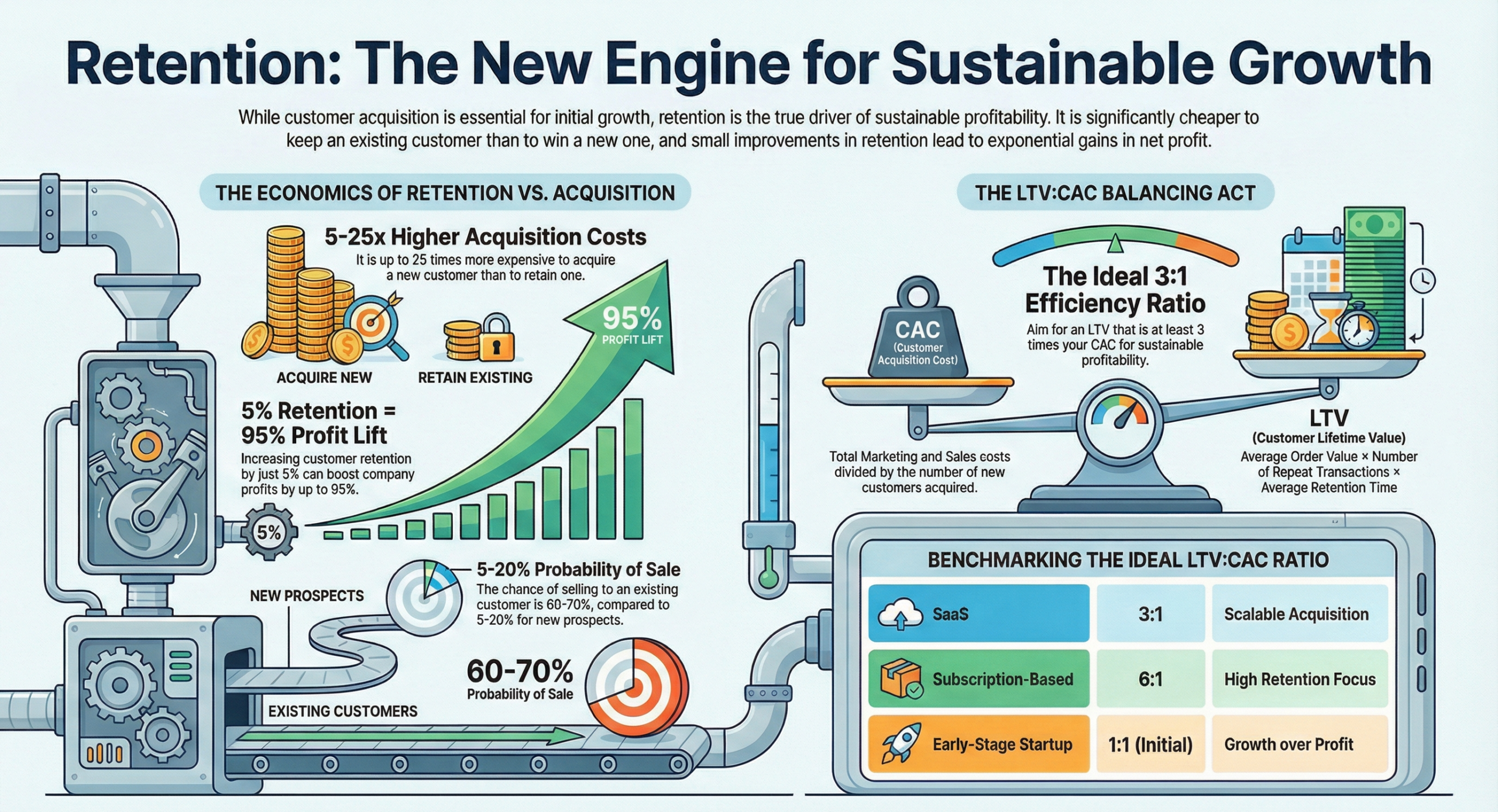
The math is undeniable: acquiring a new customer is between 5 and 25 times more expensive than retaining an existing one. In the B2B sector, where products often have a high learning curve and require significant educational content, this cost disparity is even more pronounced.
Smart brands are doubling down on keeping customers because a mere 5% increase in retention can lift profits by 25% to 95%. For a SaaS company, retention creates a “stable revenue stream” through ongoing subscriptions, allowing for better resource allocation and future planning.
The Math of Success: Mastering the SaaS Metrics
To build a brand that lasts, you must look beyond immediate revenue and focus on the health of your customer base using three key metrics:
- Customer Acquisition Cost (CAC): The total sum of marketing and sales expenses divided by the number of new customers acquired. For B2B SaaS, this includes salaries for sales teams, lead generation expenses like SEO, and technology costs for your CRM.
- Customer Lifetime Value (LTV/CLV): The overall monetary value a customer generates throughout their relationship with you. In a subscription model, this is calculated by multiplying the average monthly revenue by the average number of months a customer stays.
- The 3:1 “Golden Ratio”: For SaaS companies, an LTV:CAC ratio of 3:1 is considered the benchmark for profitability. This means for every $1 spent on acquisition, you should earn $3 back over the customer’s lifetime. If your ratio is too high (e.g., 5:1), you may be underspending and missing out on market share.
The 8-Stage Lifecycle Journey
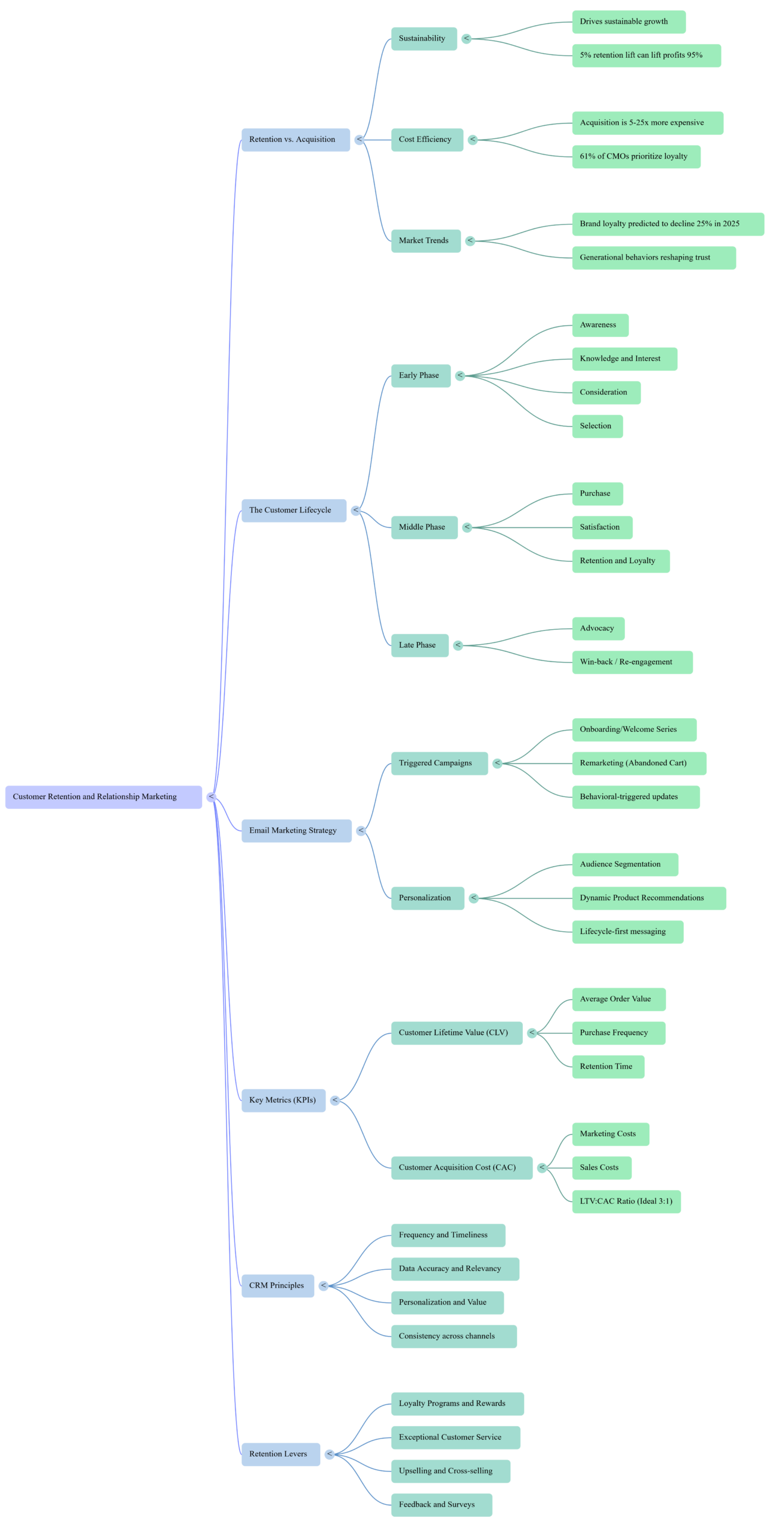
Modern CRM isn’t a one-off campaign; it’s a “coordinated experience” mapped to the full customer lifecycle. To build brand equity, your email strategy must guide users through eight distinct stages:
- 1. Awareness: Grabbing attention by establishing a brand presence across channels.
- 2. Knowledge & Interest: Establishing authority and trust once they join your list.
- 3. Consideration: Providing middle-of-funnel content that speaks to their specific pain points.
- 4. Selection: Differentiating your brand from competitors with webinars, case studies, and testimonials.
- 5. Purchase: The point of conversion, which should be followed immediately by post-purchase engagement.
- 6. Satisfaction: Using transactional “thank you” emails and support to ensure the customer feels valued.
- 7. Retention & Loyalty: Re-engaging customers through feedback requests and “refer a friend” campaigns.
- 8. Advocacy: The ultimate goal. Turning satisfied customers into “enthusiasts or evangelists” who proactively recommend your brand.
The Power of Personalization and Triggers
Success in these stages depends on relevance. Triggered emails—messages sent based on real-time behavior—are 497% more effective than standard batch emails. For onboarding specifically, triggered messages can see an 826% higher click rate and a 775% higher conversion rate. This level of personalization is what prevents “context rot” and ensures customers feel seen and heard.
Q&A: Strategic Insights for B2B Growth
Q: Should I focus on acquisition or retention to reach 10,000 users? A: While acquisition gets you in the door, retention drives sustainable growth. Especially for B2B SaaS, existing customers are 60% to 70% more likely to buy again, compared to only a 5% to 20% chance for a new lead. Prioritizing retention ensures you aren’t pouring money into a “leaking bucket” where customers leave as fast as you acquire them.
Q: What is an “Email Subscriber Lifetime Value”? A: It differs from total CLV. It measures the total additional profits that the email program specifically contributes during the lifetime of a subscription. To estimate this, divide your total email marketing profits by your number of active subscribers, then multiply by the average “lifetime” of an email address in your database.
Q: Why do B2B customers churn, and how can I stop it? A: Churn often stems from “context rot” or irrelevant communication. 76% of customers feel frustrated by a lack of personalization. To stop it, use “win-back” flows triggered by inactivity to check in and uncover why they stopped engaging.
Q: How do I move a customer from a “Buyer” to an “Advocate”? A: This is called moving up the “Loyalty Ladder”. You must move beyond the product’s features and focus on product benefits and system solutions. Advocates are born when you treat them as “partners” rather than just transactions, involving them in product decisions and rewarding their referrals.
Q: Is a low CAC always a good sign? A: Not necessarily. If a low CAC is coupled with a high churn rate, it means you are acquiring “irrelevant” customers who won’t stick around long-term. Quality over quantity is key for brand equity.
Implementation Guide: Building Your Marketing Machine
Phase 1: Establish Your “Marketer’s Memory Bank”
- Centralize Data: Use a CRM (like Salesforce or Pipedrive) or a Customer Data Platform (CDP) to unify data from website tracking, email engagement, and offline interactions.
- Data Cleansing: Ensure your data is accurate. A single bad salutation (e.g., “Hi Mr. M Bob”) can ruin a sophisticated CRM strategy.
- Identify the “Vital Few”: Use the Pareto Principle to identify the 20% of customers who provide 80% of your income. Focus your highest-touch advocacy efforts on them.
Phase 2: Orchestrate the Customer Journey
- Map Your Triggers: Define the “signals” that show a user is ready for the next step. Example: For Bluey Email, this might be a user completing their first 1,000 sends, triggering a “Milestone Celebration” email.
- Design Responsive Onboarding: Create a series of triggered emails that guide new users through your core features. Remember, onboarding is your best chance to set the tone for the entire relationship.
- Implement “Decision Splits”: Use branching logic in your email flows to send different content based on user behavior—for example, sending a “How-to” guide to users who haven’t logged in for 3 days.
Phase 3: Cultivate Advocacy and Equity
- Solicit Proactive Feedback: Use automated surveys (VoC data) to understand customer needs and use their own language in your marketing copy.
- Launch a Loyalty/Referral Program: Reward your “Advocates” for word-of-mouth promotion. This is a powerful, low-cost organic growth lever.
- Shift to “Partner” Mentality: For your highest-tier users, involve them in “beta” tests or product decisions to create deep emotional attachment.
Phase 4: Monitor and Optimize for Long-Term Value
- Track the LTV:CAC Quarterly: If your CAC rises, shift more focus toward organic channels like SEO and content marketing, which are high-quality and cost-effective for long-term growth.
- Eliminate Friction: Use analytics to identify where customers “drop off” in your funnel and simplify those processes (e.g., a complex checkout or onboarding flow).
- Adopt a “Customer-Centric Culture”: Like Amazon or Southwest Airlines, ensure every department—from engineering to finance—understands the customer’s perspective. Successful CRM requires the whole organization to be customer-focused, not just the marketing team.